


Emergency department use among HIV-infected released jail detainees
- PMID: 25331820
- PMCID: PMC4338130
- DOI: 10.1007/s11524-014-9905-4
Emergency department use among HIV-infected released jail detainees
Abstract
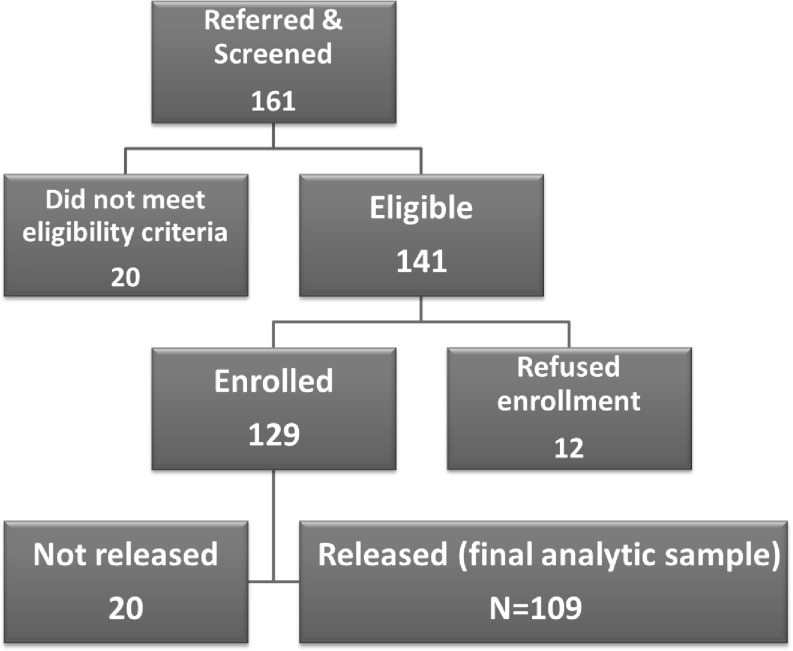
Release from short-term jail detention is highly destabilizing, associated with relapse to substance use, recidivism, and disrupted health care continuity. Little is known about emergency department (ED) use, potentially a surrogate for medical, psychiatric, or social instability, by people living with HIV/AIDS (PLWHA) leaving jails. All ED visits were reviewed from medical records for a cohort of 109 PLHWA in the year following release from county jail in Connecticut, between January 1, 2008 and December 31, 2010. Primary outcomes were frequency and timing of ED visits, modeled using multivariate negative binomial regression and Cox proportional hazards regression, respectively. Demographic, substance use, and psychiatric disorder severity factors were evaluated as potential covariates. Overall, 71 (65.1%) of the 109 participants made 300 unique ED visits (2.75 visits/person-year) in the year following jail-release. Frequency of ED use was positively associated with female sex (incidence rate ratios, IRR 2.40 [1.36-4.35]), homelessness (IRR 2.22 [1.15-4.41]), and recent substance use (IRR 2.47 [1.33-4.64]), and inversely associated with lifetime drug severity (IRR 0.01 [0-0.10]), and being retained in HIV primary care (IRR 0.80 [0.65-0.99]). Those in late or sustained HIV care used the ED sooner than those not retained in HIV primary care (median for late retention 16.3 days, median for sustained retention 24.9 days, median for no retention not reached at 12 months, p value 0.004). Using multivariate modeling, those who used the ED earliest upon release were more likely to be homeless (HR 1.98 [1.02-3.84]), to be retained in HIV care (HR 1.30 [1.04-1.61]), and to have recently used drugs (HR 2.51 [1.30-4.87]), yet had a low lifetime drug severity (HR 0.01 [0.00-0.14]). Among PLWHA released from jail, frequency of ED use is high, often soon after release, and is associated with social and drug-related destabilizing factors. Future interventions for this specific population should focus on addressing these resource gaps, ensuring housing, and establishing immediate linkage to HIV primary care after release from jail.
Figures


References
-
- Spaulding AC, Seals RM, Page MJ, Brzozowski AK, Rhodes W, Hammett TM. HIV/AIDS among inmates of and releasees from US correctional facilities, 2006: declining share of epidemic but persistent public health opportunity. Plos One. 2009;4(11):A16–A21. doi: 10.1371/journal.pone.0007558. - DOI - PMC - PubMed
-
- Draine J, Ahuja D, Altice FL, et al. Strategies to enhance linkages between care for HIV/AIDS in jail and community settings. Aids Care. 2011;2011:23(3). - PubMed
Publication types
MeSH terms
Grants and funding
LinkOut - more resources
Full Text Sources
Other Literature Sources
Medical
