


Tumor marker usage and medical care costs among older early-stage breast cancer survivors
- PMID: 25332254
- PMCID: PMC4279234
- DOI: 10.1200/JCO.2014.55.5409
Tumor marker usage and medical care costs among older early-stage breast cancer survivors
Abstract
Purpose: Although American Society of Clinical Oncology guidelines discourage the use of tumor marker assessment for routine surveillance in nonmetastatic breast cancer, their use in practice is uncertain. Our objective was to determine use of tumor marker tests such as carcinoembryonic antigen and CA 15-3/CA 27.29 and associated Medicare costs in early-stage breast cancer survivors.
Methods: By using Surveillance, Epidemiology, and End Results-Medicare records for patients diagnosed with early-stage breast cancer between 2001 and 2007, tumor marker usage within 2 years after diagnosis was identified by billing codes. Logistic regression models were used to identify clinical and demographic factors associated with use of tumor markers. To determine impact on costs of care, we used multivariable regression, controlling for other factors known to influence total medical costs.
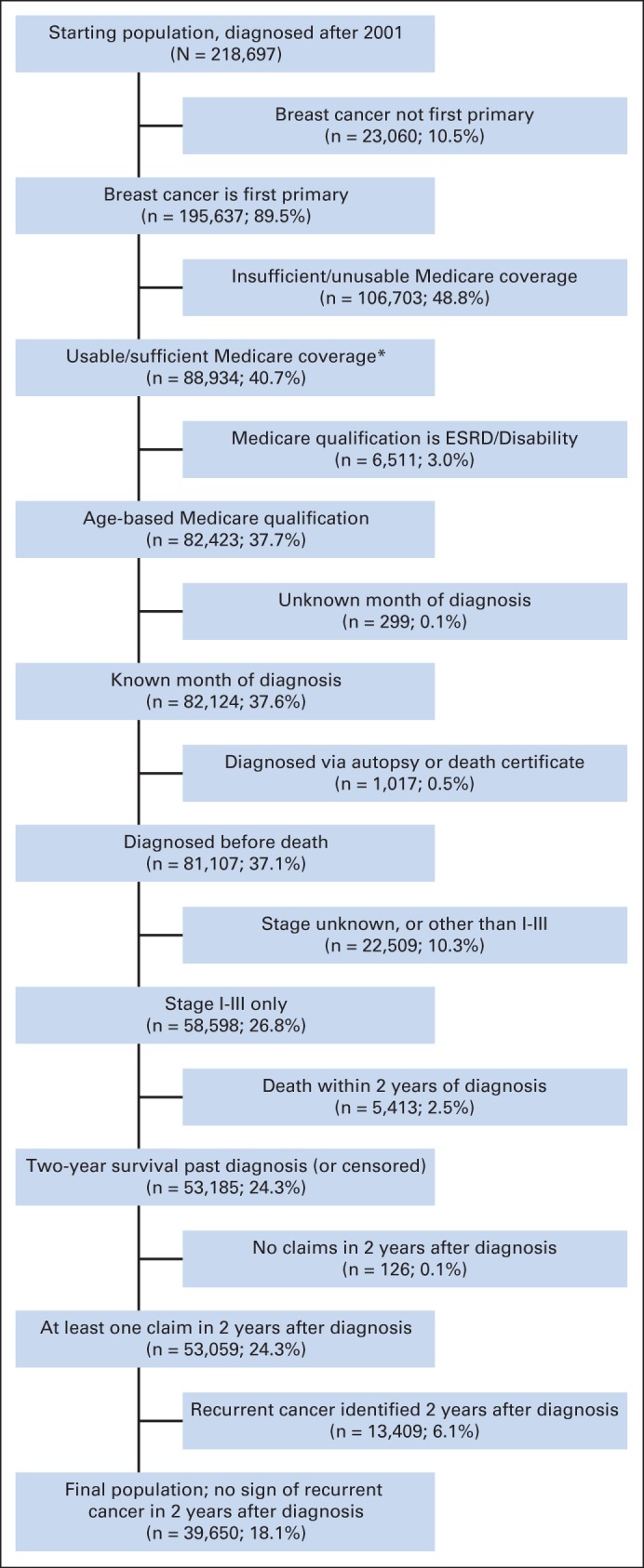
Results: We identified 39,650 eligible patients. Of these, 16,653 (42%) received at least one tumor marker assessment, averaging 5.7 tests over 2 years, with rates of use per person increasing over time. Factors significantly associated with use included age at diagnosis, diagnosis year, stage at diagnosis, race/ethnicity, geographic region, and urban/rural status. Rates of advanced imaging, but not biopsies, were significantly higher in the assessment group. Medical costs for patients who received at least one test were approximately 29% greater than costs for those who did not, adjusting for other factors.
Conclusion: Breast cancer tumor markers are frequently used among women with early-stage disease and are associated with an increase in both diagnostic procedures and total cost of care. A better understanding of factors driving the use of and the potential benefits and harms of surveillance-based tumor marker testing is needed.
© 2014 by American Society of Clinical Oncology.
Conflict of interest statement
Authors' disclosures of potential conflicts of interest and author contributions are found at the end of this article.
Figures
Comment in
-
Tumor markers in older patients with early breast cancer: why are we still doing useless tests?J Clin Oncol. 2015 Jan 10;33(2):136-7. doi: 10.1200/JCO.2014.58.1512. Epub 2014 Dec 1. J Clin Oncol. 2015. PMID: 25452451 No abstract available.
References
-
- Molina R, Jo J, Filella X, et al. C-erbB-2, CEA and CA 15.3 serum levels in the early diagnosis of recurrence of breast cancer patients. Anticancer Res. 1999;19:2551–2555. - PubMed
-
- Molina R, Jo J, Filella X, et al. c-erbB-2 oncoprotein, CEA, and CA 15.3 in patients with breast cancer: Prognostic value. Breast Cancer Res Treat. 1998;51:109–119. - PubMed
-
- Harris L, Fritsche H, Mennel R, et al. American Society of Clinical Oncology 2007 update of recommendations for the use of tumor markers in breast cancer. J Clin Oncol. 2007;25:5287–5312. - PubMed
-
- Bast RC, Jr, Ravdin P, Hayes DF, et al. 2000 update of recommendations for the use of tumor markers in breast and colorectal cancer: Clinical practice guidelines of the American Society of Clinical Oncology. J Clin Oncol. 2001;19:1865–1878. - PubMed
-
- Rosselli Del Turco M, Palli D, Cariddi A, et al. Intensive diagnostic follow-up after treatment of primary breast cancer: A randomized trial—National Research Council Project on Breast Cancer follow-up. JAMA. 1994;271:1593–1597. - PubMed
Publication types
MeSH terms
Substances
Grants and funding
LinkOut - more resources
Full Text Sources
Medical
Research Materials
