. 2014 Oct 21:5:5257.
doi: 10.1038/ncomms6257.

Genome flux and stasis in a five millennium transect of European prehistory

Affiliations

Genome flux and stasis in a five millennium transect of European prehistory

Cristina Gamba et al. Nat Commun. .

Abstract

The Great Hungarian Plain was a crossroads of cultural transformations that have shaped European prehistory. Here we analyse a 5,000-year transect of human genomes, sampled from petrous bones giving consistently excellent endogenous DNA yields, from 13 Hungarian Neolithic, Copper, Bronze and Iron Age burials including two to high (~22 × ) and seven to ~1 × coverage, to investigate the impact of these on Europe's genetic landscape. These data suggest genomic shifts with the advent of the Neolithic, Bronze and Iron Ages, with interleaved periods of genome stability. The earliest Neolithic context genome shows a European hunter-gatherer genetic signature and a restricted ancestral population size, suggesting direct contact between cultures after the arrival of the first farmers into Europe. The latest, Iron Age, sample reveals an eastern genomic influence concordant with introduced Steppe burial rites. We observe transition towards lighter pigmentation and surprisingly, no Neolithic presence of lactase persistence.


Figures
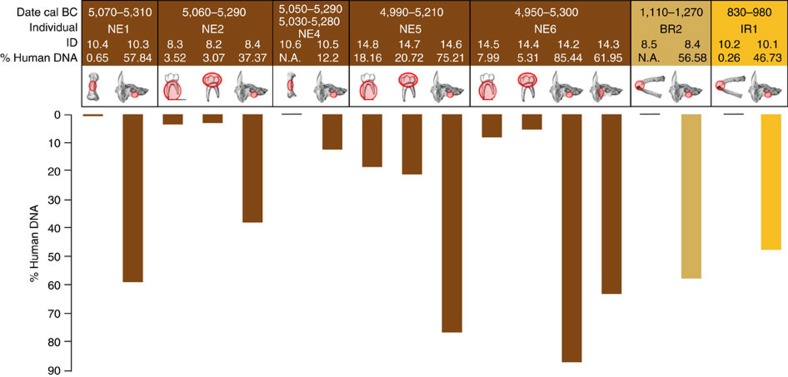
Figure 1
Figure 1. Petrous bones versus non-petrous bones.
Percentage of non-clonal endogenous DNA recovered after shotgun sequencing. The sampled bone/tooth portion is circled in red. N.A. indicates that the library did not pass quality assessment for sequencing.
Figure 2
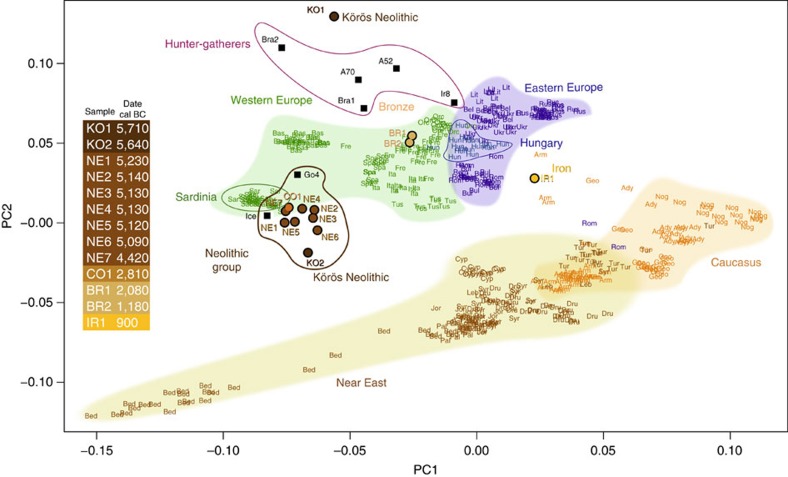
Figure 2. PCA of the ancient Hungarian time series.
Combined plot of Principal Component Analyses performed on the ancient Hungarian time series of observed genotypes compared with European, Caucasian and Near Eastern modern populations. Published ancient genomic data are plotted as squared points: Ice, Go4, A70, A52 and Ir8 (ref. 2), Bra1 and Bra2 (ref. 1). Modern population labels are: Ady, Adygei; Arm, Armenians; Bas, Basque; Bed, Bedouins; Bel, Belorussians; Bul, Bulgarians; Cyp, Cypriotes; Dru, Druze; Fre, French; Geo, Georgians; Hun, Hungarians; Ita, Italians; Jor, Jordanians; Leb, Lebanese; Lit, Lithuanians; Nog, Kuban Nogays; Orc, Orcadians; Pal, Palestinians; Rom, Romanians; Rus, Russians; Sar, Sardinians; Spa, Spaniards; Syr, Syrians; Tur, Turks; Tus, Tuscans; Ukr, Ukranians.
Figure 3
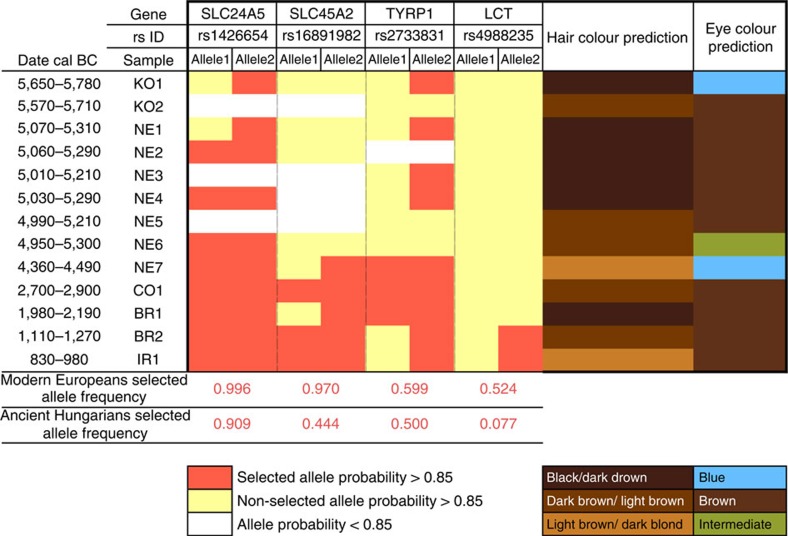
Figure 3. Selective sweeps.
Genotypes of four SNPs associated with selective sweeps in Europe and predicted hair/eye colour for Ancient Hungarian samples. Observed data are reported for the two high-coverage samples (NE1 22.1 × and BR2 21.3 × ) while imputed genotypes are reported for all samples with lower coverage (either ~1 × or ~0.1 × ).
Figure 4
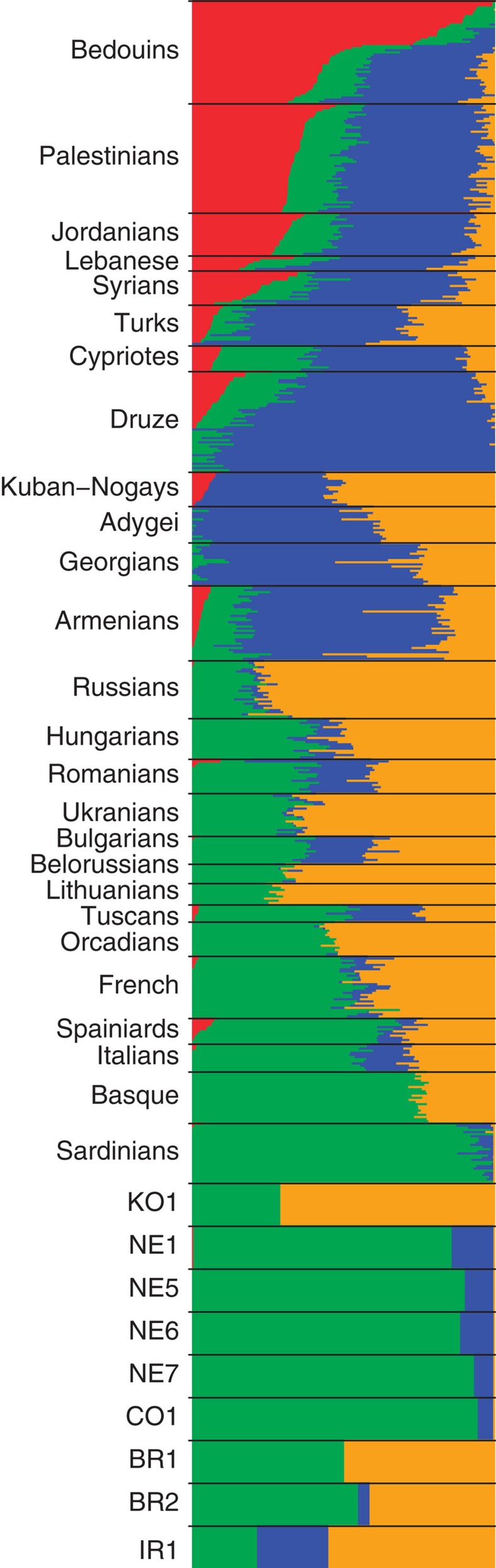
Figure 4. Ancient Hungarians ADMIXTURE plot.
ADMIXTURE analysis (K=4) of the nine 1 × imputed samples along with 552 modern reference samples (HGDP+) using a LD (r2<0.2) filtered data set of 60,824 SNPs.
Figure 5
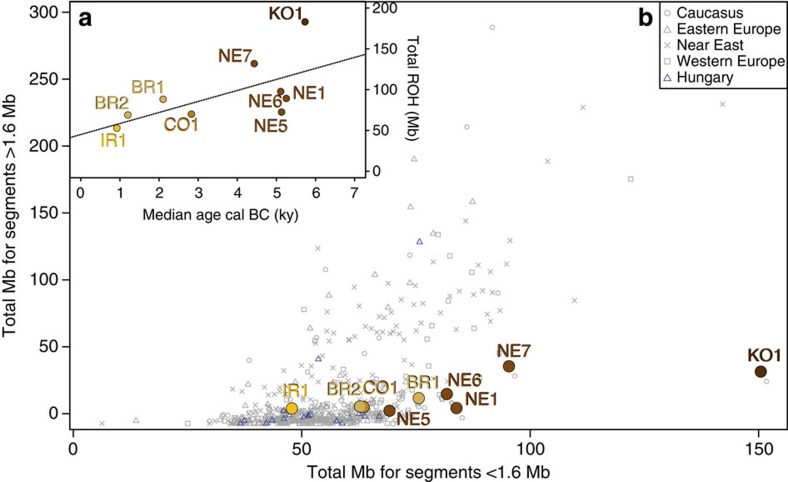
Figure 5. Short versus long ROH.
(a) Regression between age (median value, cal. BC) and total Mb of run of homozygosity (r2=0.4042, P-value=0.06573). (b) Short (<1.6 Mb) versus long (>1.6 Mb) runs of homozygosity based on 151,407 autosomal SNPs for the 9 ancient Hungarian samples compared with European, Near Eastern and Caucasian populations (Supplementary Methods).

References

    1. Sánchez-Quinto F. et al. Genomic affinities of two 7,000-year-old iberian hunter-gatherers. Curr. Biol. 22, 1494–1499 (2012). - PubMed
    1. Skoglund P. et al. Origins and genetic legacy of neolithic farmers and hunter-gatherers in Europe. Science 336, 466–469 (2012). - PubMed
    1. García-Garcerà M. et al. Fragmentation of contaminant and endogenous DNA in ancient samples determined by shotgun sequencing; prospects for human palaeogenomics. PLoS ONE 6, e24161 (2011). - PMC - PubMed
    1. Raghavan M. et al. Upper Palaeolithic Siberian genome reveals dual ancestry of Native Americans. Nature 505, 87–91 (2013). - PMC - PubMed
    1. Lazaridis I. et al. Ancient human genomes suggest three ancestral populations for present-day Europeans. Nature 513, 409–413 (2014). - PMC - PubMed

Publication types

Associated data

LinkOut - more resources