


DXA-measured visceral adipose tissue predicts impaired glucose tolerance and metabolic syndrome in obese Caucasian and African-American women
- PMID: 25335442
- PMCID: PMC4748955
- DOI: 10.1038/ejcn.2014.227
DXA-measured visceral adipose tissue predicts impaired glucose tolerance and metabolic syndrome in obese Caucasian and African-American women
Abstract
Background/objectives: New methods to measure visceral adipose tissue (VAT) by dual-energy X-ray absorptiometry (DXA) may help discern sex, race and phenotype differences in the role of VAT in cardiometabolic risk. This study was designed (1) to compare relationships of DXA-VAT, anthropometric and body composition variables with cardiometabolic risk factors in obese women; (2) to determine which variables most robustly predict impaired glucose tolerance (IGT) and metabolic syndrome (MetSx); and (3) to determine thresholds for DXA-VAT by race.
Subjects/methods: VAT mass (g) and volume (cm(3)) were measured in 229 obese (body mass index (BMI), 30-49.9) women aged 21-69 years of European-American (EA=123) and African-American (AA=106) descent using the CoreScan algorithm on a Lunar iDXA scanner. Linear regression modeling and areas under the curve (AUC of ROC (receiver operating characteristic) curves) compared relationships with cardiometabolic risk. Bootstrapping with LASSO (least absolute shrinkage and selection operator) regression modeling determined thresholds and predictors of IGT and MetSx.
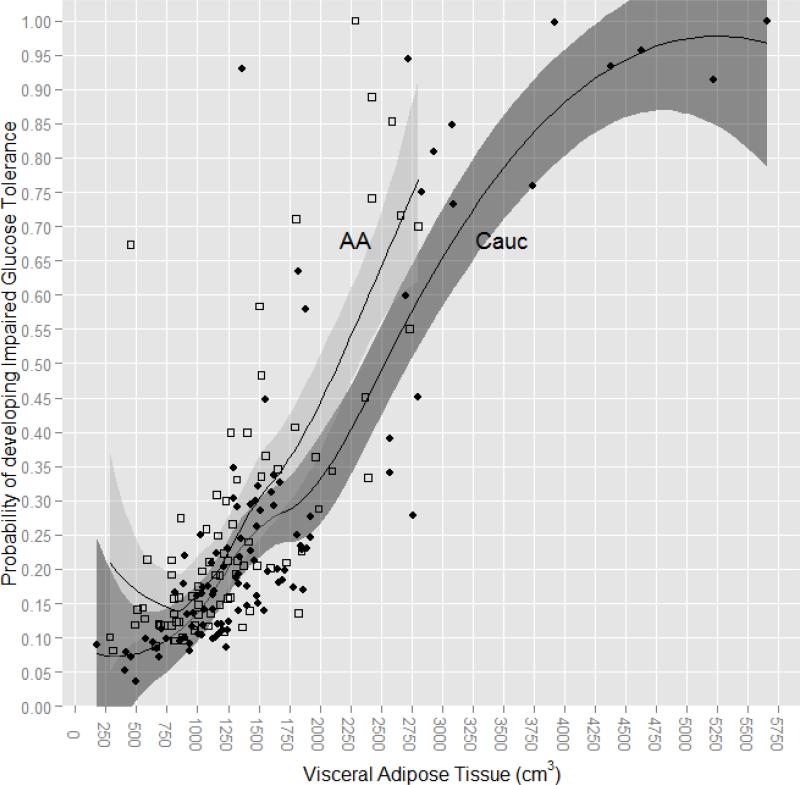
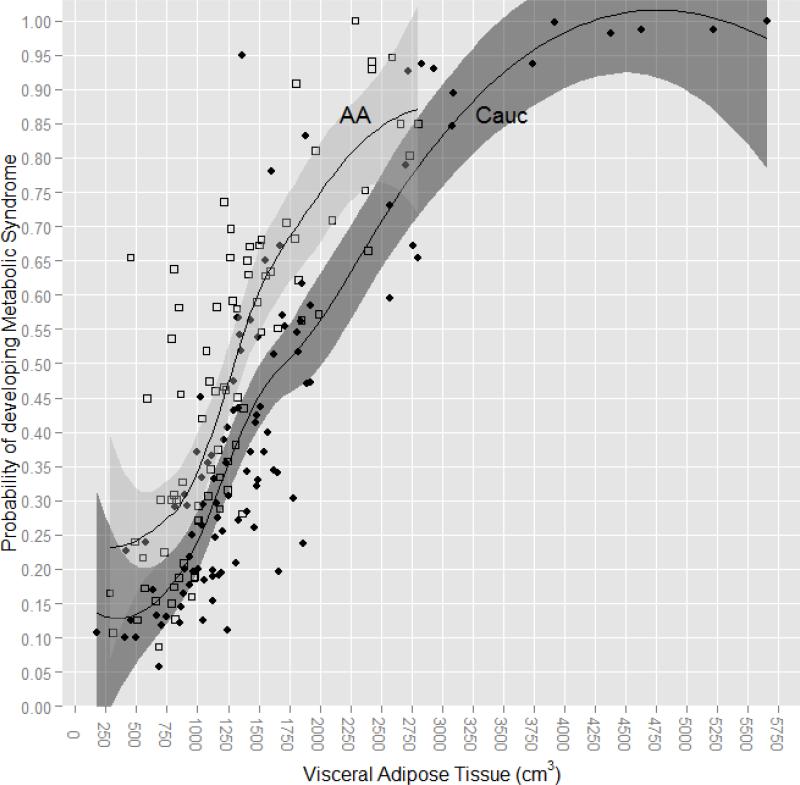
Results: DXA-VAT explained more of the variance in triglycerides, blood pressure, glucose and homeostatic model assessment-insulin resistance (HOMA-IR) compared with anthropometric and other body composition variables. DXA-VAT also had the highest AUC for IGT (0.767) and MetSx (0.749). Including race as a variable and the interaction between VAT and race in modeling did not significantly change the results. Thresholds at which the probability of developing IGT or MetSx was⩾50% were determined separately for AA women (IGT: 2120 cm(3); MetSx: 1320 cm(3)) and EA women (IGT: 2550 cm(3); MetSx: 1713 cm(3)). The odds for IGT or MetSx were fourfold greater with each standard deviation increase in DXA-VAT.
Conclusions: DXA-VAT provides robust clinical information regarding cardiometabolic risk in AA and EA obese women and offers potential utility in the risk reduction interventions.
Figures
References
-
- Lebovitz HE. The relationship of obesity to the metabolic syndrome. International journal of clinical practice Supplement. 2003 Mar;(134):18–27. PubMed PMID: 12793594. - PubMed
-
- Canoy D. Distribution of body fat and risk of coronary heart disease in men and women. Current opinion in cardiology. 2008 Nov;23(6):591–8. PubMed PMID: 18830075. - PubMed
-
- Lee CM, Huxley RR, Wildman RP, Woodward M. Indices of abdominal obesity are better discriminators of cardiovascular risk factors than BMI: a meta-analysis. J Clin Epidemiol. 2008 Jul;61(7):646–53. PubMed PMID: 18359190. - PubMed
-
- Girard J, Lafontan M. Impact of visceral adipose tissue on liver metabolism and insulin resistance. Part II: Visceral adipose tissue production and liver metabolism. Diabetes & metabolism. 2008 Nov;34(5):439–45. PubMed PMID: 18562233. - PubMed
-
- Bjorntorp P. “Portal” adipose tissue as a generator of risk factors for cardiovascular disease and diabetes. Arteriosclerosis. 1990 Jul-Aug;10(4):493–6. PubMed PMID: 2196039. - PubMed
Publication types
MeSH terms
Grants and funding
LinkOut - more resources
Full Text Sources
Other Literature Sources
Medical
