. 2014 Oct 22:5:5205.
doi: 10.1038/ncomms6205.

Nasal immunity is an ancient arm of the mucosal immune system of vertebrates

Affiliations

Nasal immunity is an ancient arm of the mucosal immune system of vertebrates

Luca Tacchi et al. Nat Commun. .

Abstract

The mucosal surfaces of all vertebrates have been exposed to similar evolutionary pressures for millions of years. In terrestrial vertebrates such as birds and mammals, the nasopharynx-associated lymphoid tissue (NALT) represents a first line of immune defence. Here we propose that NALT is an ancient arm of the mucosal immune system not restricted to terrestrial vertebrates. We find that NALT is present in rainbow trout and that it resembles other teleost mucosa-associated lymphoid tissues. Trout NALT consists of diffuse lymphoid cells and lacks tonsils and adenoids. The predominant B-cell subset found in trout NALT are IgT(+) B cells, similar to skin and gut. The trout olfactory organ is colonized by abundant symbiotic bacteria, which are coated by trout secretory immunoglobulin. Trout NALT is capable of mounting strong anti-viral immune responses following nasal delivery of a live attenuated viral vaccine. Our results open up a new tool for the control of aquatic infectious diseases via nasal vaccination.


Figures
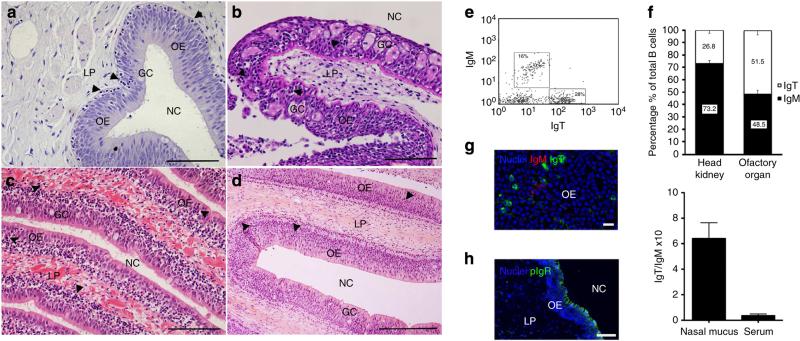
Figure 1
Figure 1. General organization of teleost NALT
The olfactory organ of four different families of teleost fish harbours diffuse lymphoid cells but lacks organized NALT. (a) Toluidine blue stain of the olfactory organ of a control adult rainbow trout (O. mykiss). (b) Haematoxylin/eosin stain of the olfactory organ of a control adult goldfish (C. auratus). (c) Haematoxylin/eosin stain of the olfactory organ of a control adult New Zealand groper (P. oxygeneios). (d) Haematoxylin/eosin stain of the olfactory organ of a control adult Australian eel (A. australis). Arrowheads indicate lymphocytes. GC, goblet cells; LP, lamina propria; NC, nasal cavity; OE, olfactory epithelium. Scale bar, 100 μm. (e) Flow cytometry analysis of rainbow trout NALT leukocytes stained with anti-IgM and anti-IgT antibodies. Numbers in outlined boxes indicate the percentage of IgM + (top left) and IgT + (bottom right) B cells. (f) Frequency (mean±s.e.) IgM+ and IgT+ cells among all B cells present in control rainbow trout NALT (N = 15). (g) Immunofluorescence staining for IgM (red) and IgT (green) in a cryosection of rainbow trout olfactory organ (N = 5); nuclei (blue) are stained with the DNA-intercalating dye DAPI. Scale bar, 10 μm. (h) Immunofluorescence staining for pIgR (green) in a cryosection of rainbow trout olfactory organ (N = 5). Nuclei (blue) are stained with the DNA-intercalating dye DAPI. Scale bar, 100 μm. (i) Mean ratio of IgT to IgM in nasal mucus and serum (N = 4) calculated by immunoblotting.
Figure 2
Figure 2. Trout nasal bacteria are coated by secretory immunoglobulins
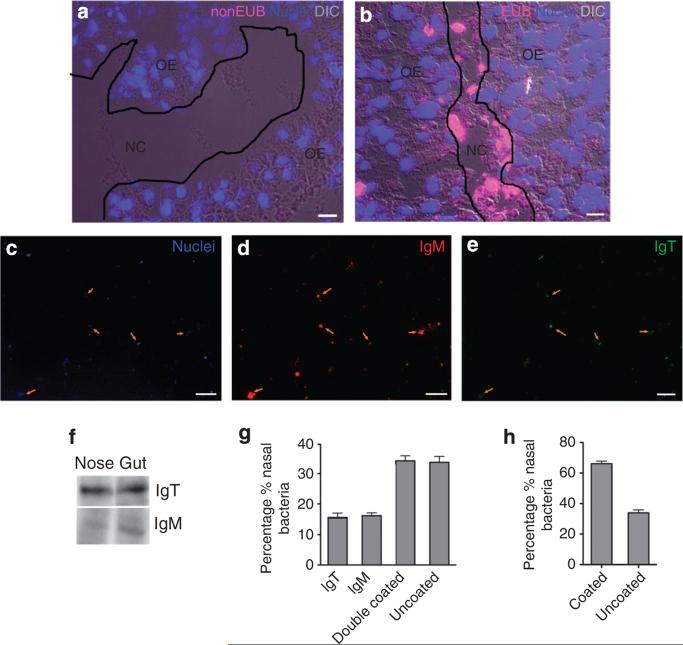
(a) Differential interference contrast images of trout olfactory organ stained with NONEUB oligoprobe by fluorescence in situ hybridization. Note that no bacterial staining was observed (N = 5). (b) Differential interference contrast images of trout olfactory organ stained with EUB338 oligoprobe (magenta) that stains ~90% of all eubacteria. Abundant bacteria (magenta) can be observed in the lumen of the olfactory organ and some within the olfactory epithelium (N = 5). Nuclei (blue) are stained with the DNA-intercalating dye DAPI. Scale bar, 20 μm. (c–e) Fluorescent microscopy images of trout nasal bacteria stained with a DAPI-Hoeschst solution (blue; c), anti-IgM (red; d) or anti-IgT (green; e). Orange arrows indicate bacteria that are positive for DAPI, IgM and IgT (double-coated population). Scale bar, 20 μm. (f) Immunoblot analysis of IgTand IgM on nasal-associated bacteria and gut luminal bacteria (as a positive control). (g) Percentage of trout nasal-associated bacteria that are uncoated, coated with IgT, IgM or both IgTand IgM quantified from immunofluorescence microscopy images. (h) Percentage of trout nasal-associated bacteria that are uncoated or coated with at least one antibody isotype quantified from immunofluorescence microscopy images. Data (mean±s.e.) are representative of three independent experiments (N = 6).
Figure 3
Figure 3. Basal expression of immune markers in trout NALT
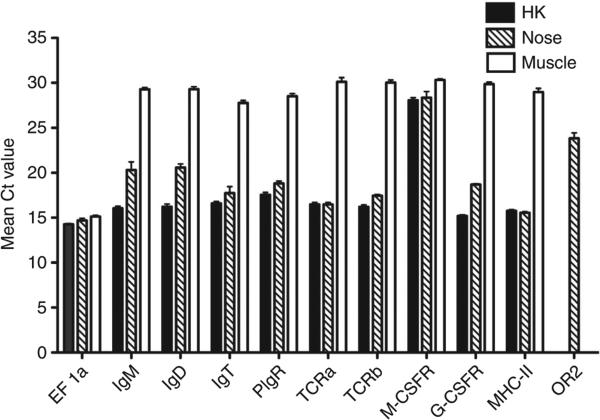
Expression levels in most cases are comparable to those of the head-kidney (HK), the main haematopoietic organ in teleosts. Quantitative real-time PCR of mRNAs for immune markers in trout HK, OO and muscle (N = 6). Data are expressed as mean Ct values±s.e. G-CSFR, granulocyte colony stimulating factor receptor; M-CSFR, macrophage colony stimulating factor receptor; ND, not detected; OR-2, olfactory receptor 2; OO, olfactory organ; TCRb, T-cell receptor beta; TRCa, T-cell receptor alpha.
Figure 4
Figure 4. Kinetics of the immune response following nasal or injection vaccination
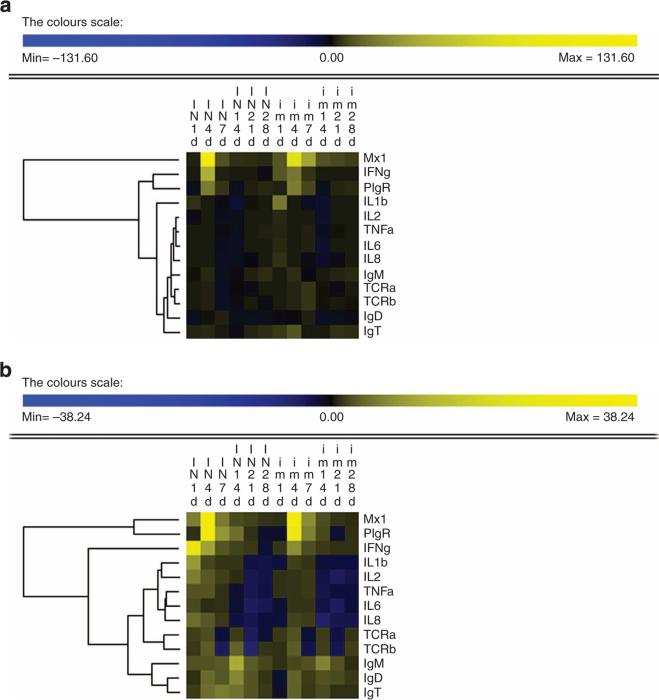
Heat map illustrates results from quantitative real-time PCR of mRNAs for selected immune markers in IHNV-immunized fish versus control fish measured at 1, 4, 7, 14, 21 and 28 days post vaccination (N = 6) in the head-kidney (HK; a) and local immune response in the olfactory organ (b) of rainbow trout. Data are expressed as mean fold increase in expression±s.e. qPCR measurements were analysed by unpaired t-test, with P-values <0.05 considered significant.
Figure 5
Figure 5. Microarray studies of the olfactory organ of rainbow trout
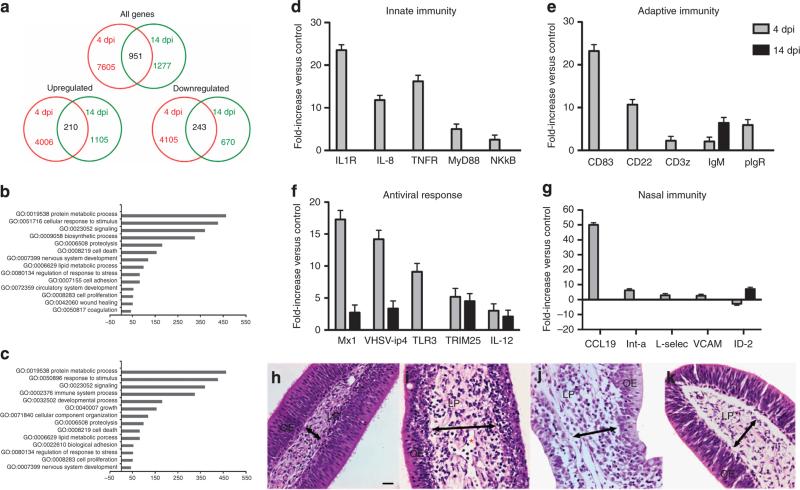
(a) Venn diagrams of microarray experiment representing the overlap of genes upregulated or downregulated in the olfactory organ of rainbow trout 4 or 14 days after IN vaccination with IHNV versus control fish. (b) Biological processes that were significantly altered following the IN vaccination 4 d.p.i. revealed by microarray studies. (c) Biological processes that were significantly modified following the IN vaccination 14 d.p.i. revealed by microarray studies. Fold change differences between control and IHNV-injected samples were calculated using cutoff of twofold. Significant differential expression at each time point (4 and 14 d.p.i.) was established by two sample (unpaired) t-tests (P<0.05) with unequal variance. (d) Representative innate immune genes modulated by IHNV vaccination at 4 or 14 d.p.i. (e) Representative adaptive immune gene expression modulated IHNV vaccination at 4 or 14 d.p.i. (f) Representative antiviral response genes expression modulated by IHNV vaccination at 4 or 14 d.p.i. (g) NALT-related genes differentially up- or downregulated in the olfactory organ of rainbow trout following nasal IHNV vaccination at 4 or 14 d.p.i. (h) Histology of the olfactory epithelium of a mock-vaccinated rainbow trout (N = 4). (i) Histological examination (haematoxylin/eosin stain) of the olfactory organ of IN vaccinated rainbow trout 4 d.p.i. with IHNV vaccine (N = 4). (j) Histological examination (haematoxylin/eosin stain) of the olfactory organ of IN IHNV-vaccinated rainbow trout 14 d.p.i. (N = 4). (k) Histological examination (haematoxylin/eosin stain) of the olfactory organ of IN IHNV-vaccinated rainbow trout 28 d.p.i. (N = 4). Scale bar, 10 μm. Black arrows indicate the width of the lamina propria (LP). OE, olfactory epithelium. The red asterisk denotes capillaries in the LP of IN vaccinated trout.
Figure 6
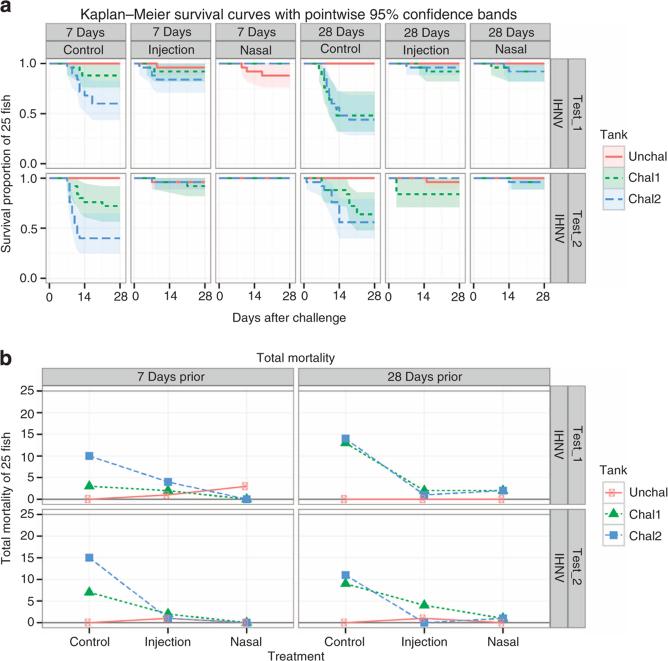
Figure 6. Nasal vaccination elicits high levels of protection against infectious haematopoietic virus
Survival curves (a) and total mortality (b) of IHNV intranasal vaccine method (IN) compared with intramuscular (i.m.) injection delivery in two different tests. Trout (N = 25 per tank in duplicate tanks) were challenged to virulent IHNV i.p. at 7 and 28 days post vaccination. An exact logistic regression model was used to analyse results as explained in Methods. Chal, challenge; Unchal, unchallenged.
Figure 7
Figure 7. Nasal vaccination confers high protection against the bacterial pathogen Y. ruckeri
Survival curves (a) and total mortality (b) of ERM intranasal vaccine method (IN) compared with intramuscular (i.m.) injection delivery. Trout (N = 25 per tank in duplicate tanks) were challenge (Chal) to virulent Y. ruckeri by immersion at 7 and 28 days post vaccination. An exact logistic regression model was used to analyse results as explained in Methods. Unchal, unchallenged.

References

    1. Ache BW, Young JM. Olfaction: diverse species, conserved principles. Neuron. 2005;48:417–430. - PubMed
    1. Kiyono H, Fukuyama S. NALT-versus Peyer's-patch-mediated mucosal immunity. Nat. Rev. Immunol. 2004;4:699–710. - PMC - PubMed
    1. Flajnik MF, Kasahara M. Origin and evolution of the adaptive immune system: genetic events and selective pressures. Nat. Rev. Genet. 2010;11:47–59. - PMC - PubMed
    1. Salinas I, Zhang YA, Sunyer JO. Mucosal immunoglobulins and B cells of teleost fish. Dev. Comp. Immunol. 2011;35:1346–1365. - PMC - PubMed
    1. Zhang YA, et al. IgT, a primitive immunoglobulin class specialized in mucosal immunity. Nat. Immunol. 2010;11:827–835. - PMC - PubMed

LinkOut - more resources