


Participation in EHR based simulation improves recognition of patient safety issues
- PMID: 25336294
- PMCID: PMC4287422
- DOI: 10.1186/1472-6920-14-224
Participation in EHR based simulation improves recognition of patient safety issues
Abstract
Background: Electronic health records (EHR) are becoming increasingly integrated into the clinical environment. With the rapid proliferation of EHRs, a number of studies document an increase in adverse patient safety issues due to the EHR-user interface. Because of these issues, greater attention has been placed on novel educational activities which incorporate use of the EHR. The ICU environment presents many challenges to integrating an EHR given the vast amounts of data recorded each day, which must be interpreted to deliver safe and effective care. We have used a novel EHR based simulation exercise to demonstrate that everyday users fail to recognize a majority of patient safety issues in the ICU. We now sought to determine whether participation in the simulation improves recognition of said issues.
Methods: Two ICU cases were created in our EHR simulation environment. Each case contained 14 safety issues, which differed in content but shared common themes. Residents were given 10 minutes to review a case followed by a presentation of management changes. Participants were given an immediate debriefing regarding missed issues and strategies for data gathering in the EHR. Repeated testing was performed in a cohort of subjects with the other case at least 1 week later.
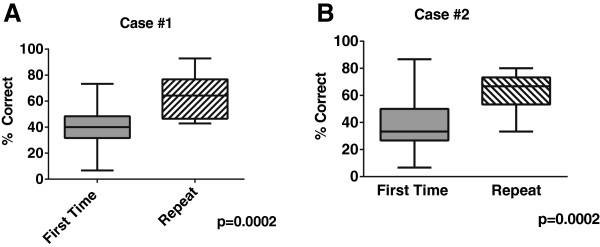
Results: 116 subjects have been enrolled with 25 subjects undergoing repeat testing. There was no difference between cases in recognition of patient safety issues (39.5% vs. 39.4%). Baseline performance for subjects who participated in repeat testing was no different than the cohort as a whole. For both cases, recognition of safety issues was significantly higher among repeat participants compared to first time participants. Further, individual performance improved from 39.9% to 63.6% (p = 0.0002), a result independent of the order in which the cases were employed. The degree of improvement was inversely related to baseline performance. Further, repeat participants demonstrated a higher rate of recognition of changes in vitals, misdosing of antibiotics and oversedation compared to first time participants.
Conclusion: Participation in EHR simulation improves EHR use and identification of patient safety issues.
Figures




References
-
- Charles D, King J, Vaishali P, Furukawa MF. Adoption of electronic health record systems among U.S. Non-federal acute care hospitals: 2008–2012. ONC Data Brief. 2013;9:1–9.
Pre-publication history
-
- The pre-publication history for this paper can be accessed here:http://www.biomedcentral.com/1472-6920/14/224/prepub
Publication types
MeSH terms
Grants and funding
LinkOut - more resources
Full Text Sources
Other Literature Sources
Medical
