. 2014 Dec;45(12):3725-9.
doi: 10.1161/STROKEAHA.114.005377. Epub 2014 Oct 21.

2014 Thomas Willis Award Lecture: sex, stroke, and innovation

Affiliations

2014 Thomas Willis Award Lecture: sex, stroke, and innovation

Patricia D Hurn. Stroke. 2014 Dec.

Abstract

Innovation is a form of purposeful discovery behavior that exploits the unexpected, utilizes imagination, and provides one avenue of new solutions to complex human health needs. It is through this lens that two examples are described in which innovative approaches have been used to dissect the complexities of stroke pathophysiology. The first example focuses on one of the most fundamental genetic factors relevant to the brain and ischemic injury: biological sex. Much might be gained by understanding the details of sex-specific pathobiology, if the field is to develop therapies that work well in patients of both sexes. The second example surrounds brain-spleen cell cycling after stroke which is fundamental to our evolving understanding that stroke is a systemic disease, rather than solely a lesion of the brain. While much work remains, it is now apparent that brain-spleen cell cycling is temporally specific, varies in intensity, and involves cell players that are of much wider lineages than originally believed. In the future, it is likely that innovation will need to turn to “big data”, particularly if our field is to tackle the daunting questions that most greatly matter to unraveling brain injury. The huge availability and growth rate of biomedical data, handled in a shared but coherent environment, offers an opportunity to further vitalize stroke research.

Keywords: brain ischemia; immune system; sex; spleen; stroke.


Figures
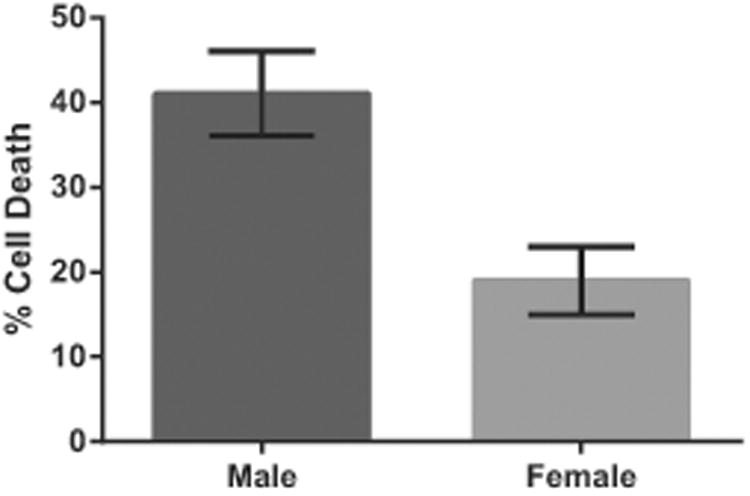
Fig. 1
Fig. 1
Data from primary astrocyte cultures: XX cells tolerate oxygen and glucose deprivation (OGD) with lower mortality than do XY cells. For details on technical methods, see reference 17.
Fig 2
Fig 2
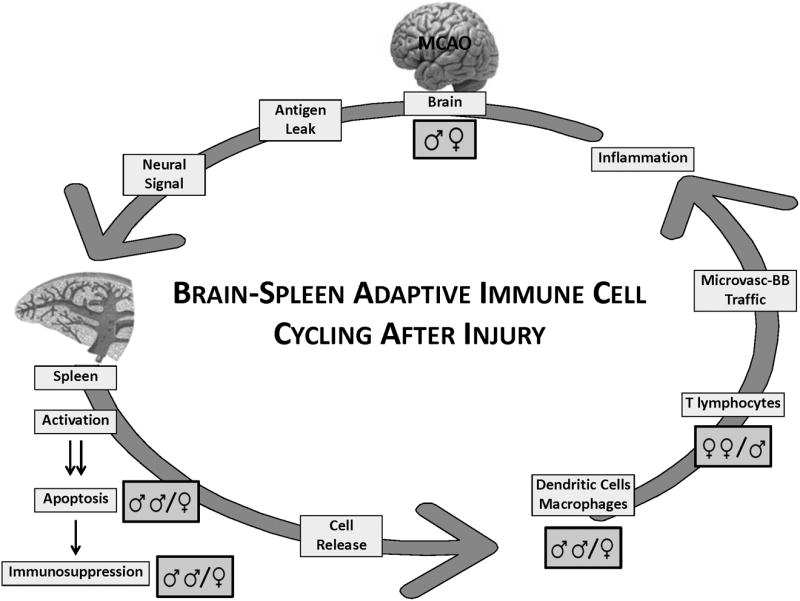
Brain-spleen immune cell cycling after experimental stroke. The evolving brain injury "signals" through the central nervous system for activation and apoptosis of the spleen, with consequent loss of many splenic immunocytes, leading to systemic immunosuppression. Remaining intra-splenic cell subsets (e.g. macrophages, lymphocytes and dendritic cells) are released into the blood, followed by trafficking across a cerebral microvasculature replete with inflammatory display of adhesion molecules and chemokines. The result is enhanced cerebral inflammation and damage, thus re-invigorating the cycle. Several points in the cycle are hypothesized to be sex-dependent. For example, splenic consequences post-experimental stroke have been observed to be more robust in male vs. female mice. Further, inflammatory cell trafficking is not identical in the male vs female post-ischemic brain. For example, macrophage infiltration into brain is particularly robust in male mice. Whether this observation is best explained by the typically larger infarct in male vs. female brain after experimental ischemia (middle cerebral artery occlusion), or by specific mechanisms of cell trafficking is unclear at present.

References

    1. Ness RB. Innovation Generation. Oxford University Press; New York: 2012.
    1. Herson PS, Palmateer J, Hurn PD. Biological sex and mechanisms of ischemic brain injury. Transl Stroke Res. 2013;4:413–9. - PMC - PubMed
    1. Gibson CL. Cerebral ischemic stroke: is gender important? J Cereb Blood Flow Metab. 2013;33:1355–61. - PMC - PubMed
    1. Liu F, McCollough LD. Interactions between age, sex and hormones in experimental ischemic stroke. Neurochem Int. 2012;61:1255–65. - PMC - PubMed
    1. Haast RA, Gustafson DR, Kiliaan AJ. Sex differences in stroke. J Cereb Blood Flow Metab. 2012;32:2100–7. - PMC - PubMed

Publication types