


Combined benefit of prediction and treatment: a criterion for evaluating clinical prediction models
- PMID: 25336898
- PMCID: PMC4197927
- DOI: 10.4137/CIN.S13780
Combined benefit of prediction and treatment: a criterion for evaluating clinical prediction models
Abstract
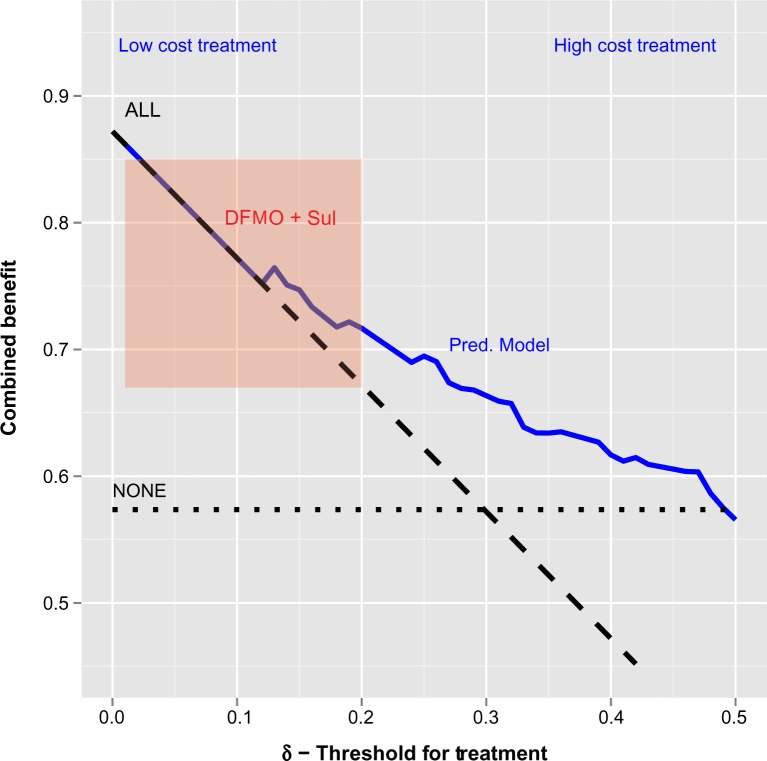
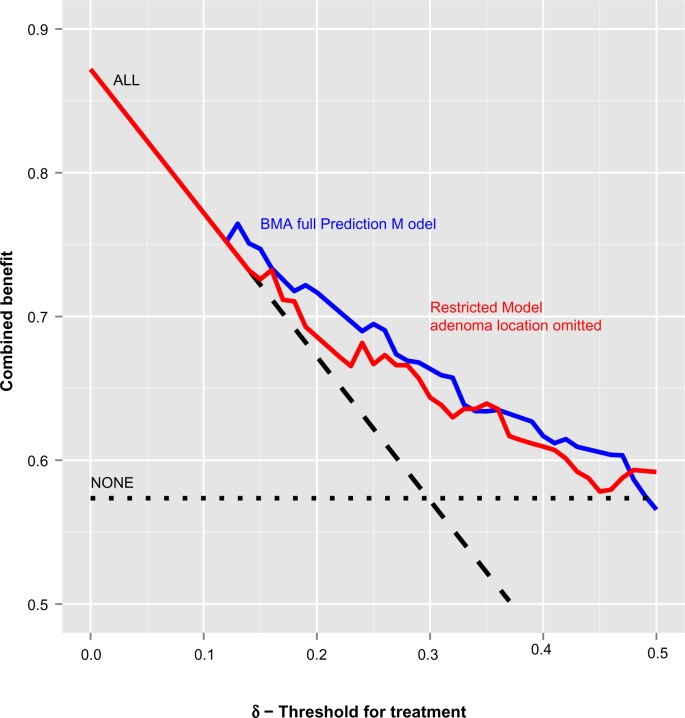
Clinical treatment decisions rely on prognostic evaluation of a patient's future health outcomes. Thus, predictive models under different treatment options are key factors for making good decisions. While many criteria exist for judging the statistical quality of a prediction model, few are available to measure its clinical utility. As a consequence, we may find that the addition of a clinical covariate or biomarker improves the statistical quality of the model, but has little effect on its clinical usefulness. We focus on the setting where a treatment decision may reduce a patient's risk of a poor outcome, but also comes at a cost; this may be monetary, inconvenience, or the potential side effects. This setting is exemplified by cancer chemoprevention, or the use of statins to reduce the risk of cardiovascular disease. We propose a novel approach to assessing a prediction model using a formal decision analytic framework. We combine the predictive model's ability to discriminate good from poor outcome with the net benefit afforded by treatment. In this framework, reduced risk is balanced against the cost of treatment. The relative cost-benefit of treatment provides a useful index to assist patient decisions. This index also identifies the relevant clinical risk regions where predictive improvement is needed. Our approach is illustrated using data from a colorectal adenoma chemoprevention trial.
Keywords: chemoprevention; decision analysis; model evaluation; predictive modeling.
Figures



References
-
- Geisser S. Predictive Inference: An Introduction. Chapman and Hall; New York: 1993.
-
- Harrell FE. Regression Modeling Strategies. Springer; New York: 2001.
-
- Pencina MJ, Agostino RBD, Agostino RBD, Vasan RS. Evaluating the added predictive ability of a new marker: From area under the roc curve to reclassification and beyond. Stat Med. 2008;27(2):157172. - PubMed
LinkOut - more resources
Full Text Sources
Other Literature Sources
Research Materials
