Review
. 2014 Aug;5(5):201-11.
doi: 10.1159/000365770. Epub 2014 Aug 7.

Fibrodysplasia ossificans progressiva: clinical course, genetic mutations and genotype-phenotype correlation

Affiliations
Review

Fibrodysplasia ossificans progressiva: clinical course, genetic mutations and genotype-phenotype correlation

Irina Hüning et al. Mol Syndromol. 2014 Aug.

Abstract

Fibrodysplasia ossificans progressiva (FOP, MIM 135100) is a rare autosomal dominant genetic disorder and the most disabling condition of heterotopic (extraskeletal) ossification in humans. Mutations in the ACVR1 gene (MIM 102576) were identified as a genetic cause of FOP [Shore et al., 2006]. Most patients with FOP have the same recurrent single nucleotide change c.617G>A, p.R206H in the ACVR1 gene. Furthermore, 11 other mutations in the ACVR1 gene have been described as a cause of FOP. Here, we review phenotypic and molecular findings of 130 cases of FOP reported in the literature from 1982 to April 2014 and discuss possible genotype-phenotype correlations in FOP patients.

Keywords: ACVR1; FOP; Great toe malformations; Heterotopic ossifications; Progressive immobility.


Figures
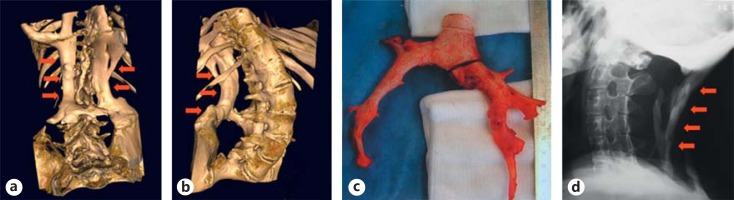
Fig. 1
Fig. 1
Heterotopic ossifications in FOP patients. a, b 3D-CT imaging of the lumbar region and presentation of additional bone tissue beside the spine with fusion to the pelvic bones. c Surgical specimen of heterotopic bone after removal. Histologically, the bone tissue shows a normal healthy structure. d Presentation of heterotopic bone causing immobility in the neck region by X-ray. Image from Stefanova et al. [2012].
Fig. 2
Fig. 2
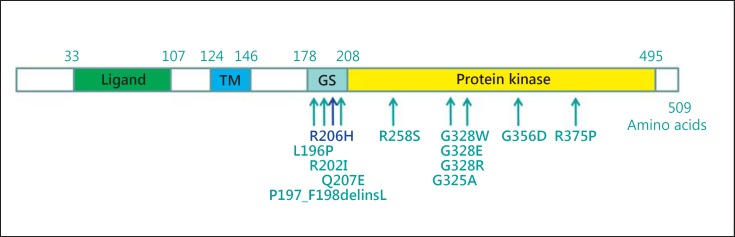
Schematic illustration of the ACVR1 protein and all mutations described up to date. The classical mutation p.R206H is located in the GS-rich domain. All known mutations up to date are located in the GS-rich domain and the protein kinase domain. Modified after Kaplan et al. [2009].
Fig. 3
Fig. 3
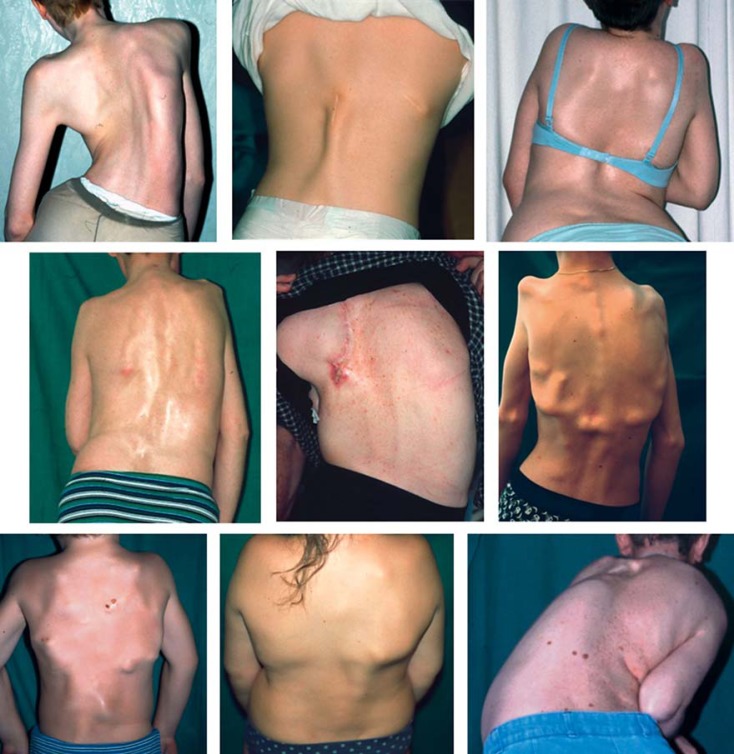
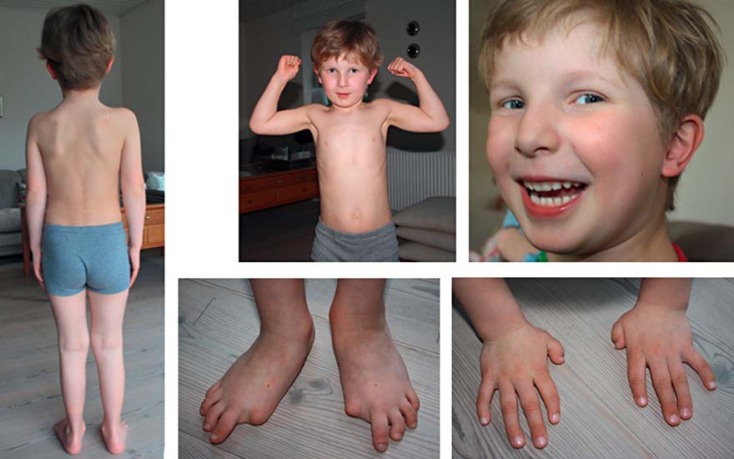
Patients with the ‘classical’ mutation c.617G>A (p.R206H) in the ACVR1 gene. Heterotopic ossifications appear in a typical anatomic pattern in all patients. Some patients show heterotopic ossifications after trauma. In the typical course of disease, patients develop severe scoliosis and thorax insufficiency. Image from Stefanova et al. [2012].
Fig. 4
Fig. 4
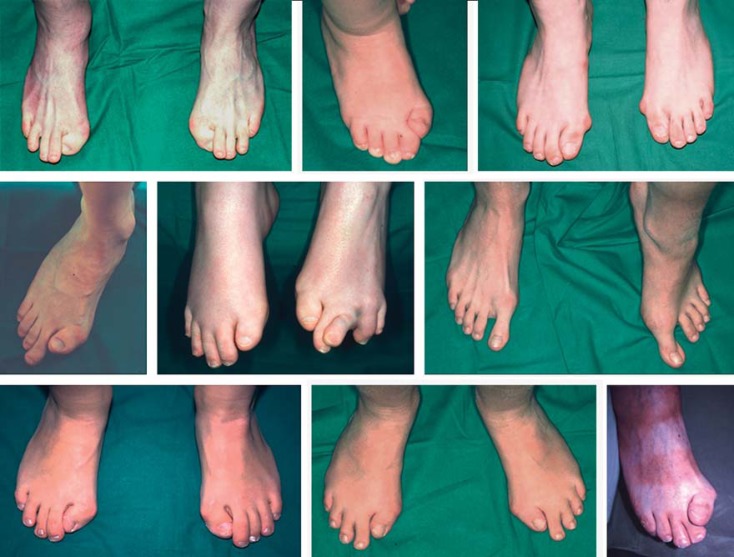
Feet of patients with the common mutation c.617G>A (p.R206H). The very first sign of FOP is a congenital malformation of the great toes (brachydactyly and fibular deviation), present in almost all patients with the ‘classical’ ACVR1 mutation. Image from Stefanova et al. [2012].
Fig. 5
Fig. 5
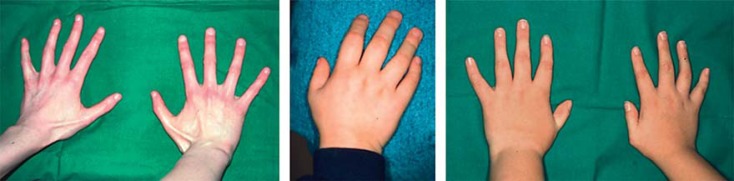
Some patients with c.617G>A (p.R206H) in the ACVR1 gene show short thumbs. Image from Stefanova et al. [2012].
Fig. 6
Fig. 6
Patient with the mutation c.1067G>A (p.G356D) in the ACVR1 gene, reported by Kaplan et al. [2009] and Stefanova et al. [2012]. At the age of 5 years, the boy has no heterotopic bone formation or mobility restriction. Image from Stefanova et al. [2012].
Fig. 7
Fig. 7
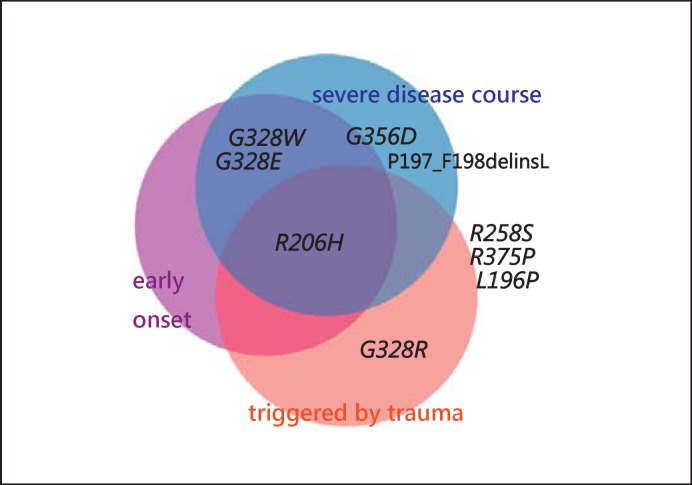
Different amino acid changes in the ACVR1 protein and their involvement in the following clinical aspects of FOP: early onset of ossifications, severe disease course, and the trigger of ossifications by trauma or surgery. The changes presented outside the circles seem to correlate with a relatively late disease onset, mild disease course, and no influence of injuries on the development of ossifications.
Fig. 8
Fig. 8
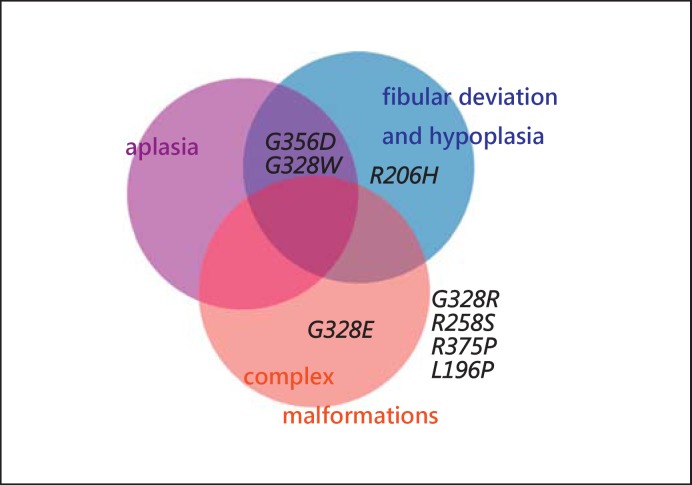
Association of the mutations in the ACVR1 gene with great toe malformations. Patients with the ‘classical’ mutation p.R206H usually show great toe malformations, such as fibular deviation and hypoplasia. In patients with the amino acid changes p.G356D and p.G328W, not only fibular deviation and hypoplasia, but also aplasia of the great toes has been observed. Patients with the amino acid change p.G328E have complex digital malformations (oligodactyly and syndactyly), otherwise not seen in FOP patients. The clear reports of patients with the amino acid changes p.G328R, p.R258S, p.R375P, and p.L196P describe mild or no malformations of the great toes.

References

    1. Al-Haggar M, Ahmad N, Yahia S, Shams A, Hasaneen B, et al. Sporadic fibrodysplasia ossificans progressiva in an Egyptian infant with c.617G>A mutation in ACVR1 gene: a case report and review of literature. Case Rep Genet. 2013;2013:834605. - PMC - PubMed
    1. Bauer KH, Bode W. Erbpathologie der Stützgewebe beim Menschen. Erbbiologie und Erbpathologie körperlicher Zustände und Funktionen. 1940;1:105.
    1. Bocciardi R, Bordo D, Di Duca M, Di Rocco M, Ravazzolo R. Mutational analysis of the ACVR1 gene in Italian patients affected with fibrodysplasia ossificans progressiva: confirmations and advancements. Eur J Hum Genet. 2009;17:311–318. - PMC - PubMed
    1. Carvalho DR, Navarro MM, Martins BJ, Coelho KE, Mello WD, et al. Mutational screening of ACVR1 gene in Brazilian fibrodysplasia ossificans progressiva patients. Clin Genet. 2010;77:171–176. - PubMed
    1. Chen D, Zhao M, Mundy GR. Bone morphogenetic proteins. Growth Factors. 2004;22:233–241. - PubMed