


The use of google trends in health care research: a systematic review
- PMID: 25337815
- PMCID: PMC4215636
- DOI: 10.1371/journal.pone.0109583
The use of google trends in health care research: a systematic review
Abstract
Background: Google Trends is a novel, freely accessible tool that allows users to interact with Internet search data, which may provide deep insights into population behavior and health-related phenomena. However, there is limited knowledge about its potential uses and limitations. We therefore systematically reviewed health care literature using Google Trends to classify articles by topic and study aim; evaluate the methodology and validation of the tool; and address limitations for its use in research.
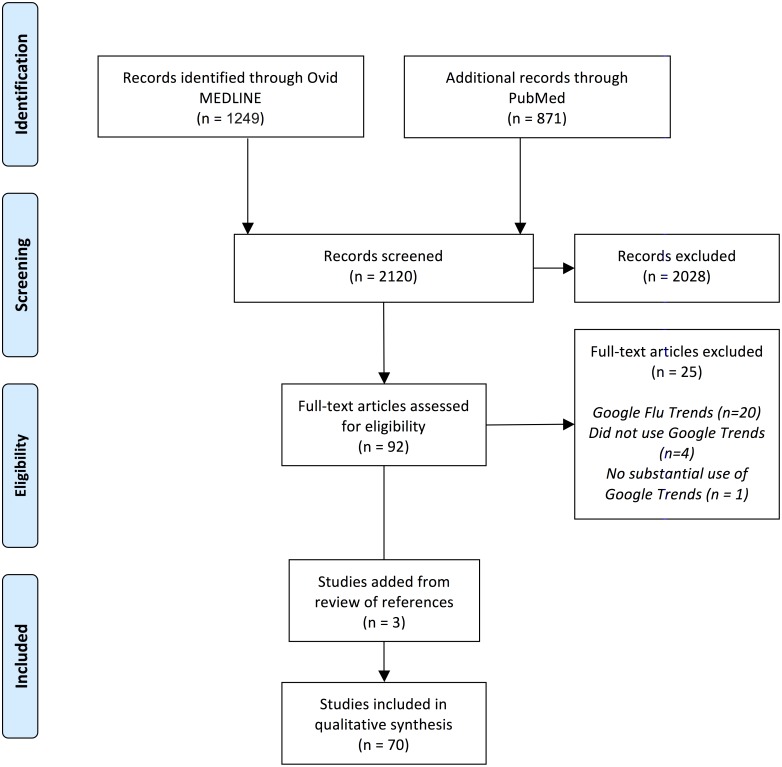
Methods and findings: PRISMA guidelines were followed. Two independent reviewers systematically identified studies utilizing Google Trends for health care research from MEDLINE and PubMed. Seventy studies met our inclusion criteria. Google Trends publications increased seven-fold from 2009 to 2013. Studies were classified into four topic domains: infectious disease (27% of articles), mental health and substance use (24%), other non-communicable diseases (16%), and general population behavior (33%). By use, 27% of articles utilized Google Trends for casual inference, 39% for description, and 34% for surveillance. Among surveillance studies, 92% were validated against a reference standard data source, and 80% of studies using correlation had a correlation statistic ≥0.70. Overall, 67% of articles provided a rationale for their search input. However, only 7% of articles were reproducible based on complete documentation of search strategy. We present a checklist to facilitate appropriate methodological documentation for future studies. A limitation of the study is the challenge of classifying heterogeneous studies utilizing a novel data source.
Conclusion: Google Trends is being used to study health phenomena in a variety of topic domains in myriad ways. However, poor documentation of methods precludes the reproducibility of the findings. Such documentation would enable other researchers to determine the consistency of results provided by Google Trends for a well-specified query over time. Furthermore, greater transparency can improve its reliability as a research tool.
Conflict of interest statement
References
-
- Barrett-Connor E, Ayanian JZ, Brown ER, Coultas DB, Francis CK, et al. (2011) A Nationwide Framework for Surveillance of Cardiovascular and Chronic Lung Diseases. - PubMed
-
- Ginsberg J, Mohebbi MH, Patel RS, Brammer L, Smolinski MS, et al. (2009) Detecting influenza epidemics using search engine query data. Nature 457: 1012–U1014. - PubMed
-
- Google (2014) Google Trends. Available: http://www.google.com/trends/. Accessed 2014 April 25.
-
- Google (2014) Google Trends Help. https://support.google.com/trends/. Accessed: 04/25/14.
Publication types
MeSH terms
LinkOut - more resources
Full Text Sources
Other Literature Sources
Miscellaneous
