


Weaker circadian activity rhythms are associated with poorer executive function in older women
- PMID: 25337947
- PMCID: PMC4548515
- DOI: 10.5665/sleep.4260
Weaker circadian activity rhythms are associated with poorer executive function in older women
Abstract
Study objectives: Older adults and patients with dementia often have disrupted circadian activity rhythms (CARs). Disrupted CARs are associated with health declines and could affect cognitive aging. We hypothesized that among older women, weaker CARs would be associated with poorer cognitive function 5 y later.
Design: Prospective observational study.
Setting: Three US clinical sites.
Participants: There were 1,287 community-dwelling older women (82.8 ± 3.1 y) participating in an ongoing prospective study who were free of dementia at the baseline visit.
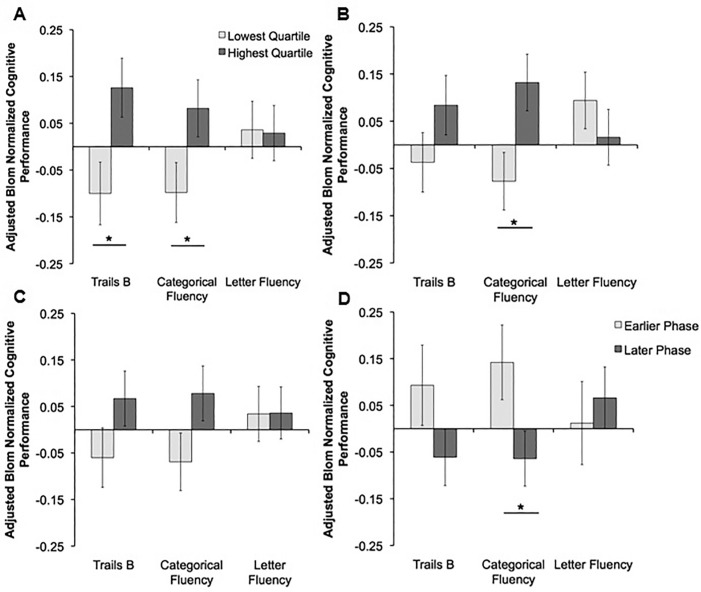
Measurements and results: Baseline actigraphy was used to determine CAR measures (amplitude, mesor, and rhythm robustness, analyzed as quartiles; acrophase analyzed by peak activity time < 13:34 and > 15:51). Five years later, cognitive performance was assessed with the Modified Mini-Mental Status Examination (3MS), California Verbal Learning Task (CVLT), digit span, Trail Making Test B (Trails B), categorical fluency, and letter fluency. We compared cognitive performance with CARs using analyses of covariance adjusted for a number of health factors and comorbidities. Women in the lowest quartile for CAR amplitude performed worse on Trails B and categorical fluency compared to women in the highest quartile (group difference (d) = 30.42 sec, d = -1.01 words respectively, P < 0.05). Women in the lowest quartile for mesor performed worse on categorical fluency (d = -0.86 words, P < 0.05). Women with a later acrophase performed worse on categorical fluency (d = -0.69 words, P < 0.05). Controlling for baseline Mini-Mental State Examination and sleep factors had little effect on our results.
Conclusion: Weaker circadian activity rhythm patterns are associated with worse cognitive function, especially executive function, in older women without dementia. Further investigation is required to determine the etiology of these relationships.
Keywords: actigraphy; cognition; cognitive impairment; executive function; verbal memory.
© 2014 Associated Professional Sleep Societies, LLC.
Figures
References
-
- Bliwise DL, King AC, Harris RB, Haskell WL. Prevalence of self-reported poor sleep in a healthy population aged 50-65. Soc Sci Med. 1992;34:49–55. - PubMed
-
- Foley DJ, Monjan AA, Brown SL, Simonsick EM, Wallace RB, Blazer DG. Sleep complaints among elderly persons: an epidemiologic study of three communities. Sleep. 1995;18:425–32. - PubMed
-
- Ohayon MM, Carskadon MA, Guilleminault C, Vitiello MV. Meta-analysis of quantitative sleep parameters from childhood to old age in healthy individuals: developing normative sleep values across the human lifespan. Sleep. 2004;27:1255–73. - PubMed
-
- Blackwell T, Yaffe K, Ancoli-Israel S, et al. Poor sleep is associated with impaired cognitive function in older women: the study of osteoporotic fractures. J Gerontol A Biol Sci Med Sci. 2006;61:405–10. - PubMed
Publication types
MeSH terms
Grants and funding
LinkOut - more resources
Full Text Sources
Other Literature Sources
Medical
