


School-based countrywide seroprevalence survey reveals spatial heterogeneity in malaria transmission in the Gambia
- PMID: 25338083
- PMCID: PMC4206471
- DOI: 10.1371/journal.pone.0110926
School-based countrywide seroprevalence survey reveals spatial heterogeneity in malaria transmission in the Gambia
Abstract
Background: As the geographical distribution of malaria transmission becomes progressively clustered, identifying residual pockets of transmission is important for research and for targeting interventions. Malarial antibody-based surveillance is increasingly recognised as a valuable complement to classic methods for the detection of infection foci especially at low transmission levels. The study presents serological evidence for transmission heterogeneity among school children in The Gambia measured during the dry, non-transmission season.
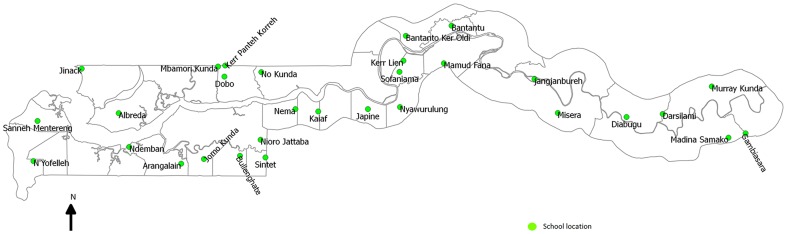
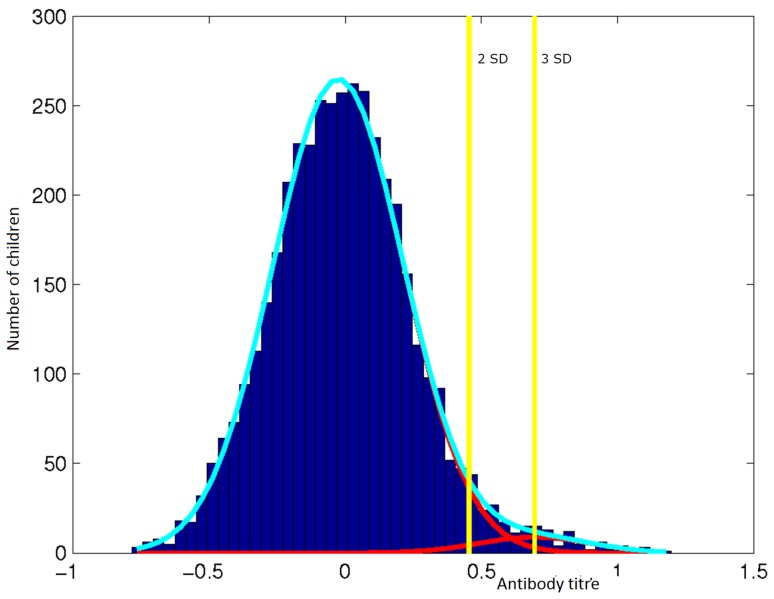
Methods: Healthy primary school children were randomly selected from 30 schools across the country and screened for malaria infection (microscopy) and antimalarial antibodies (MSP119). Antibody distribution was modelled using 2-component finite mixture model with cut-off for positivity from pooled sera set at 2-standard deviation from the mean of the first component. Factors associated with a positive serological status were identified in a univariate model and then combined in a multilevel mixed-effects logistic regression model, simultaneously adjusting for variations between individuals and school.
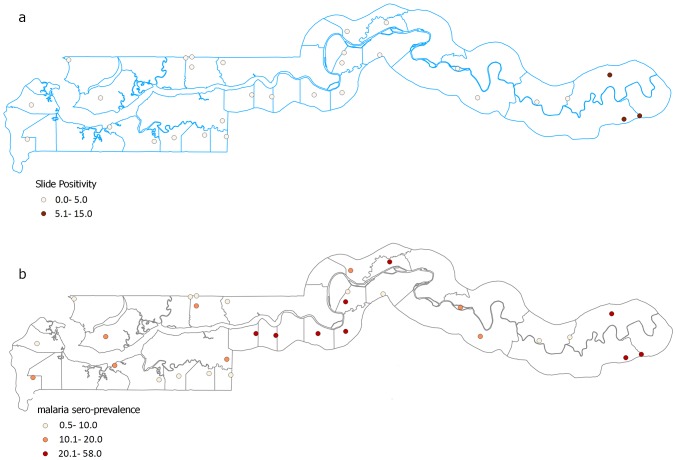
Results: A total of 4140 children, 1897 (46%) boys, were enrolled with mean age of 10.2 years (SD 2.6, range 4-20 years). Microscopy results available for 3640 (87.9%) children showed that 1.9% (69) were positive for Plasmodium falciparum infections, most of them (97.1%, 67/69) asymptomatic. The overall seroprevalence was 12.7% (527/4140) with values for the schools ranging from 0.6% to 43.8%. Age (OR 1.12, 95% CI 1.07-1.16,) and parasite carriage (OR 3.36, 95% CI 1.95-5.79) were strongly associated with seropositivity.
Conclusion: Serological responses to malaria parasites could identify individuals who were or had been infected, and clusters of residual transmission. Field-adapted antibody tests able to guide mass screening and treatment campaigns would be extremely useful.
Conflict of interest statement
Figures
References
-
- World Health Organization. (2010) World malaria report. Geneva, Switzerland: World Health Organization.
-
- Greenwood BM (1989) The microepidemiology of malaria and its importance to malaria control. Trans R Soc Trop Med Hyg 83 Suppl: 25–29 - PubMed
Publication types
MeSH terms
Substances
Grants and funding
LinkOut - more resources
Full Text Sources
Other Literature Sources
Research Materials
