


Adherent-invasive Escherichia coli (AIEC) in pediatric Crohn's disease patients: phenotypic and genetic pathogenic features
- PMID: 25338542
- PMCID: PMC4210564
- DOI: 10.1186/1756-0500-7-748
Adherent-invasive Escherichia coli (AIEC) in pediatric Crohn's disease patients: phenotypic and genetic pathogenic features
Abstract
Background: Adherent-invasive Escherichia coli (AIEC) have been implicated in the ethiopathogenesis of Crohn's disease (CD). In this study, we analyzed a collection of intestinal mucosa-associated E. coli isolates, presenting AIEC phenotypes, isolated from biopsies of CD pediatric patients and non-inflammatory bowel diseases (IBD) controls, in order to investigate their genetic and phenotypic pathogenic features.
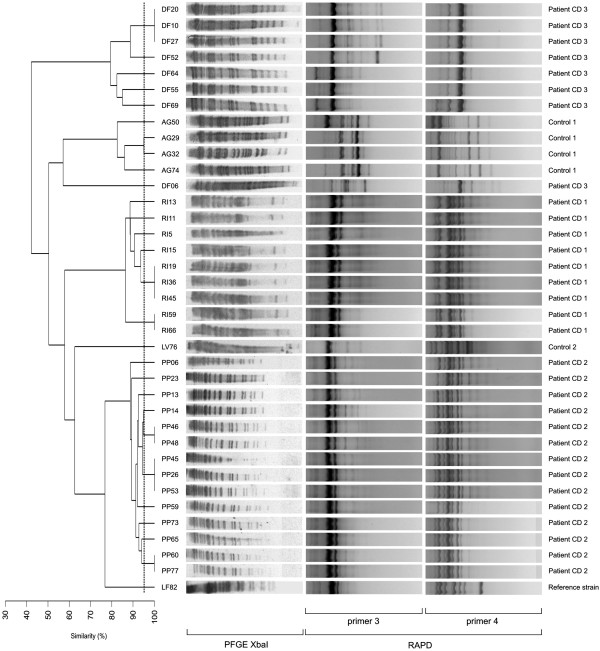
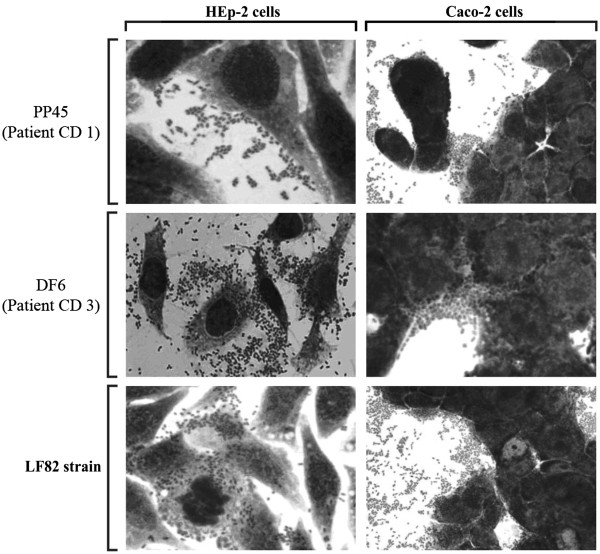
Results: A total of 616 E. coli isolates from biopsies of four pediatric CD patients and of four non-IBD controls were collected and individually analyzed. For AIEC identification, adherent isolates were assayed for invasiveness, and the capacity of the adhesive-invasive isolates to survive and replicate intracellularly was determined over macrophages J774. In this way we identified 36 AIEC-like isolates. Interestingly, their relative abundance was significantly higher in CD patients (10%; 31/308) than in non-IBD controls (1%; 5/308) (χ2 = 38.96 p < 0.001). Furthermore pulsed field gel electrophoresis (PFGE) and randomly amplified polymorphic DNA (RAPD) techniques were applied to analyze the clonality of the 36 AIEC-like isolates. The results obtained allowed us to identify 27 distinct genotypes (22 from CD patients and 5 from non-IBD controls). As for the AIEC prototype strain LF82, all 27 AIEC genotypes presented an aggregative pattern of adherence (AA) that was inhibited by D-mannose, indicating that adhesiveness of AIEC is likely mediated by type 1 pili. PCR analisys was used to investigate presence of virulence genes. The results indicated that among the 27 AIEC isolates, the incidence of genes encoding virulence factors K1 (χ2 = 6.167 P = 0.013), kpsMT II (χ2 = 6.167 P = 0.013), fyuA (χ2 = 6.167 P = 0.013), and ibeA (χ2 = 8.867 P = 0.003) was significantly higher among AIEC strains isolated from CD patients than non-IBD controls.
Conclusions: The identification of AIEC strains in both CD and non-IBD controls, confirmed the "pathobiont" nature of AIEC strains. The finding that AIEC-like isolates were more abundant in CD patients, indicates that a close association of these strains with CD may also exists in pediatric patients.
Figures
References
Publication types
MeSH terms
Supplementary concepts
LinkOut - more resources
Full Text Sources
Other Literature Sources
Medical
Research Materials
