. 2015 Dec;172(23):5647-60.
doi: 10.1111/bph.12986. Epub 2015 Jan 12.

Aspirin enhances protective effect of fish oil against thrombosis and injury-induced vascular remodelling

Affiliations

Aspirin enhances protective effect of fish oil against thrombosis and injury-induced vascular remodelling

Yanjun Gong et al. Br J Pharmacol. 2015 Dec.

Abstract

Background and purpose: Although aspirin (acetylsalicylic acid) is commonly used to prevent ischaemic events in patients with coronary artery disease, many patients fail to respond to aspirin treatment. Dietary fish oil (FO), containing ω3 polyunsaturated fatty acids (PUFAs), has anti-inflammatory and cardio-protective properties, such as lowering cholesterol and modulating platelet activity. The objective of the present study was to investigate the potential additional effects of aspirin and FO on platelet activity and vascular response to injury.

Experimental approach: Femoral arterial remodelling was induced by wire injury in mice. Platelet aggregation, and photochemical- and ferric chloride-induced carotid artery thrombosis were employed to evaluate platelet function.

Key results: FO treatment increased membrane ω3 PUFA incorporation, lowered plasma triglyceride and cholesterol levels, and reduced systolic BP in mice. FO or aspirin alone inhibited platelet aggregation; however, when combined, they exhibited synergistic suppression of platelet activity in mice, independent of COX-1 inhibition. FO alone, but not aspirin, attenuated arterial neointimal growth in response to injury. Strikingly, a combination of FO and aspirin synergistically inhibited injury-induced neointimal hyperplasia and reduced perivascular inflammatory reactions. Moreover, co-administration of FO and aspirin decreased the expression of pro-inflammatory cytokines and adhesion molecules in inflammatory cells. Consistently, a pro-resolution lipid mediator-Resolvin E1, was significantly elevated in plasma in FO/aspirin-treated mice.

Conclusions and implications: Co-administration of FO and low-dose aspirin may act synergistically to protect against thrombosis and injury-induced vascular remodelling in mice. Our results support further investigation of adjuvant FO supplementation for patients with stable coronary artery disease.


Figures

Figure 1
Figure 1
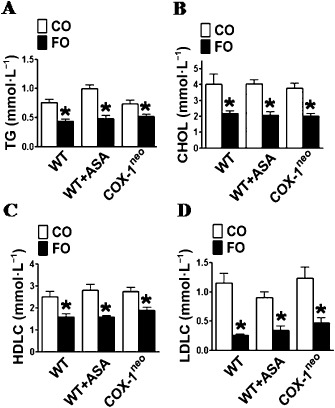
Effect of dietary FO and aspirin (ASA) treatment on serum lipids in mice. WT and COX‐1neo mice were fed 19% FO or CO diet for 2 weeks, and aspirin (30 mg·L −1) was administered in drinking water, as indicated. Serum levels of TG (A), total cholesterol (B), HDLC (C) and LDLC (D)were measured. *P < 0.05 versus CO, n = 10–15.
Figure 2
Figure 2
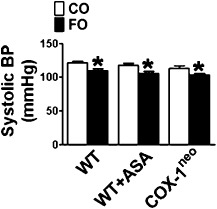
Effect of FO plus aspirin (ASA) on BP. Systolic BP was recorded by tail‐cuff measurement. *P < 0.05 versus CO, n = 9–13.
Figure 3
Figure 3
Effect of dietary FO and aspirin (ASA) on inhibition of platelet aggregation. (A) Representative tracings of FO‐treated mouse platelet aggregation induced by ADP and collagen; (B) representative tracings of aspirin‐treated mouse platelet aggregation induced by ADP and collagen; (C) representative tracings of FO‐ and aspirin co‐treated mouse platelet aggregation induced by ADP and collagen; (D) quantification of the area under platelet aggregation curve for (A–C). *P < 0.05 versus CO, #P < 0.05 as indicated, n = 5–7. a.u. stands for arbitrary unit. (E) Effect of genetic knock‐down (COX‐1neo) and inhibition (aspirin) of COX‐1 on platelet aggregation from FO‐treated mice. (F) Quantification of the area under aggregation curve for €. *P < 0.05 as indicated, n = 5–7.
Figure 4
Figure 4
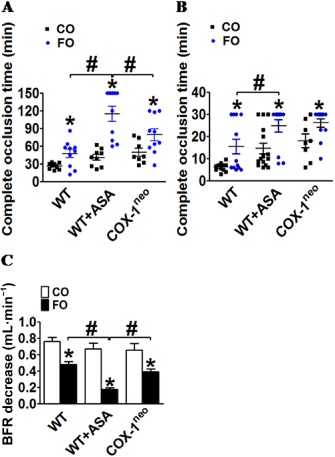
Protective effect of dietary FO plus aspirin against thrombus formation in vivo. (A) Effect of FO and aspirin on complete occlusion time in a photochemical‐induced thrombosis mouse model. *P < 0.05 versus CO, #P < 0.05 as indicated, n = 8–11; effect of FO and aspirin on complete occlusion time (B) and the decrease in blood flow rate (BFR) in a 30 min period (C) in the ferric chloride‐induced thrombosis mouse model. *P < 0.05 versus CO, #P < 0.05 as indicated, n = 8–15.
Figure 5
Figure 5
Effect of dietary FO and aspirin (ASA) on TxA2 metabolite (Tx‐M). Urinary Tx‐M was measured in a 24 h urine specimen collected in a metabolic cage. *P < 0.05, n = 10–15.
Figure 6
Figure 6
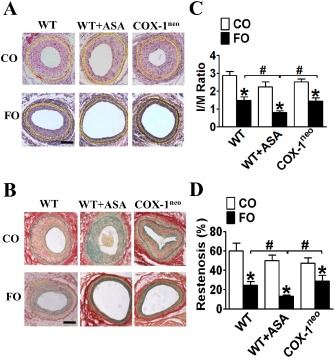
Effect of dietary FO plus aspirin (ASA) on vascular remodelling in response to mechanical injury. Representative haematoxylin and eosin (A) and Ponceaou S‐Picric acid‐Victoria blue (B) staining of cross sections of wire‐injured arteries from WT, aspirin‐treated andCOX‐1neo mice fed with a FO or CO diet. Scale bar, 50 μm; yellow dashed lines indicate both IEL and eternal elastic lamina. Quantification of I/M ratio (C) and restenosis (D) in arteries post‐injury from WT, aspirin‐treated and COX‐1neo mice fed a FO or CO diet. * P < 0.05 versus CO; #P < 0.05 as indicated, n = 7–11.
Figure 7
Figure 7
Synergistic effect of dietary FO and aspirin (ASA) on perivascular inflammatory cell infiltration following injury. (A) Representative immunostaining of CD68 in injured artery cross sections from WT, aspirin‐treated and COX‐1neo mice fed a FO or CO diet. Scale bar, 50 μm; (B) Quantification of CD68+ cell for (A). *P < 0.05 versus CO control; #P < 0.05 as indicated, n = 6–12; (C) Representative immunostaining of CD11b in injured artery cross sections from WT, aspirin‐treated and COX‐1neo mice fed a FO or CO diet. Scale bar, 50 μm; (D) Quantification of CD11b+ cells for (C). * P < 0.05 versus CO; #P < 0.05 as indicated, n = 7–11.
Figure 8
Figure 8
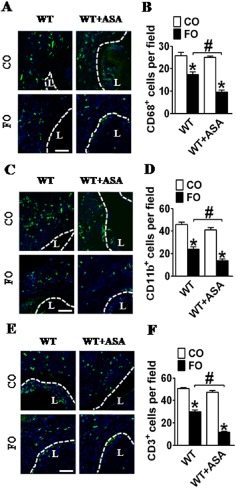
Effect of dietary FO and aspirin (ASA) on early recruitment of inflammatory cells in injured femoral arteries. Representative immunofluorescent staining of CD68(A), CD11b (C) and CD3 (E) in injured femoral artery sections from aspirin alone, FO alone, or FO‐ and aspirin‐treated mice. L, lumen of femoral artery; (B, D, F) Quantification of CD68+, CD11b+ and CD3+ cells in injured femoral artery sections from aspirin alone, FO alone, or FO‐ and aspirin‐treated mice. * P < 0.05 versus CO; #P < 0.05 as indicated, n = 6–7.
Figure 9
Figure 9
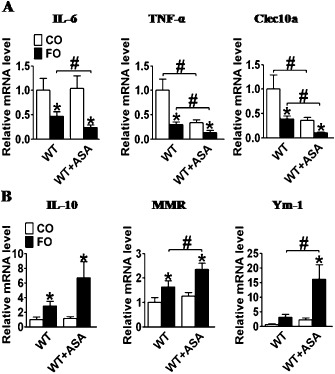
Effect of dietary FO and aspirin (ASA) on mRNA expression of anti‐ and pro‐inflammatory genes in macrophages. (A) IL‐6, TNFα and Clec10a gene expression in macrophages from aspirin alone, FO alone, or FO and aspirin‐treated mice; (B) IL‐10, MMR and Ym‐1 gene expression in macrophages from aspirin alone, FO alone, or FO and aspirin‐treated mice. *P < 0.05 versus CO; # P < 0.05 as indicated, n = 6–12.
Figure 10
Figure 10
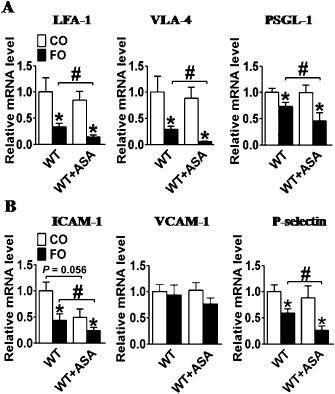
Effect of dietary FO and aspirin (ASA) on the expression of adhesion molecules on leukocytes and endothelium. (A) LFA‐1, VLA‐4, PSGL‐1 gene expression on leukocytes from aspirin alone, FO alone, or FO and aspirin‐treated mice;(B) ICAM‐1, VCAM‐1, and P‐selectin gene expression in aortas from aspirin alone, FO alone, or FO and aspirin‐treated mice.*P < 0.05 versus CO; #P < 0.05 as indicated, n = 5–8.
Figure 11
Figure 11
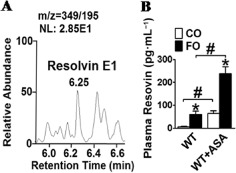
Detection of resolvin E1 in plasma of aspirin (ASA), FO, or FO and aspirin‐treated mice. (A) Selected ion monitoring chromatogram of resolvin E1 isolated from freshly collected plasma; (B) quantification of plasma resolvin E1 production in aspirin, FO, or FO and aspirin‐treated mice. *P < 0.05 versus CO; #P < 0.05 as indicated, n = 8–11.

References

    1. Abdolahi A, Georas SN, Brenna JT, Cai X, Thevenet‐Morrison K, Phipps RP et al (2014). The effects of aspirin and fish oil consumption on lysophosphatidylcholines and lysophosphatidic acids and their correlates with platelet aggregation in adults with diabetes mellitus. Prostaglandins Leukot Essent Fatty Acids 90: 61–68. - PMC - PubMed
    1. Alexander SPH, Benson HE, Faccenda E, Pawson AJ, Sharman JL, Spedding M et al (2013a). The Concise Guide to PHARMACOLOGY 2013/14: Catalytic receptors. Br J Pharmacol 170: 1676–1705. - PMC - PubMed
    1. Alexander SPH, Benson HE, Faccenda E, Pawson AJ, Sharman JL, Spedding M et al (2013b). The Concise Guide to PHARMACOLOGY 2013/14: Enzymes. Br J Pharmacol 170: 1797–1867. - PMC - PubMed
    1. Arita M, Yoshida M, Hong S, Tjonahen E, Glickman JN, Petasis NA et al (2005). Resolvin E1, an endogenous lipid mediator derived from omega‐3 eicosapentaenoic acid, protects against 2,4,6‐trinitrobenzene sulfonic acid‐induced colitis. Proc Natl Acad Sci U S A 102: 7671–7676. - PMC - PubMed
    1. Astrup A (2014). Yogurt and dairy product consumption to prevent cardiometabolic diseases: epidemiologic and experimental studies. Am J Clin Nutr 99 (5 Suppl.): 1235S–1242S. - PubMed

Publication types

MeSH terms