


Avoidance as expectancy in rats: sex and strain differences in acquisition
- PMID: 25339874
- PMCID: PMC4186307
- DOI: 10.3389/fnbeh.2014.00334
Avoidance as expectancy in rats: sex and strain differences in acquisition
Abstract
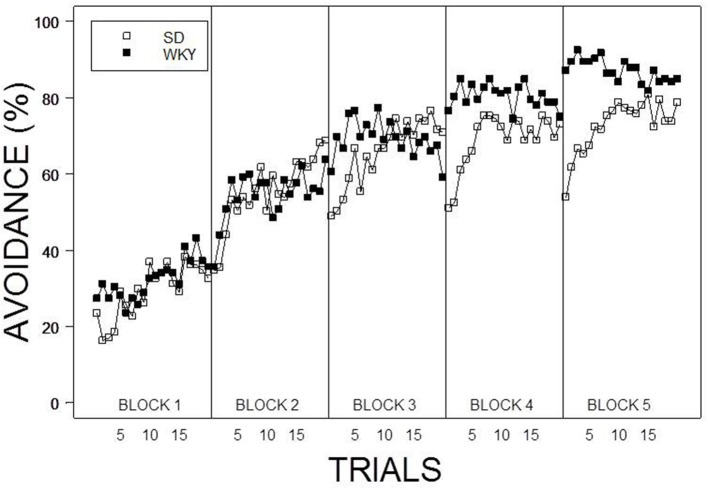
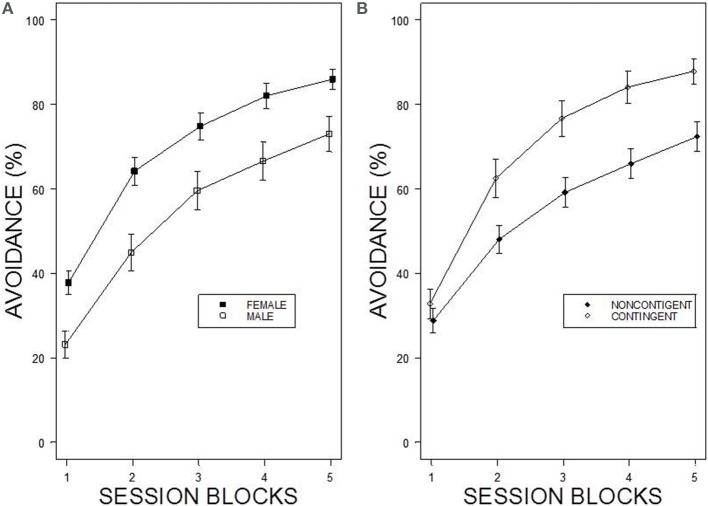
Avoidance is a core feature of anxiety disorders and factors which increase avoidance expression or its resistance represent a source of vulnerability for anxiety disorders. Outbred female Sprague Dawley (SD) rats and inbred male and female Wistar-Kyoto (WKY) rats expressing behaviorally inhibited (BI) temperament learn avoidance faster than male SD rats. The training protocol used in these studies had a longstanding interpretive flaw: a lever-press had two outcomes, termination of the warning signal (WS) and prevention of foot shock. To disambiguate between these two explanations, we conducted an experiment in which: (a) a lever-press terminated the WS and prevented shock, and (b) a lever-press only prevented shock, but did not influence the duration of the WS. Thus, a 2 × 2 × 2 (Strain × Sex × Training) design was employed to assess the degree to which the response contingency of the WS termination influenced acquisition. Male and female SD and WKY rats were matched on acoustic startle reactivity within strain and sex and randomly assigned to the training procedures. In addition, we assessed whether the degree of avoidance acquisition affected estrus cycling in female rats. Consistent with earlier work, avoidance performance of female rats was generally superior to males and WKY rats were superior to SD rats. Moreover, female SD and male WKY rats were roughly equivalent. Female sex and BI temperament were confirmed as vulnerability factors in faster acquisition of avoidance behavior. Avoidance acquisition disrupted estrus cycling with female WKY rats recovering faster than female SD rats. Although termination of the WS appears to be reinforcing, male and female WKY rats still achieved a high degree (greater than 80% asymptotic performance) of avoidance in the absence of the WS termination contingency. Such disambiguation will facilitate determination of the neurobiological basis for avoidance learning and its extinction.
Keywords: Wistar-Kyoto (WKY) rat; anxiety; behavioral inhibition; expectancy; lever-press avoidance; shock avoidance; vulnerability.
Figures
References
-
- American Psychiatric Association. (2000). Diagnostic and Statistical Manual of Mental Disorders, 4th-TR edn. Washington, DC: American Psychiatric Association
-
- Beck K. D., Jiao X., Ricart T. M., Myers C. E., Minor T. R., Pang K. C., et al. (2011). Vulnerability factors in anxiety: strain and sex differences in the use of signals associated with non-threat during the acquisition and extinction of active-avoidance behavior. Prog. Neuropsychopharmacol. Biol. Psychiatry 35, 1659–1670 10.1016/j.pnpbp.2011.05.002 - DOI - PubMed
Grants and funding
LinkOut - more resources
Full Text Sources
Other Literature Sources
