Review
. 2014;20(42):6584-643.
doi: 10.2174/1381612820666140826153913.

Immunotoxins constructed with ribosome-inactivating proteins and their enhancers: a lethal cocktail with tumor specific efficacy

Affiliations
Free PMC article
Review

Immunotoxins constructed with ribosome-inactivating proteins and their enhancers: a lethal cocktail with tumor specific efficacy

Roger Gilabert-Oriol et al. Curr Pharm Des. 2014.
Free PMC article

Abstract

The term ribosome-inactivating protein (RIP) is used to denominate proteins mostly of plant origin, which have N-glycosidase enzymatic activity leading to a complete destruction of the ribosomal function. The discovery of the RIPs was almost a century ago, but their usage has seen transition only in the last four decades. With the advent of antibody therapy, the RIPs have been a subject of extensive research especially in targeted tumor therapies, which is the primary focus of this review. In the present work we enumerate 250 RIPs, which have been identified so far. An attempt has been made to identify all the RIPs that have been used for the construction of immunotoxins, which are conjugates or fusion proteins of an antibody or ligand with a toxin. The data from 1960 onwards is reviewed in this paper and an extensive list of more than 450 immunotoxins is reported. The clinical reach of tumor-targeted toxins has been identified and detailed in the work as well. While there is a lot of potential that RIPs embrace for targeted tumor therapies, the success in preclinical and clinical evaluations has been limited mainly because of their inability to escape the endo/lysosomal degradation. Various strategies that can increase the efficacy and lower the required dose for targeted toxins have been compiled in this article. It is plausible that with the advancements in platform technologies or improved endosomal escape the usage of tumor targeted RIPs would see the daylight of clinical success.


Figures
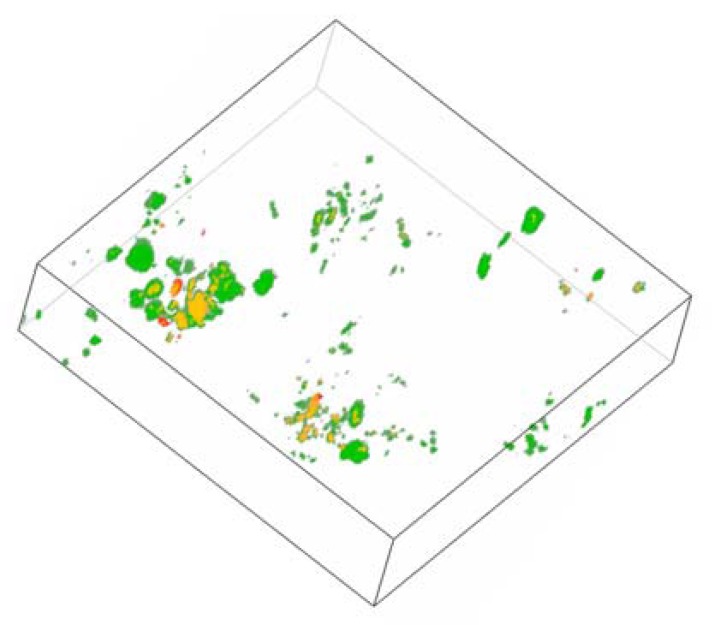
Fig. (1)
Fig. (1)
Three-dimensional depiction (z-stacks) of the endosomal network of ECV-304 cells loaded with Alexasaporin. ECV-304 cells were challenged for 3 h with 1 µM Alexa-Fluor 488 labeled saporin (type I RIP from Saponaria officinalis L.). Cells were co-incubated with pH rodo™ Red Dextran, a marker for endo/lysosomes and analyzed by confocal live cell imaging. Depicted is the endo/lysosomal network of one living ECV-304 cell. Green: Alexasaporin in celular vesicles, red: pHrodo™ Red Dextran in endosomes/lysosomes, yellow: co-localization of Alexasaporin and pHrodo™ Red Dextran in endosomes/lysosomes. The figure illustrates the fact that saporin is internalized and trapped in to the endosomal vesicles, thereafter it is degraded by the endo/lysosomal degradation.
Fig. (2)
Fig. (2)
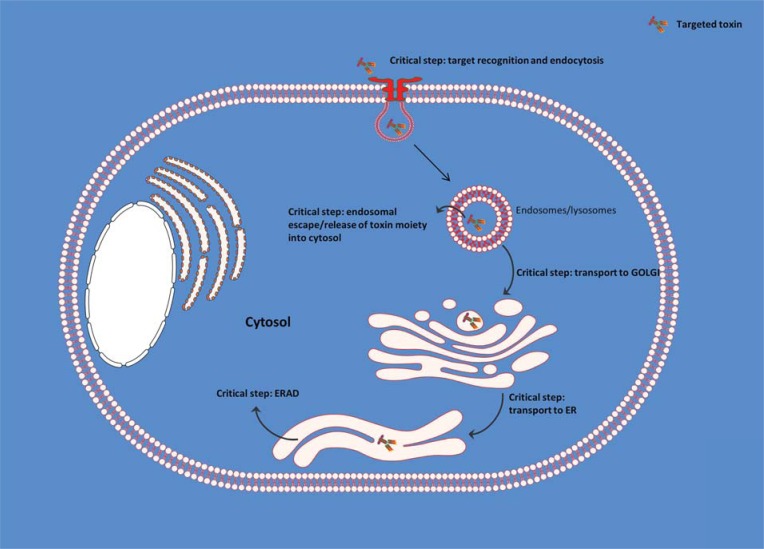
An overview of the steps required for the recognition and internalization of the targeted toxin in the tumor cells. The critical step of target recognition determines the specificity, thereafter the celular machinery takes over and in the ideal case the toxin escapes from the endosomal membrane thus inactivating the ribosomes via N-glycosidase activity.
Fig. (3)
Fig. (3)
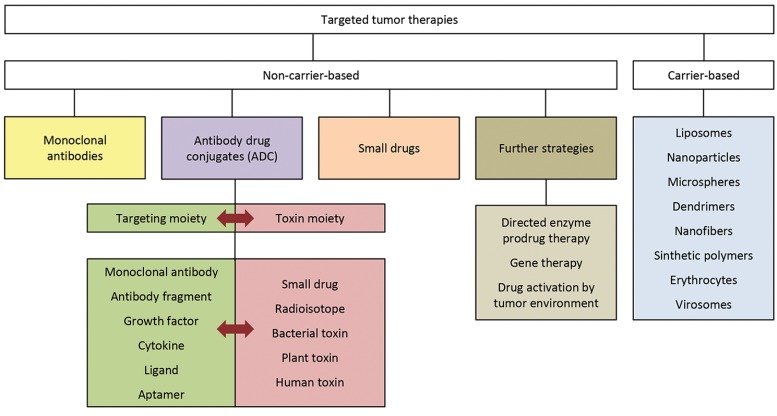
A classification chart summarizing the carrier or non-carrier based approaches for targeted tumor therapy. While targeted toxins fall under the noncarrier based approach, toxins may also be incorporated in inert carriers for better stability.
Fig. (4)
Fig. (4)
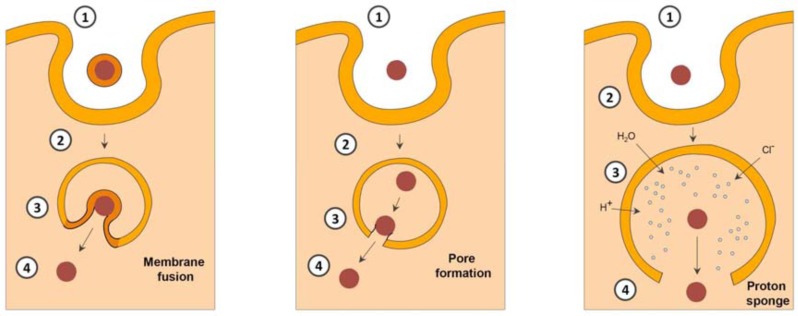
A mechanistic description of the three widely known phenomena for the endosomal escape of molecules. Past internalization the toxin release may be facilitated via membrane fusion, pore formation or proton sponge effect. Table 3 describes in detail all the compounds that facilitate these effects for improving the efficacy of targeted toxins.
Fig. (5)
Fig. (5)
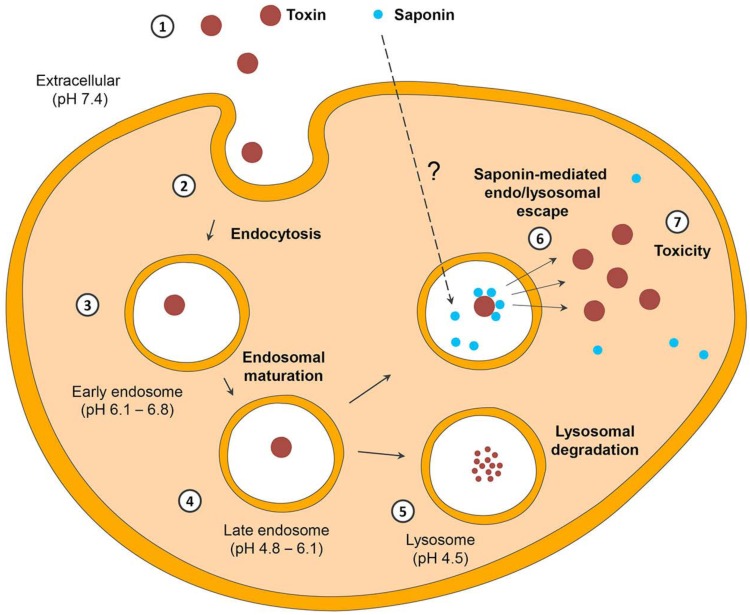
A schematic description for the efficacy enhancement of certain plant type I RIPs using triterpenoidal saponins. 1. The toxin reaches the cell 2. Internalization and formation of endosomal vesicles, 3. Maturation of the endosomal vesicles along with the entrapped toxin, 4. Late endosome formation. 5. The toxin undergoes lysosomal degradation and thus the toxic effect is not elicited. 6. Particular saponins accumulates inside the endo/lysosomes by unknown mechanisms. The presence of saponins faciliates the endo/lysosomal release of the toxin in a pH dependent manner. 7. The toxin induces cell death inside the cytosol via apoptosis.

References

    1. Peumans WJ, Hao Q, Van Damme EJ. Ribosome-inactivating proteins from plants more than RNA N-glycosidasesκ. FASEB J. 2001;15:1493–506. - PubMed
    1. de Virgilio M, Lombardi A, Caliandro R, Fabbrini MS. Ribosome-inactivating proteins from plant defense to tumor attack. Toxins (Basel). 2011;2:2699–737. - PMC - PubMed
    1. Pastan I, Hassan R, Fitzgerald DJ, Kreitman RJ. Immunotoxin therapy of cancer. Nat Rev Cancer. 2006;6:559–65. - PubMed
    1. Hong X, Wang-Yi L. Cinnamonin- a versatile type II ribosome inactivating protein. Acta Biochimica et Biophysica Sinica. 2004;36:169–76. - PubMed
    1. Weng A, Thakur M, von Mallinckrodt B , et al. Saponins modulate the intracellular trafficking of protein toxins. J Control Release. 2012;164:74–86. - PubMed

Publication types

Substances