


Potential role of the airway wall in the asthma of obesity
- PMID: 25342709
- PMCID: PMC4281642
- DOI: 10.1152/japplphysiol.00684.2014
Potential role of the airway wall in the asthma of obesity
Abstract
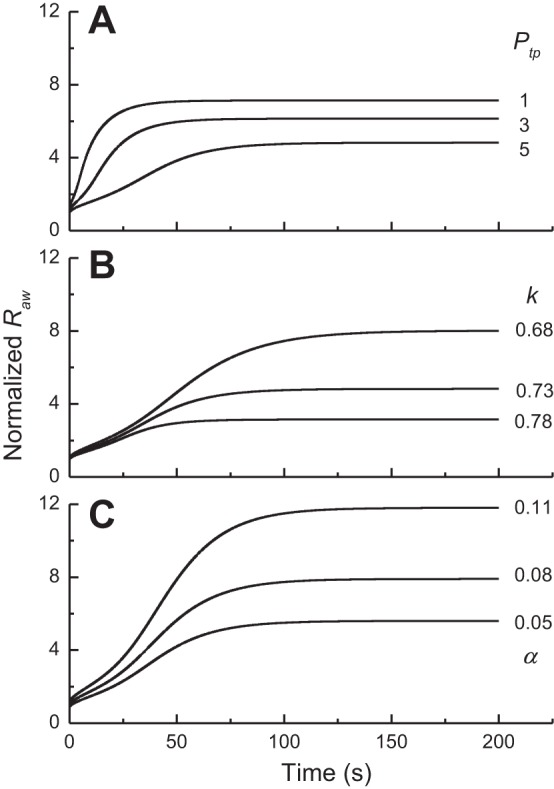
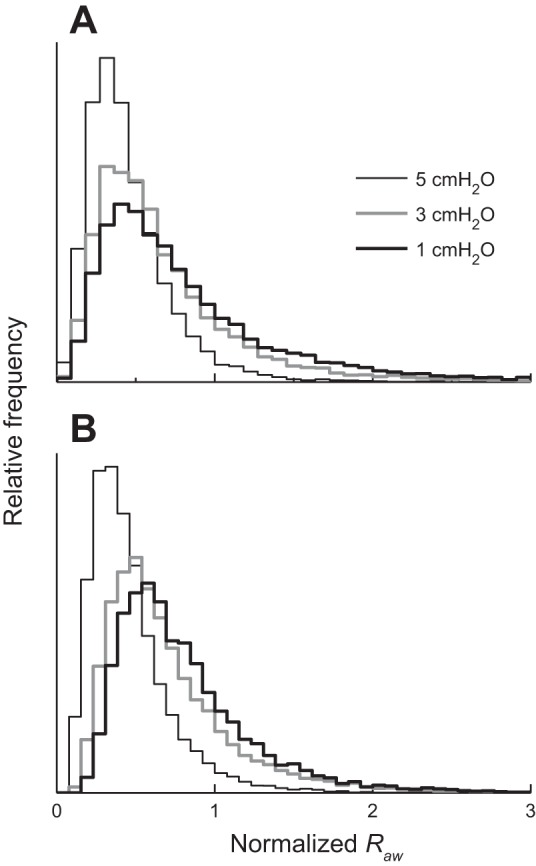
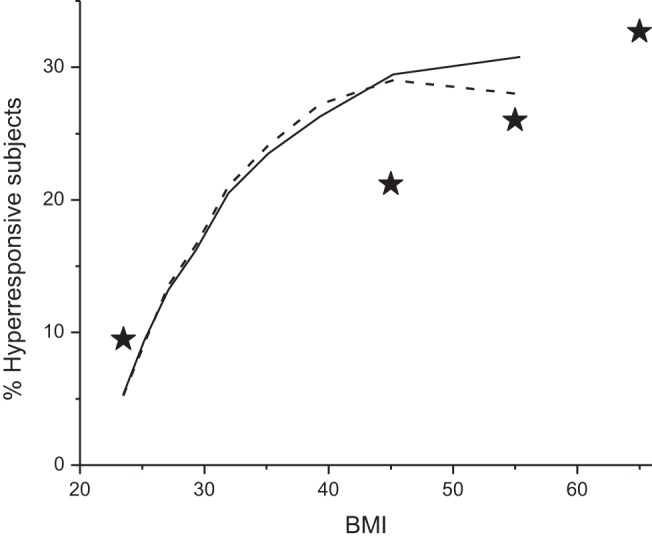
The pathogenesis of late-onset TH2-low asthma in obesity is thought to be related to weight-related decreases in lung volume, but why only a subset of individuals with obesity develop this condition is unknown. We tested the hypothesis that natural variations in both airway wall stiffness and airway wall thickness could lead to a subpopulation of hyperresponsive individuals exhibiting the symptoms of asthma in the setting of obesity. Increases in airway resistance (Raw) after airway smooth muscle stimulation were simulated using a computational model of an elastic airway embedded in elastic parenchyma. Using a range of randomly chosen values for both airway wall stiffness and thickness, we determined the resulting probability distributions of Raw responsiveness for a variety of different levels of transpulmonary pressure (Ptp). As Ptp decreased from 5 to 1 cmH2O, the resulting distributions of Raw moved toward progressively higher levels of responsiveness. With appropriate choices for the mean and standard deviation of the parameter that controls either airway wall stiffness or thickness, the model predicts a relationship between airway hyperresponsiveness and body mass index that is similar to that which has been reported in populations with obesity. We conclude that natural variations in airway wall mechanics and geometry between different individuals can potentially explain why an increasing percentage of the population exhibits the symptoms of asthma as the obesity of the population increases.
Keywords: airway hyperresponsiveness; airway resistance; airway-parenchymal interdependence; computational model.
Copyright © 2015 the American Physiological Society.
Figures
References
-
- Adler A, Bates JH. A micromechanical model of airway-parenchymal interdependence. Ann Biomed Eng 28: 309–317, 2000. - PubMed
-
- Bates JH, Cojocaru A, Lundblad LK. Bronchodilatory effect of deep inspiration on the dynamics of bronchoconstriction in mice. J Appl Physiol 103: 1696–1705, 2007. - PubMed
-
- Bates JH, Lauzon AM. Parenchymal tethering, airway wall stiffness, and the dynamics of bronchoconstriction. J Appl Physiol (1985) 102: 1912–1920, 2007. - PubMed
Publication types
MeSH terms
Grants and funding
LinkOut - more resources
Full Text Sources
Other Literature Sources
Medical
