


Review
doi: 10.2147/IJNRD.S40172.
eCollection 2014.
Diabetic nephropathy - complications and treatment
Affiliations
- PMID: 25342915
- PMCID: PMC4206379
- DOI: 10.2147/IJNRD.S40172
Item in Clipboard
Review
Diabetic nephropathy - complications and treatment
Int J Nephrol Renovasc Dis.
.
Abstract
Diabetic nephropathy is a significant cause of chronic kidney disease and end-stage renal failure globally. Much research has been conducted in both basic science and clinical therapeutics, which has enhanced understanding of the pathophysiology of diabetic nephropathy and expanded the potential therapies available. This review will examine the current concepts of diabetic nephropathy management in the context of some of the basic science and pathophysiology aspects relevant to the approaches taken in novel, investigative treatment strategies.
Keywords: albuminuria; diabetes; diabetic nephropathy; inflammation; kidney disease.
Figures
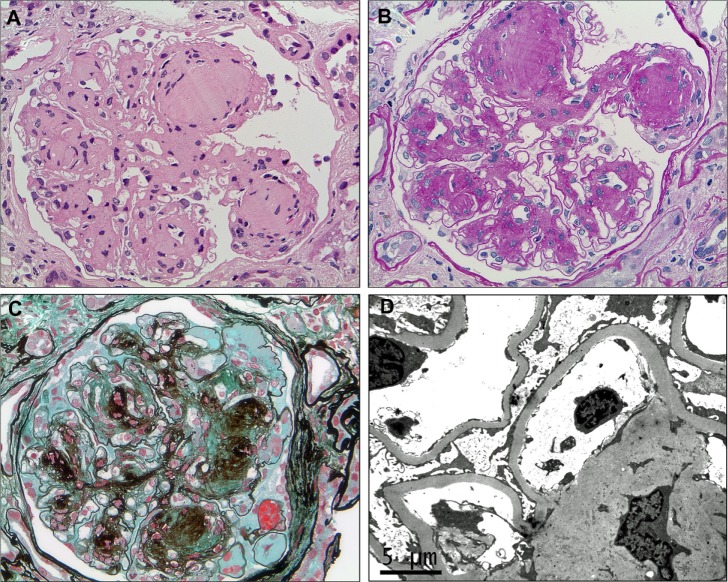
Characteristic histological features of diabetic nephropathy. Notes: In advanced diabetic nephropathy, there is extensive mesangial expansion due to increased extracellular matrix production, with the formation of spherical, eosinophilic nodules with a central hypocellular or acellular area, known as Kimmelstiel–Wilson nodules (A) (hematoxylin–eosin, ×400). These nodules are also typically strongly periodic acid–Schiff-positive and may be seen compressing and narrowing the peripheral capillary loops (B) (periodic acid–Schiff, ×400). The increased matrix stains dark with silver and the Kimmelstiel–Wilson nodules may demonstrate a lamellated appearance. Capillary microaneurysms can be seen at the periphery on the right (in the 1–5 o’clock position), in association with mesangiolysis (C) (Masson’s trichrome–methenamine silver, ×400). There is diffuse thickening of the glomerular basement membrane, which is apparent on electron microscopy even if it is difficult to discern by light microscopy in early disease, and often accompanied by some degree of podocyte foot process effacement (D) (electron microscopy).
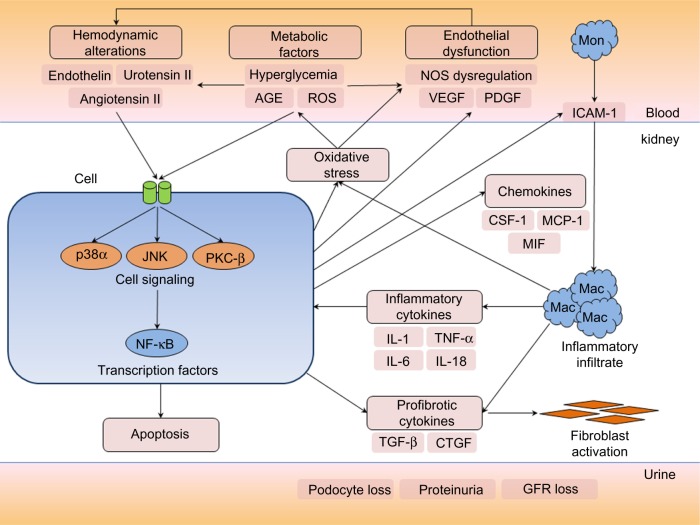
Overview of the pathological pathways in diabetic nephropathy. Notes: In the diabetic milieu, metabolic derangements and hemodynamic alterations, particularly activation of the renin–angiotensin system, trigger a number of cell signaling cascades, including the MAPKs (p38 and JNK) and PKC-β, which mediate a cellular response through activation of key transcription factors such as NF-κB. In response to such signals, renal cells such as tubular epithelial cells, podocytes, and mesangial cells can produce chemokines, growth factors, and profibrotic cytokines. CSF-1 and MCP-1 function as chemotactic molecules and promote the recruitment of monocytes from the circulation. Upregulation of ICAM-1 on endothelial cells – a key leukocyte adhesion molecule – facilitates infiltration of circulating mononuclear cells into the kidney. CSF-1 also promotes monocyte/macrophage differentiation, proliferation, and activation. MIF functions to retain macrophages at sites of inflammation and has counter-regulatory functions against the anti-inflammatory actions of glucocorticoids. Activated macrophages can produce proinflammatory and profibrotic cytokines, reactive oxygen species, and antiangiogenic factors and contribute to a cycle of inflammation, oxidative stress, cellular injury, progressive fibrosis, and loss of glomerular filtration rate. Podocyte loss, endothelial dysfunction, alterations in the GBM, and tubular injury contribute to increasing proteinuria during the development and progression of diabetic nephropathy. Abbreviations: AGE, advanced glycation end-products; GBM, glomerular basement membrane; GFR, glomerular filtration rate; Mac, macrophages; Mon, monocyte; NOS, nitric oxide synthase; ROS, reactive oxygen species.
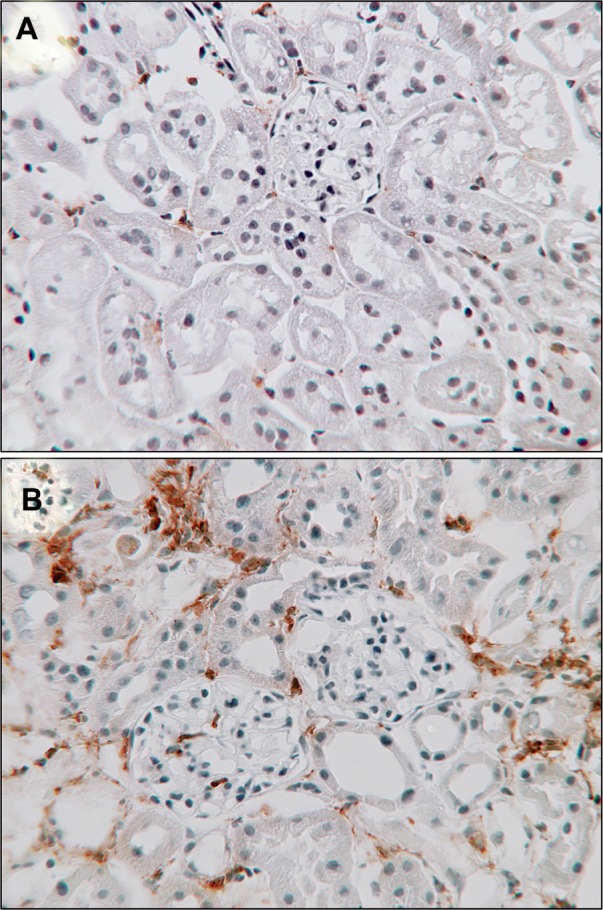
Macrophages in diabetic nephropathy. Notes: Immunostaining for a macrophage marker (CD68) in kidney sections shows sparse interstitial macrophages in age-matched, nondiabetic control mice (A) compared to diabetic mice after 20 weeks of diabetes induced by streptozotocin (B) (CD68 brown, counterstained with hematoxylin, ×250).
References
-
- International Diabetes Federation . IDF Diabetes Atlas. 6th ed. Brussels, Belgium: International Diabetes Federation; 2013. [Accessed September 2, 2014]. Available from: http://www.idf.org/sites/default/files/EN_6E_Atlas_Full_0.pdf.
-
- Centers for Disease Control and Prevention . National diabetes fact sheet: national estimates and general information on diabetes and prediabetes in the United States. Atlanta, GA: US Department of Health and Human Services; 2011. [Accessed September 2, 2014]. Available from: http://www.cdc.gov/diabetes/pubs/pdf/ndfs_2011.pdf.
-
- Tapp RJ, Shaw JE, Zimmet PZ, et al. Albuminuria is evident in the early stages of diabetes onset: results from the Australian Diabetes, Obesity, and Lifestyle Study (AusDiab) Am J Kidney Dis. 2004;44(5):792–798. - PubMed
-
- Scott LJ, Warram JH, Hanna LS, Laffel LM, Ryan L, Krolewski AS. A nonlinear effect of hyperglycemia and current cigarette smoking are major determinants of the onset of microalbuminuria in type 1 diabetes. Diabetes. 2001;50(12):2842–2849. - PubMed
-
- Rossing P, Hougaard P, Parving HH. Risk factors for development of incipient and overt diabetic nephropathy in type 1 diabetic patients: a 10-year prospective observational study. Diabetes Care. 2002;25(5):859–864. - PubMed
Publication types
LinkOut - more resources
Full Text Sources
Other Literature Sources
Medical
