


VIRTUAL REALITY CUE EXPOSURE THERAPY FOR THE TREATMENT OF TOBACCO DEPENDENCE
- PMID: 25342999
- PMCID: PMC4204479
VIRTUAL REALITY CUE EXPOSURE THERAPY FOR THE TREATMENT OF TOBACCO DEPENDENCE
Abstract
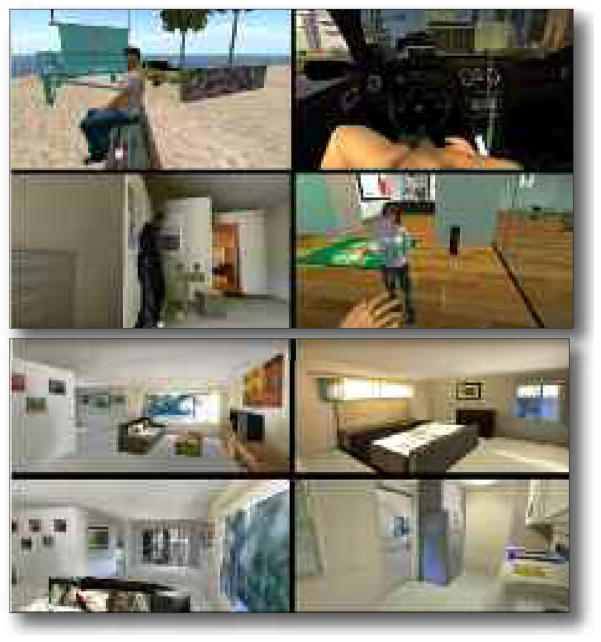
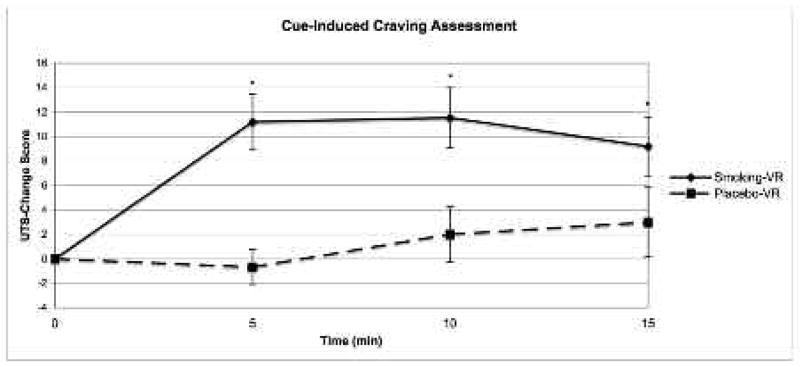
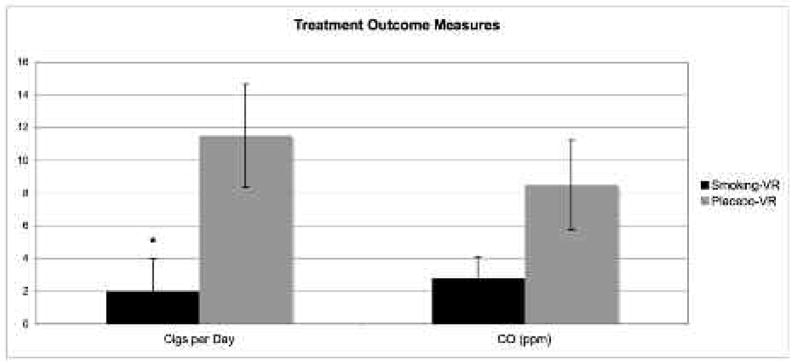
Researchers and clinicians have recently begun using Virtual Reality (VR) to create immersive and interactive cue exposure paradigms. The current study aimed to assess the effectiveness of individual cue exposure therapy (CET), using smoking-related VR cues (smoking-VR) as a smoking cessation treatment compared to a placebo-VR (neutral cue) treatment. The sample consisted of healthy treatment-seeking cigarette smokers, who underwent bi-weekly cognitive behavioral group therapy (CBT) plus either smoking-VR CET or placebo-VR CET (random assignment). Smoking-VR CET participants had a higher quit rate than placebo-VR CET participants (P = 0.015). Smoking-VR CET treated participants also reported smoking significantly fewer cigarettes per day at the end of treatment than placebo-VR CET treated participants (P = 0.034). These data indicate that smoking-related VR CET may prove useful in enhancing the efficacy of CBT treatment for tobacco dependence.
Keywords: Cognitive-behavioral Therapy; Nicotine; Smoking Cessation; Tobacco Dependence; Virtual Reality.
Figures
References
-
- Abrams DB, Monti PM, Carey KB, Pinto RP, Jacobus SI. Re activity to smoking cues and relapse: two studies of discriminant validity. Behav Res Ther. 1988;26(3):225–233. - PubMed
-
- Abrams DB, Monti PM, Pinto RP, Elder JP, Brown RA, Jacobus SI. Psychosocial stress and coping in smokers who relapse or quit. Health Psychol. 1987;6(4):289–303. - PubMed
-
- Abrams DB, Niaura RS, Brown RA, Emmons KM, Goldstein MG, Monti PM. The Tobacco Dependence Treatment Handbook: A Guide to Best Practices. The Guilford Press; 2003.
-
- Baumann SB, Sayette MA. Smoking cues in a virtual world provoke craving in cigarette smokers. Psychol Addict Behav. 2006;20(4):484–489. - PubMed
-
- Berman JS, Katzev RD. Factors involved in the rapid elimination of avoidance behavior. Behav Res Ther. 1972;10(3):247–256. - PubMed
Grants and funding
LinkOut - more resources
Full Text Sources