Review
. 2014 Sep 4:6:73.
doi: 10.12703/P6-73. eCollection 2014.

Leptin signaling

Affiliations
Review

Leptin signaling

Hyeong-Kyu Park et al. F1000Prime Rep. .

Abstract

Leptin is secreted by adipose tissue and regulates energy homeostasis, glucose and lipid metabolism, immune function, and other systems. The binding of leptin to its specific receptor activates various intracellular signaling pathways, including Janus kinase 2 (JAK2)/ signal transducer and activator of transcription 3 (STAT3), insulin receptor substrate (IRS)/phosphatidylinositol 3 kinase (PI3K), SH2-containing protein tyrosine phosphatase 2 (SHP2)/mitogen-activated protein kinase (MAPK), and 5' adenosine monophosphate-activated protein kinase (AMPK)/ acetyl-CoA carboxylase (ACC), in the central nervous system and peripheral tissues. Understanding of leptin signaling provides insights into its roles in health and disease.


Figures
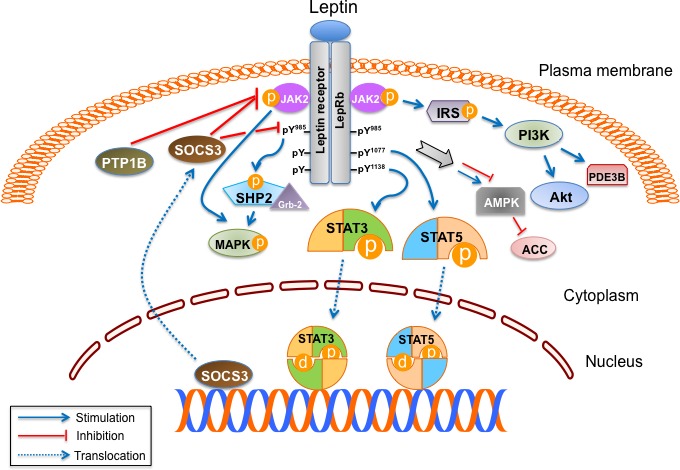
Figure 1.
Figure 1.. Multiple leptin signaling pathways
The binding of leptin to the long isoform of leptin receptor (LepRb) results in its dimerization, leading to the formation of the LepRb/Janus kinase 2 (JAK2) complex. The activated JAK2 phosphorylates itself and also Tyr985, Tyr1077, and Tyr1138 in LepRb. Signal transducer and activator of transcription (STAT) 3 and STAT5 bind to phospho-Tyr1138 and phospho-Tyr1077 in LepRb and are subsequently phosphorylated. Active STAT3 and STAT5 dimers then translocate to the nucleus and activate the transcription of their target genes, which mediate leptin's anorexigenic effect. Suppressor of cytokine signaling 3 (SOCS3), a target gene of STAT3, inhibits the JAK2/STAT3 pathway by interacting with phospho-Tyr985 or JAK2 and acting as a feedback inhibitor of leptin signaling. Protein tyrosine phosphatase 1B (PTP1B) also inhibits leptin signaling through dephosphorylation of JAK2. After JAK2 activation, SH2-containing protein tyrosine phosphatase 2 (SHP2) binds to phospho-Tyr985 in the LepRb and recruits the adaptor protein growth factor receptor-bound protein 2 (Grb2), leading to activation of the mitogen-activated protein kinase (MAPK) signaling cascade. Leptin activates MAPK independent of SHP2 and also regulates phosphatidylinositol 3 kinase (PI3K) signaling through insulin receptor substrate (IRS) phosphorylation. Forkhead box O1 (FoxO1), mammalian target of rapamycin (mTOR), and phosphodiesterase 3B (PDE3B) are important downstream targets of PI3K in the leptin signaling pathway. Leptin regulates feeding and metabolism through 5' adenosine monophosphate-activated protein kinase (AMPK) and acetyl-CoA carboxylase (ACC) in the brain and peripheral organs.
Figure 2.
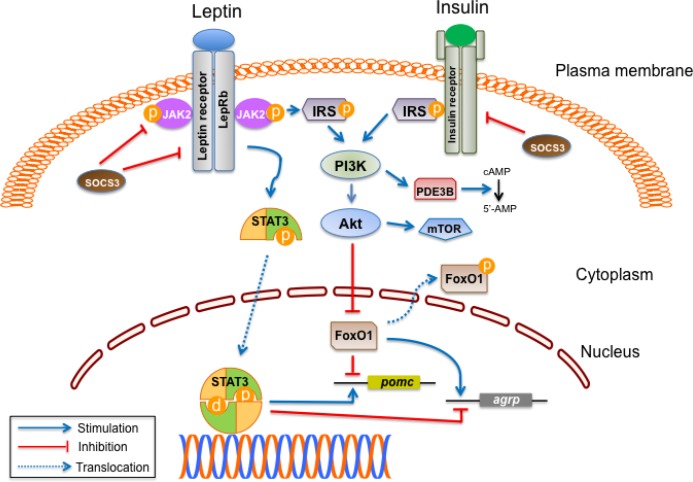
Figure 2.. Interactions of leptin and insulin signaling in hypothalamus
Leptin activates signal transducer and activator of transcription (STAT) 3 when it binds to the long isoform of leptin receptor (LepRb) in the arcuate nucleus, ventromedial hypothalamus, and other hypothalamic neurons. Activated STAT3 stimulates pomc expression and inhibits agrp expression in the hypothalamus. Leptin and insulin signaling pathways converge on phosphatidylinositol 3 kinase (PI3K). Activation of PI3K by either leptin or insulin leads to phosphorylation of Forkhead box O1 (FoxO1) through Akt, which can also activate the mammalian target of rapamycin (mTOR). Inactivation of FoxO1 by phosphorylation results in its export from the nucleus and allows for the binding of STAT3 to pomc or agrp promoter. In addition, the leptin-mediated activation of PI3K recruits phosphodiesterase 3B (PDE3B), thereby reducing cAMP (cyclic adenosine monophosphate) levels. STAT3 increases the expression of suppressor of cytokine signaling 3 (SOCS3), which leads to feedback inhibition of leptin and insulin signaling. Abbreviation: JAK2, Janus kinase 2.

References

    1. Dardeno TA, Chou SH, Moon H, Chamberland JP, Fiorenza CG, Mantzoros CS. Leptin in human physiology and therapeutics. Front Neuroendocrinol. 2010;31:377–93. doi: 10.1016/j.yfrne.2010.06.002. - DOI - PMC - PubMed
    1. Dalamaga M, Chou SH, Shields K, Papageorgiou P, Polyzos SA, Mantzoros CS. Leptin at the intersection of neuroendocrinology and metabolism: current evidence and therapeutic perspectives. Cell Metab. 2013;18:29–42. doi: 10.1016/j.cmet.2013.05.010. - DOI - PubMed
    1. Moon H, Dalamaga M, Kim S, Polyzos SA, Hamnvik O, Magkos F, Paruthi J, Mantzoros CS. Leptin's role in lipodystrophic and nonlipodystrophic insulin-resistant and diabetic individuals. Endocr Rev. 2013;34:377–412. doi: 10.1210/er.2012-1053. - DOI - PMC - PubMed
    1. Ahima RS, Osei SY. Leptin signaling. Physiol Behav. 2004;81:223–41. doi: 10.1016/j.physbeh.2004.02.014. - DOI - PubMed
    1. Kelesidis T, Kelesidis I, Chou S, Mantzoros CS. Narrative review: the role of leptin in human physiology: emerging clinical applications. Ann Intern Med. 2010;152:93–100. doi: 10.7326/0003-4819-152-2-201001190-00008. - DOI - PMC - PubMed