


Serum levels of leptin receptor in patients with systemic sclerosis
- PMID: 25343103
- PMCID: PMC4204583
- DOI: 10.5582/irdr.2013.v2.2.55
Serum levels of leptin receptor in patients with systemic sclerosis
Abstract
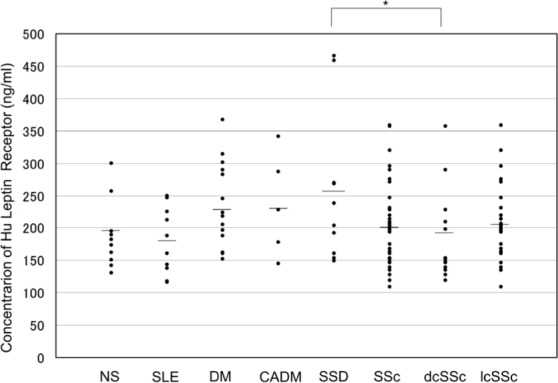
Microvascular damage is one of the primary pathologic components of systemic sclerosis (SSc). Serological abnormalities of angiogenic and angiostatic factors in SSc have previously been described. Like these factors, the plasma levels of leptin were significantly elevated in patients with SSc in comparison to normal controls. However, leptin receptor has not been examined in patients with SSc. The current study used sandwich ELISA to evaluate the serum levels of leptin receptor in patients with SSc. Serum samples were obtained from 36 patients with SSc. Samples were also obtained from 12 healthy control subjects and 10 patients with scleroderma spectrum disorder (SSD) who did not fulfill the criteria for SSc but who had the potential to develop SSc. Mean serum leptin receptor levels were significantly higher in patients with SSD than in patients with SSc (255.7 ng/mL vs. 184.6 ng/mL, p < 0.05 according to a Mann-Whitney test). There were no statistically significant differences between healthy control subjects and patients with SSc. Clinical parameters were evaluated, and the frequency of esophageal reflux was significantly lower in patients with elevated serum leptin receptor levels than in those with reduced levels (6.3% vs. 35.3%, p < 0.05). In summary, these results suggest that the serum levels of leptin receptor are a clinically useful marker of SSD, and measurement of serum leptin receptor over time in patients with SSD may lead to early detection of SSc.
Keywords: ELISA; Leptin receptor; scleroderma spectrum disorder; systemic sclerosis.
Figures
References
-
- Korn JH. Immunologic aspects of scleroderma. Curr Opin Rheumatol. 1989; 1:479-484 - PubMed
-
- Mauch C, Kreig T. Fibroblast-matrix interactions and their role in the pathogenesis of fibrosis. Rheum Dis Clin North Am. 1990; 16:93-107 - PubMed
-
- Distler O, Distler JH, Scheid A, Acker T, Hirth A, Rethage J, Michel BA, Gay RE, Müller-Ladner U, Matucci-Cerinic M, Plate KH, Gassmann M, Gay S. Uncontrolled expression of vascular endothelial growth factor and its receptors leads to insufficient skin angiogenesis in patients with systemic sclerosis. Circ Res. 2004; 95:109-116 - PubMed
-
- Davies CA, Jeziorska M, Freemont AJ, Herrick AL. The differential expression of VEGF, VEGFR-2, and GLUT-1 proteins in disease subtypes of systemic sclerosis. Hum Pathol. 2006; 37:190-197 - PubMed
-
- Riccieri V, Stefanantoni K, Vasile M, Macrì V, Sciarra I, Iannace N, Alessandri C, Valesini G. Abnormal plasma levels of different angiogenic molecules are associated with different clinical manifestations in patients with systemic sclerosis. Clin Exp Rheumatol. 2011; 29(Suppl 65):S46-S52 - PubMed
LinkOut - more resources
Full Text Sources
Other Literature Sources