


Incidence, impact, and predictors of cranial nerve palsy and haematoma following carotid endarterectomy in the international carotid stenting study
- PMID: 25344019
- PMCID: PMC4225222
- DOI: 10.1016/j.ejvs.2014.08.002
Incidence, impact, and predictors of cranial nerve palsy and haematoma following carotid endarterectomy in the international carotid stenting study
Abstract
Objective: Cranial nerve palsy (CNP) and neck haematoma are complications of carotid endarterectomy (CEA). The effects of patient factors and surgical technique were analysed on the risk, and impact on disability, of CNP or haematoma in the surgical arm of the International Carotid Stenting Study (ICSS), a randomized controlled clinical trial of stenting versus CEA in patients with symptomatic carotid stenosis.
Materials and methods: A per-protocol analysis of early outcome in patients receiving CEA in ICSS is reported. Haematoma was defined by the surgeon. CNP was confirmed by an independent neurologist. Factors associated with the risk of CNP and haematoma were investigated in a binomial regression analysis.
Results: Of the patients undergoing CEA, 45/821 (5.5%) developed CNP, one of which was disabling (modified Rankin score = 3 at 1 month). Twenty-eight (3.4%) developed severe haematoma. Twelve patients with haematoma also had CNP, a significant association (p < .01). Independent risk factors modifying the risk of CNP were cardiac failure (risk ratio [RR] 2.66, 95% CI 1.11 to 6.40), female sex (RR 1.80, 95% CI 1.02 to 3.20), the degree of contralateral carotid stenosis, and time from randomization to treatment >14 days (RR 3.33, 95% CI 1.05 to 10.57). The risk of haematoma was increased in women, by the prescription of anticoagulant drugs pre-procedure and in patients with atrial fibrillation, and was decreased in patients in whom a shunt was used and in those with a higher baseline cholesterol level.
Conclusions: CNP remains relatively common after CEA, but is rarely disabling. Women should be warned about an increased risk. Attention to haemostasis might reduce the incidence of CNP. ICSS is a registered clinical trial: ISRCTN 25337470.
Keywords: Carotid artery stenosis; Carotid atherosclerosis; Carotid endarterectomy; Cranial nerves; Haematoma.
Copyright © 2014. Published by Elsevier Ltd.
Figures
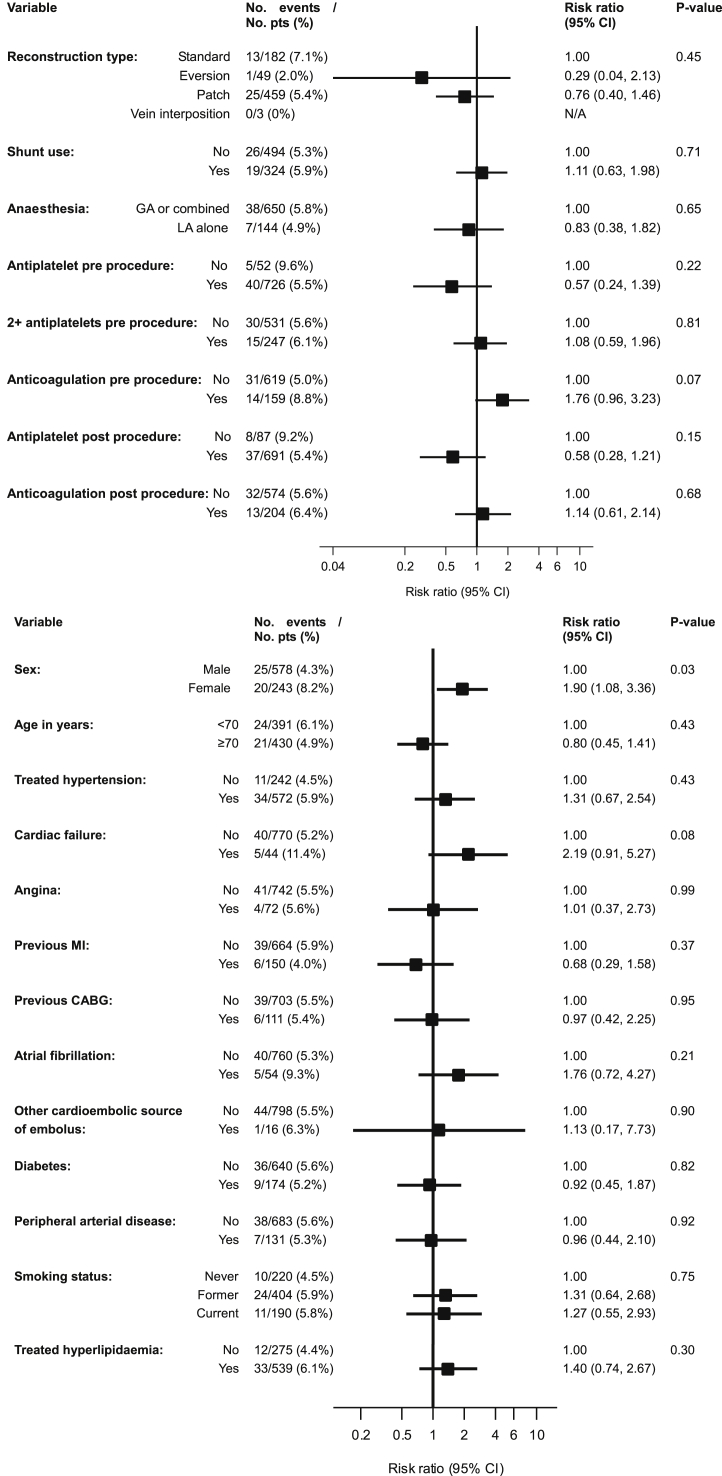
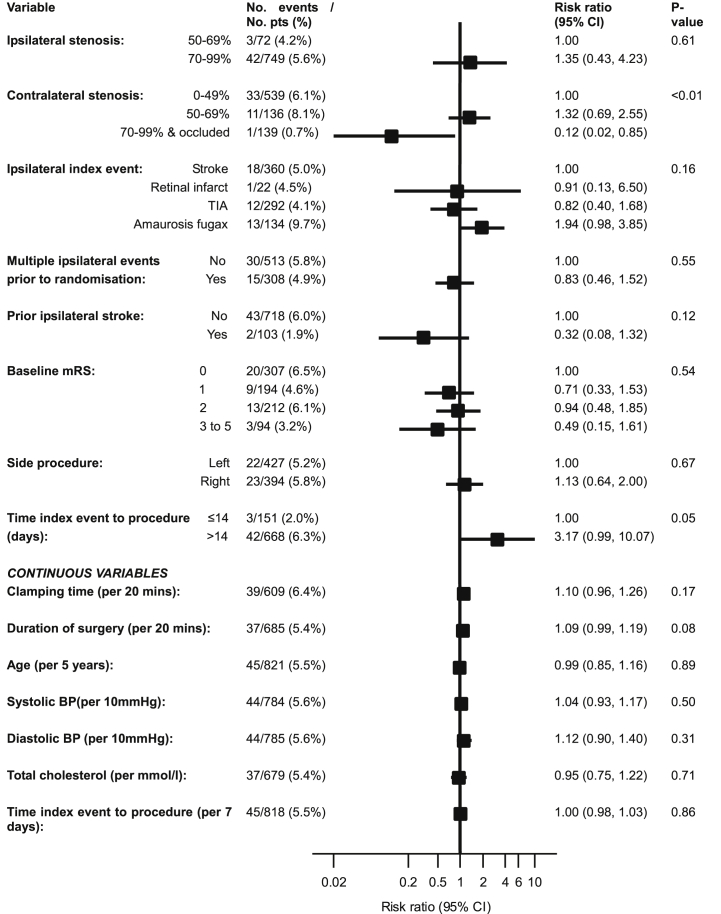
References
-
- Rerkasem K., Rothwell P.M. Systematic review of randomized controlled trials of carotid endarterectomy for symptomatic carotid stenosis. Stroke. 2011;42:e543–e544. - PubMed
-
- Liapis C.D., Sir Bell P.R.F., Mikhailidis D., Sivenius J., Nicolaides A., Fernandes e Fernandes J., on behalf of the ESVS Guidelines Collaborators ESVS guidelines. Invasive treatment of carotid stenosis: indications, techniques. Eur J Vasc Endovasc Surg. 2009;37:S1–S19. - PubMed
-
- Rothwell P.M., Eliasziw M., Gutnikov S.A., Fox A.J., Taylor D.W., Mayber M.R., for the Carotid Endarterectomy Trialists' Collaboration Analysis of pooled data from the randomized controlled trials of endarterectomy for symptomatic carotid stenosis. Lancet. 2003;361:107–116. - PubMed
-
- Massey E.W., Heyman A., Utley C., Haynes C., Fuchs J. Cranial nerve paralysis following carotid endarterectomy. Stroke. 1984;15:157–159. - PubMed
-
- Greenstein A.J., Chassin M.R., Wang J., Rockman C.B., Riles T.S., Tuhrim S. Association between minor and major surgical complications after carotid endarterectomy: results of the New York Carotid Artery Surgery Study. J Vasc Surg. 2007;46:1138–1146. - PubMed
Publication types
MeSH terms
Associated data
Grants and funding
LinkOut - more resources
Full Text Sources
Other Literature Sources
