. 2015 Jan;388(1):79-86.
doi: 10.1007/s00210-014-1061-6. Epub 2014 Oct 26.

Neuroprotective effect of masitinib in rats with postischemic stroke

Affiliations

Neuroprotective effect of masitinib in rats with postischemic stroke

Ivan Kocic et al. Naunyn Schmiedebergs Arch Pharmacol. 2015 Jan.

Abstract

This study evaluated the therapeutic potential of masitinib, an oral tyrosine kinase inhibitor with activity against c-Kit and platelet-derived growth factor receptors (PDGFR), to reduce ischemic brain area and neurological deficit. Using a well-established filament model of ischemic stroke in rats, the responses to oral treatment with masitinib alone or in combination with recombinant tissue plasminogen activator (rt-PA) were compared to those after rt-PA (10 mg/kg intravenously (i.v.)) monotherapy. In both cases, two doses of masitinib were used--25 or 100 mg/kg, twice per day. Ischemic brain area and the neurological deficit were assessed using the triphenyltetrazolium chloride (TTC) method and behavioral neurological tests, respectively. Masitinib, as a single agent, reduced significantly the infarct size, as compared with the stroke control group. Brain ischemic area decreased from 9.14 to 4.36 % (25 mg/kg) or 2.60 % (100 mg/kg). Moreover, a combined treatment of masitinib with rt-PA produced a stronger effect than the one observed after each of the compound alone. The size of the brain ischemic area (rt-PA 1.67 %) was further reduced to 0.83 or 0.7 % at masitinib doses of 25 and 100 mg/kg, respectively. Masitinib reduced significantly brain ischemia induced by experimental stroke and potentiated the therapeutic effect of rt-PA.


Figures
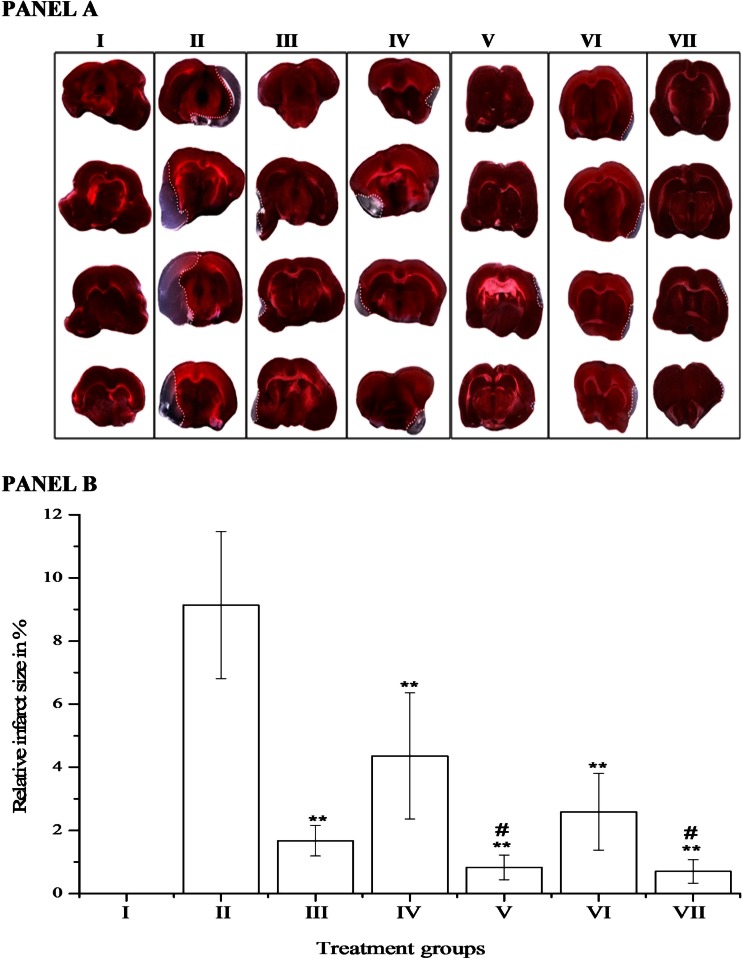
Fig. 1
Fig. 1
TTC images of brain sections and relative infarct size in experimental groups. a and b I—basic control group (BCG); II—stroke control group (SCG); III—rt-PA monotherapy; IV—masitinib (25 mg/kg) monotherapy; V—masitinib (25 mg/kg) + rt-PA; VI—masitinib (100 mg/kg) monotherapy; and VII—masitinib (100 mg/kg) + rt-PA. All data in (b) represent the mean ± S.E.M. **p < 0.01, statistically significant, as compared to stroke control group (SCG); #p < 0.05, statistically significant, as compared to rt-PA monotherapy group

References

    1. Anastassiadis T, Deacon SW, Devarajan K, Ma H, Peterson JR. Comprehensive assay of kinase catalytic activity reveals features of kinase inhibitor selectivity. Nat Biotechnol. 2011;11:1039–1045. doi: 10.1038/nbt.2017. - DOI - PMC - PubMed
    1. Bederson JB, Pitts LH, Tsuji M, Nishimura MC, Davis RL, Bartkowski H. Rat middle cerebral artery occlusion: evaluation of the model and development of a neurologic examination. Stroke. 1986;17:472–476. doi: 10.1161/01.STR.17.3.472. - DOI - PubMed
    1. Bederson JB, Pitts LH, Germano SM, Nishimura MC, Davis RL, Bartkowski HM. Evaluation of 2,3,5-triphenyltetrazolium chloride as a stain for detection and quantification of experimental cerebral infarction in rats. Stroke. 1986;17:1304–1308. doi: 10.1161/01.STR.17.6.1304. - DOI - PubMed
    1. Bereczki D, Liu M, Prado GF, Fekete I. Cochrane report: a systematic review of mannitol therapy for acute ischemic stroke and cerebral parenchymal hemorrhage. Stroke. 2000;31:2719–2722. doi: 10.1161/01.STR.31.11.2719. - DOI - PubMed
    1. Chu X, Qi C, Zou L, Fu X. Intraluminal suture occlusion and ligation of the distal branch of internal carotid artery: an improved rat model of focal cerebral ischemia-reperfusion. J Neurosci Meth. 2008;158:1–7. doi: 10.1016/j.jneumeth.2007.08.030. - DOI - PubMed

Publication types
