


Ginseng extract and ginsenoside Rb1 attenuate carbon tetrachloride-induced liver fibrosis in rats
- PMID: 25344394
- PMCID: PMC4216840
- DOI: 10.1186/1472-6882-14-415
Ginseng extract and ginsenoside Rb1 attenuate carbon tetrachloride-induced liver fibrosis in rats
Abstract
Background: Ginsenosides, the major bioactive compounds in ginseng root, have been found to have antioxidant, immunomodulatory and anti-inflammatory activities. This study investigated the effects of ginsenosides on carbon tetrachloride (CCl4)-induced hepatitis and liver fibrosis in rats.
Methods: Male Sprague-Dawley rats were randomly divided into four groups: control, CCl4, CCl4 + 0.5 g/kg Panax ginseng extract and CCl4 + 0.05 g/kg ginsenoside Rb1 groups. The treated groups were orally given Panax ginseng extract or ginsenoside Rb1 two weeks before the induction of liver injury for successive 9 weeks. Liver injury was induced by intraperitoneally injected with 400 ml/l CCl4 at a dose of 0.75 ml/kg body weight weekly for 7 weeks. The control group was intraperitoneally injected with olive oil.
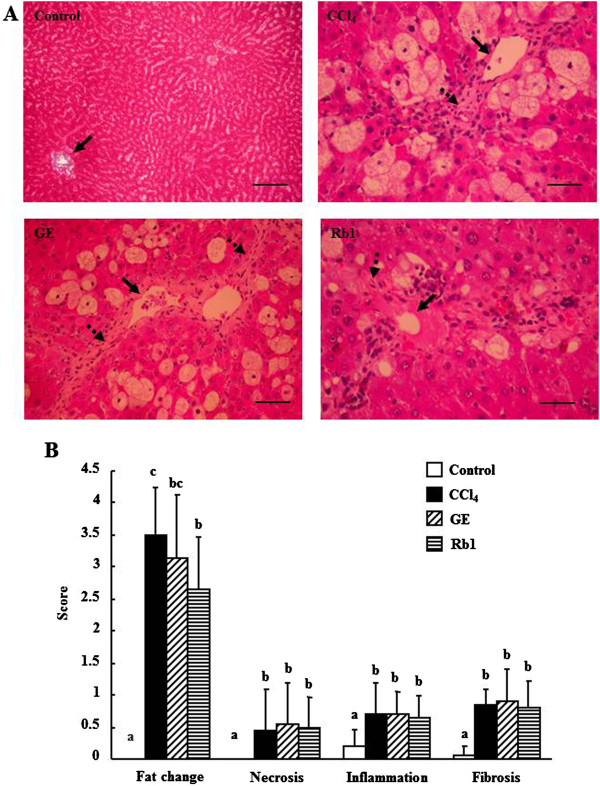
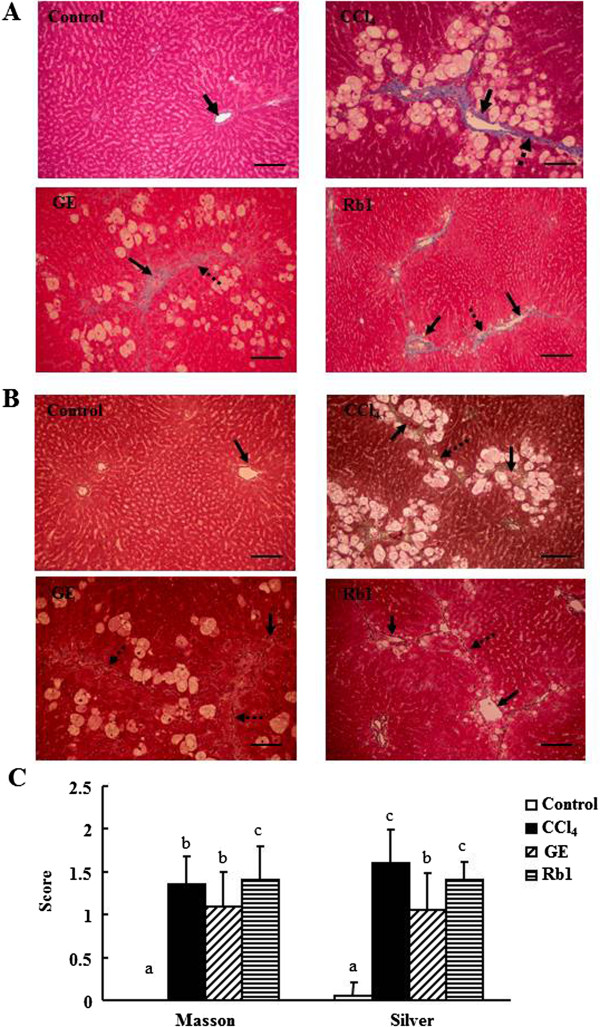
Results: The pathological results showed that ginsenoside Rb1 decreased hepatic fat deposition (2.65 ± 0.82 vs 3.50 ± 0.75, p <0.05) and Panax ginseng extract lowered hepatic reticular fiber accumulation (1.05 ± 0.44 vs 1.60 ± 0.39, p <0.01) increased by CCl4. Plasma alanine aminotransferase and aspartate aminotransferase activities were increased by CCl4 (p <0.01), and aspartate aminotransferase activity was decreased by Panax ginseng extract at week 9 (p <0.05). Exposure to CCl4 for 7 weeks, the levels of plasma and hepatic triglycerides (p <0.01), hepatic cholesterol (p <0.01), interleukin-1β (p <0.01), prostaglandin E2 (p <0.05), soluble intercellular adhesion molecule-1 (p <0.05), hydroxyproline (p <0.05), matrix metalloproteinase-2 (p <0.05) and tissue inhibitor of metalloproteinase-1 (TIMP-1) (p <0.01) were elevated, however, hepatic interleukin-10 level was lowered (p <0.05). Both Panax ginseng extract and ginsenoside Rb1 decreased plasma and hepatic triglyceride, hepatic prostaglandin E2, hydroxyproline and TIMP-1 levels, and Panax ginseng extract further inhibited interleukin-1β concentrations (p <0.05).
Conclusions: Panax ginseng extract and ginsenoside Rb1 attenuate plasma aminotransferase activities and liver inflammation to inhibit CCl4-induced liver fibrosis through down-regulation of hepatic prostaglandin E2 and TIMP-1.
Figures


References
-
- Neubauer K, Saile B, Ramadori G. Liver fibrosis and altered matrix synthesis. Can J Gastroenterol. 2001;15(3):187–193. - PubMed
-
- Lu SN, Su WW, Yang SS, Chang TT, Cheng KS, Wu JC, Lin HH, Wu SS, Lee CM, Changchien CS, Chen CJ, Sheu JC, Chen DS, Chen CH. Secular trends and geographic variations of hepatitis B virus and hepatitis C virus-associated hepatocellular carcinoma in Taiwan. Int J Cancer. 2006;119(8):1946–1952. doi: 10.1002/ijc.22045. - DOI - PubMed
Pre-publication history
-
- The pre-publication history for this paper can be accessed here:http://www.biomedcentral.com/1472-6882/14/415/prepub
Publication types
MeSH terms
Substances
LinkOut - more resources
Full Text Sources
Other Literature Sources
Medical
Research Materials
Miscellaneous
