


Protocol for developing the evidence base for a national salt reduction programme for India
- PMID: 25344488
- PMCID: PMC4212187
- DOI: 10.1136/bmjopen-2014-006629
Protocol for developing the evidence base for a national salt reduction programme for India
Abstract
Introduction: The scientific evidence base in support of salt reduction is strong but the data required to translate these insights into reduced population salt intake are mostly absent. The aim of this research project is to develop the evidence base required to formulate and implement a national salt reduction programme for India.
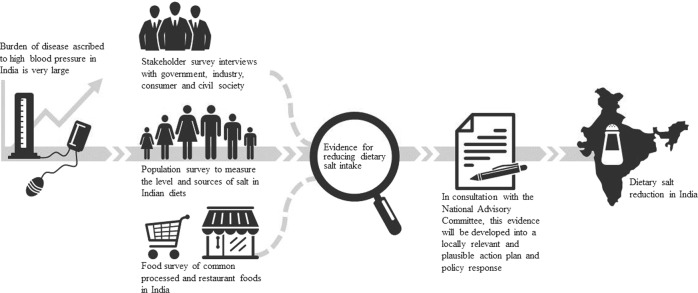
Methods and analysis: The research will comprise three components: a stakeholder analysis involving government, industry, consumers and civil society organisations; a population survey using an age-stratified and sex-stratified random samples drawn from urban (slum and non-slum) and rural areas of North and South India; and a systematic quantitative evaluation of the nutritional components of processed and restaurant foods. The stakeholder interviews will be analysed using qualitative methods to summarise the main themes and define the broad range of factors influencing the food environment in India. The population survey will estimate the mean daily salt consumption through the collection of 24 h urine samples with concurrent dietary surveys identifying the main sources of dietary sodium/salt. The survey of foods will record the nutritional composition of the chief elements of food supply. The findings from this research will be synthesised and proposals for a national salt reduction strategy for India will be developed in collaboration with key stakeholders.
Ethics and dissemination: This study has been approved by the Human Research Ethics Committees of the University of Sydney and the Centre for Chronic Disease Control in New Delhi, and also by the Indian Health Ministry's Screening Committee. The project began fieldwork in February 2014 and will report the main results in 2016. The findings will be targeted primarily at public health policymakers and advocates, but will be disseminated widely through other mechanisms including conference presentations and peer-reviewed publications, as well as to the participating communities.
Keywords: EPIDEMIOLOGY.
Published by the BMJ Publishing Group Limited. For permission to use (where not already granted under a licence) please go to http://group.bmj.com/group/rights-licensing/permissions.
Figures
References
-
- WHO. The world health report 2002: reducing risks, promoting healthy life. World Health Organization, 2002 - PubMed
-
- Asaria P, Chisholm D, Mathers C, et al. Chronic disease prevention: health effects and financial costs of strategies to reduce salt intake and control tobacco use. Lancet 2007;370:2044–53 - PubMed
-
- Srinath Reddy K, Shah B, Varghese C, et al. Responding to the threat of chronic diseases in India. Lancet 2005;366:1744–9 - PubMed
-
- WHO. Reducing salt intake in populations: report of a WHO forum and technical meeting, 5–7 October 2006, Paris, France, 2007
Publication types
MeSH terms
Substances
Grants and funding
LinkOut - more resources
Full Text Sources
Other Literature Sources
Medical
