


Follow-up and clinical significance of unsatisfactory liquid-based Papanicolaou tests
- PMID: 25346238
- PMCID: PMC4356524
- DOI: 10.1002/cncy.21490
Follow-up and clinical significance of unsatisfactory liquid-based Papanicolaou tests
Abstract
Background: To the authors' knowledge, few studies to date have examined adherence to recommended guidelines for follow-up and outcomes after an unsatisfactory Papanicolaou (Pap) test (UPT) with liquid-based technologies.
Methods: Within 4 US health plans, the median time to follow-up and the percentage of patients with follow-up testing by 120 days was calculated after a UPT. Multivariable analyses evaluated the association between clinical factors and follow-up testing. The authors compared the risk of a diagnosis of cervical intraepithelial neoplasia of type 2 or worse (CIN2+) after a UPT with the risk after a satisfactory Pap test while controlling for study site, test year, and other covariates.
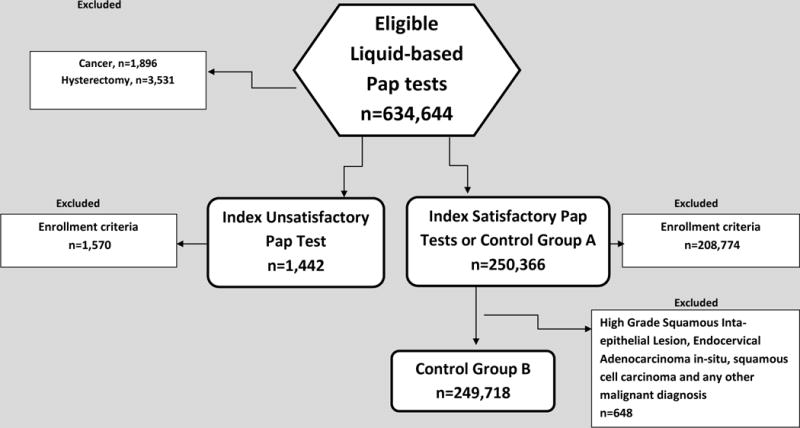
Results: A total of 634,644 Pap tests performed between 2004 and 2010 were included in the current study. Of 1442 UPTs, 53.4% had follow-up testing within 120 days; follow-up differed across the health plans (P<.001) and was found to be higher among patients aged <50 years (57.2% vs 48.8%; P = .01) and those with positive human papillomavirus (HPV) results (84.6% vs 53.9; P <.01). The risk of CIN2+ was similar for patients with both unsatisfactory and satisfactory Pap tests. However, after a UPT, the variables of age <50 years, having no previous history of Pap testing, having a history of a previous abnormal Pap test, and positive HPV status were all found to be risk factors for CIN2+; a positive HPV test was found to be the strongest risk factor for developing CIN2+. A negative HPV test result was protective for a CIN2+ diagnosis.
Conclusions: Various clinical factors associated with the risk of CIN2+ appear to influence the receipt of follow-up after a UPT. HPV test results in patients with UPTs might be used in follow-up strategies; specifically, a negative test result might reduce the urgency for repeat Pap testing.
Keywords: Papanicolaou test; SurePath; ThinPrep; conventional; liquid-based; unsatisfactory.
© 2015 American Cancer Society.
Conflict of interest statement
Figures
References
-
- Bray F, Loos AH, McCarron P, et al. Trends in cervical squamous cell carcinoma incidence in 13 European countries: changing risk and the effects of screening. Cancer Epidemiol Biomarkers Prev. 2005 Mar;14(3):677–686. - PubMed
-
- Leyden WA, Manos MM, Geiger AM, et al. Cervical cancer in women with comprehensive health care access: attributable factors in the screening process. J Natl Cancer Inst. 2005 May 4;97(9):675–683. - PubMed
-
- Pairwuti S. False-negative Papanicolaou smears from women with cancerous and precancerous lesions of the uterine cervix. Acta Cytol. 1991 Jan-Feb;35(1):40–46. - PubMed
-
- van der Graaf Y, Vooijs GP, Gaillard HL, Go DM. Screening errors in cervical cytologic screening. Acta Cytol. 1987 Jul-Aug;31(4):434–438. - PubMed
Publication types
MeSH terms
Grants and funding
LinkOut - more resources
Full Text Sources
Other Literature Sources
Medical
Research Materials
