


Predictors of abstinence from heavy drinking during treatment in COMBINE and external validation in PREDICT
- PMID: 25346505
- PMCID: PMC4397985
- DOI: 10.1111/acer.12541
Predictors of abstinence from heavy drinking during treatment in COMBINE and external validation in PREDICT
Abstract
Background: The goal of the current study was to use tree-based methods (Zhang and Singer, 2010, Recursive Partitioning and Applications, 2nd ed. Springer, New York) to identify predictors of abstinence from heavy drinking in COMBINE (Anton et al. JAMA 2006; 295:2003), the largest study of pharmacotherapy for alcoholism in the United States to date, and to validate these results in PREDICT (Mann et al. Addict Biol 2012; 18:937), a parallel study conducted in Germany.
Methods: We compared a classification tree constructed according to purely statistical criteria to a tree constructed according to a combination of statistical criteria and clinical considerations for prediction of no heavy drinking during treatment in COMBINE. We considered over 100 baseline predictors. The tree approach was compared to logistic regression. The trees and a deterministic forest identified the most important predictors of no heavy drinking for direct testing in PREDICT.
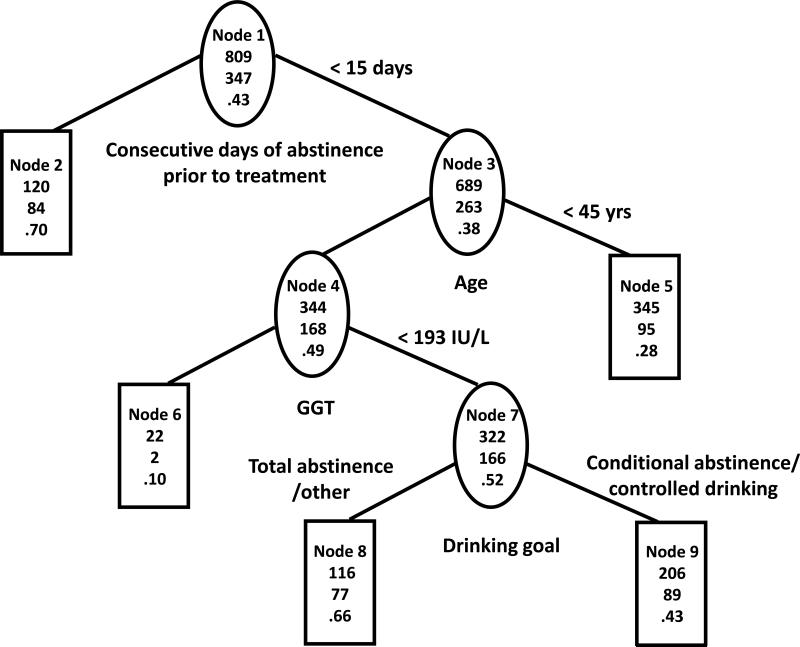
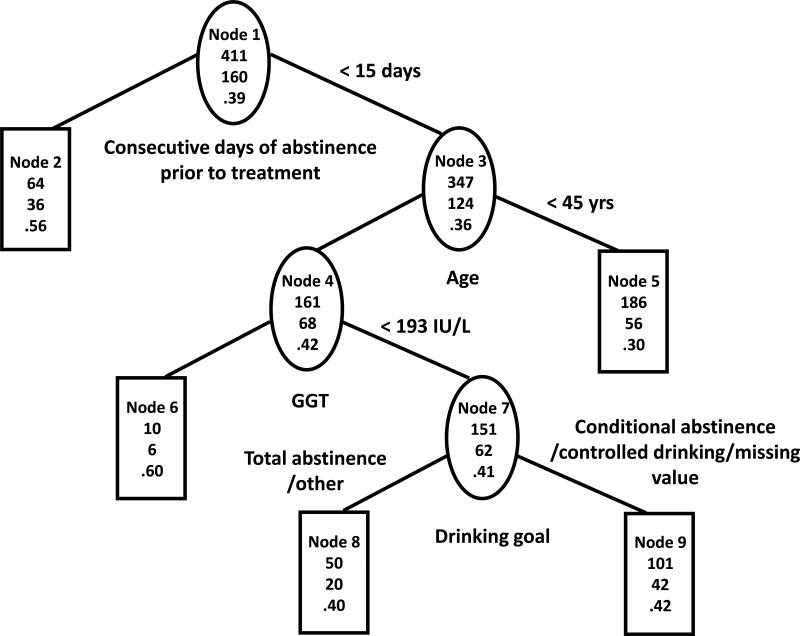
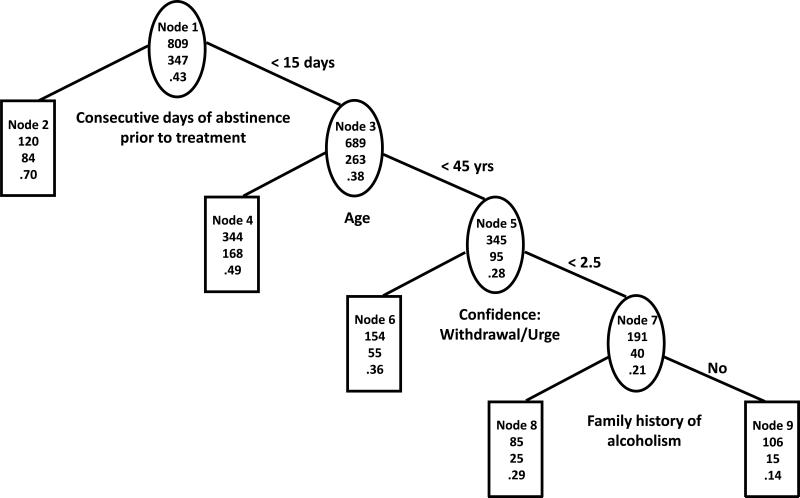
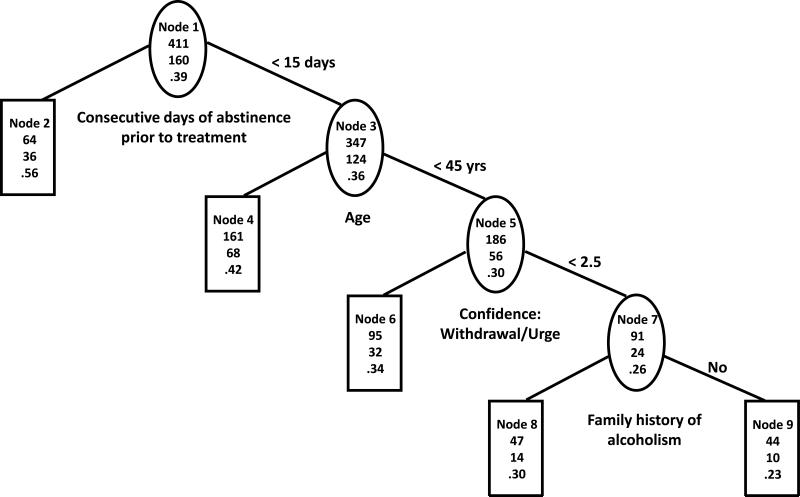
Results: The tree built using both clinical and statistical considerations consisted of 4 splits based on consecutive days of abstinence (CDA) prior to randomization, age, family history of alcoholism, and confidence to resist drinking in response to withdrawal and urges. The tree based on statistical considerations with 4 splits also split on CDA and age but also on gamma-glutamyl transferase level and drinking goal. Deterministic forest identified CDA, age, and drinking goal as the most important predictors. Backward elimination logistic regression among the top 18 predictors identified in the deterministic forest analyses identified only age and CDA as significant main effects. Longer CDA and goal of complete abstinence were associated with better outcomes in both data sets.
Conclusions: The most reliable predictors of abstinence from heavy drinking were CDA and drinking goal. Trees provide binary decision rules and straightforward graphical representations for identification of subgroups based on response and may be easier to implement in clinical settings.
Keywords: Alcohol Dependence; Classification Tree; Clinical Trial; Deterministic Forest; Logistic Regression.
Copyright © 2014 by the Research Society on Alcoholism.
Figures
References
-
- Adamson SJ, Sellman JD, Frampton CMA. Patient predictors of alcohol treatment outcome: A systematic review. Journal of Substance Abuse Treatment. 2009;36:75–86. - PubMed
-
- Anton RF, Moak DH, Latham P, Waid LR, Myrick H, Voronin K, et al. Naltrexone combined with either cognitive behavioral or motivational enhancement therapy for alcohol dependence. Journal of Clinical Psychopharmacology. 2005;25(4):349–357. - PubMed
-
- Anton RF, O'Malley SS, Ciraulo D, et al. Combined pharmacotherapies and behavioral interventions for alcohol dependence. The COMBINE study: a randomized controlled trial. JAMA. 2006;295:2003–2017. - PubMed
-
- Berner MM, Wahl S, Brueck R, Frick K, Smolka R, Haug M, Hoffman S, Reinhard I, Lemenager T, Gann H, Batra A, Mann K, the PREDICT study group Alcohol Clin Exp Res. 2013 DOI: 10.1111/acer.12317. Epub ahead of print. - PubMed
-
- Breiman L, Friedman JH, Olshen RA, Stone CJ. Classification and Regression Trees. Chapman & Hall/CRC.; Wadsworth, CA.: 1984.
Publication types
MeSH terms
Substances
Grants and funding
LinkOut - more resources
Full Text Sources
Other Literature Sources
Medical
