


Altered functional response to risky choice in HIV infection
- PMID: 25347679
- PMCID: PMC4210250
- DOI: 10.1371/journal.pone.0111583
Altered functional response to risky choice in HIV infection
Abstract
Background: Risky decision-making is commonly observed in persons at risk for and infected with HIV and is associated with executive dysfunction. Yet it is currently unknown whether HIV alters brain processing of risk-taking decision-making.
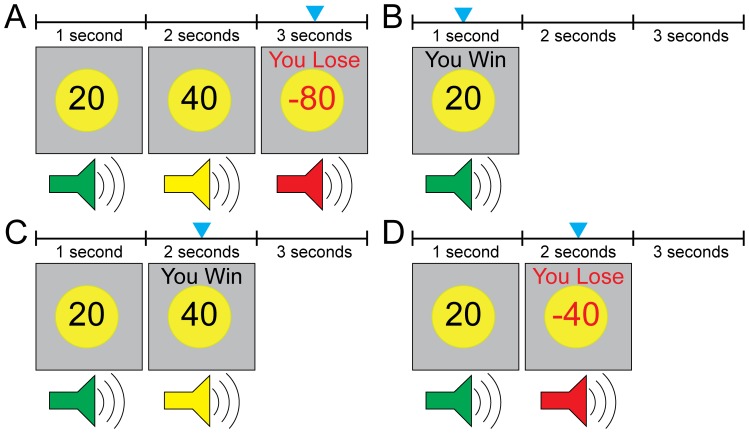
Methods: This study examined the neural substrate of a risky decision-making task in 21 HIV seropositive (HIV+) and 19 seronegative (HIV-) comparison participants. Functional magnetic resonance imaging was conducted while participants performed the risky-gains task, which involves choosing among safe (20 cents) and risky (40/80 cent win or loss) choices. Linear mixed effects analyses examining group and decision type were conducted. Robust regressions were performed to examine the relationship between nadir CD4 count and Kalichman sexual compulsivity and brain activation in the HIV+ group. The overlap between the task effects and robust regressions was explored.
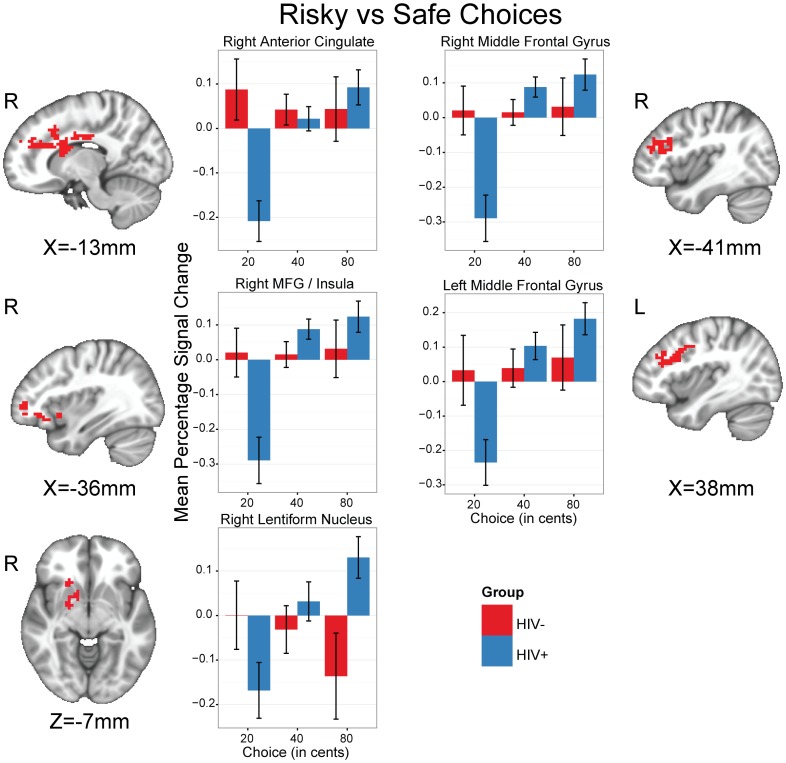
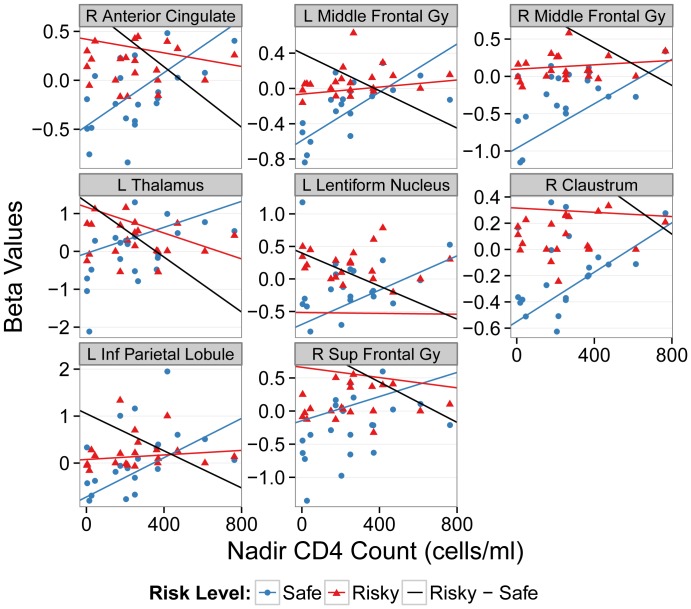
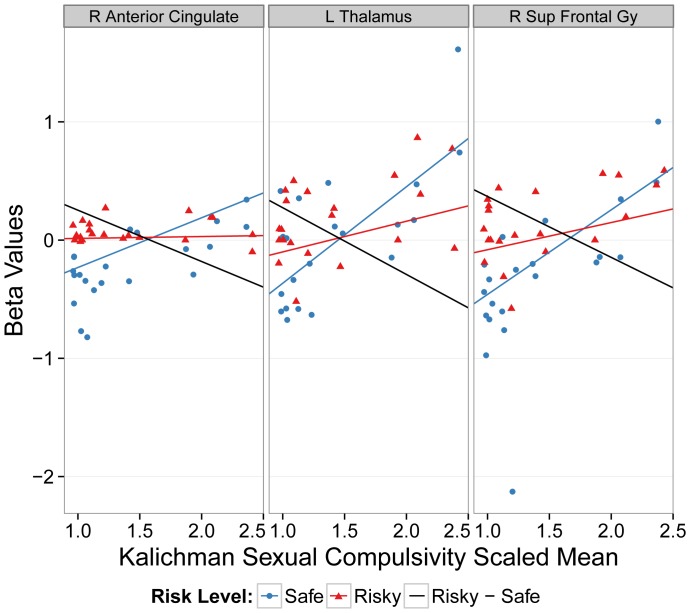
Results: Although there were no serostatus effects in behavioral performance on the risky-gains task, HIV+ individuals exhibited greater activation for risky choices in the basal ganglia, i.e. the caudate nucleus, but also in the anterior cingulate, dorsolateral prefrontal cortex, and insula relative to the HIV- group. The HIV+ group also demonstrated reduced functional responses to safe choices in the anterior cingulate and dorsolateral prefrontal cortex relative to the HIV- group. HIV+ individuals with higher nadir CD4 count and greater sexual compulsivity displayed lower differential responses to safe versus risky choices in many of these regions.
Conclusions: This study demonstrated fronto-striatal loop dysfunction associated with HIV infection during risky decision-making. Combined with similar between-group task behavior, this suggests an adaptive functional response in regions critical to reward and behavioral control in the HIV+ group. HIV-infected individuals with higher CD4 nadirs demonstrated activation patterns more similar to seronegative individuals. This suggests that the severity of past immunosuppression (CD4 nadir) may exert a legacy effect on processing of risky choices in the HIV-infected brain.
Conflict of interest statement
Figures
References
-
- Berger JR, Arendt G (2000) HIV dementia: the role of the basal ganglia and dopaminergic systems. J Psychopharmacol 14: 214–221. - PubMed
-
- Alexander GE, Crutcher MD, DeLong MR (1990) Basal ganglia-thalamocortical circuits: parallel substrates for motor, oculomotor, “prefrontal” and “limbic” functions. Prog Brain Res 85: 119–146. - PubMed
MeSH terms
Grants and funding
LinkOut - more resources
Full Text Sources
Other Literature Sources
Medical
Research Materials
Miscellaneous
