. 2015 Jan;83(1):247-58.
doi: 10.1128/IAI.02520-14. Epub 2014 Oct 27.

Intestinal alkaline phosphatase deficiency leads to lipopolysaccharide desensitization and faster weight gain

Affiliations

Intestinal alkaline phosphatase deficiency leads to lipopolysaccharide desensitization and faster weight gain

Ye Yang et al. Infect Immun. 2015 Jan.

Abstract

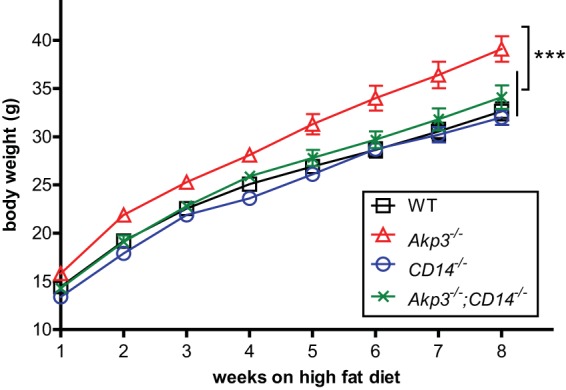
Animals develop in the presence of complex microbial communities, and early host responses to these microbes can influence key aspects of development, such as maturation of the immune system, in ways that impact adult physiology. We previously showed that the zebrafish intestinal alkaline phosphatase (ALPI) gene alpi.1 was induced by Gram-negative bacterium-derived lipopolysaccharide (LPS), a process dependent on myeloid differentiation primary response gene 88 (MYD88), and functioned to detoxify LPS and prevent excessive host inflammatory responses to commensal microbiota in the newly colonized intestine. In the present study, we examined whether the regulation and function of ALPI were conserved in mammals. We found that among the mouse ALPI genes, Akp3 was specifically upregulated by the microbiota, but through a mechanism independent of LPS or MYD88. We showed that disruption of Akp3 did not significantly affect intestinal inflammatory responses to commensal microbiota or animal susceptibility to Yersinia pseudotuberculosis infection. However, we found that Akp3(-/-) mice acquired LPS tolerance during postweaning development, suggesting that Akp3 plays an important role in immune education. Finally, we demonstrated that inhibiting LPS sensing with a mutation in CD14 abrogated the accelerated weight gain in Akp3(-/-) mice receiving a high-fat diet, suggesting that the weight gain is caused by excessive LPS in Akp3(-/-) mice.


Figures

FIG 1
FIG 1
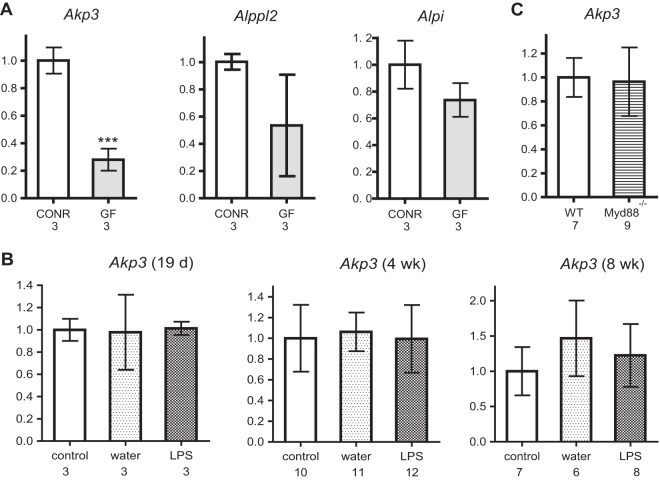
Akp3 is upregulated by the microbiota in an LPS- and MYD88-independent manner. (A) Comparison of Akp3, Alppl2, and Alpi levels between 4-week-old conventionally raised (CONR) and germfree (GF) mice. (B) Comparison of Akp3 transcription levels between control, water-treated, and LPS-treated wild-type mice (19 days, 4 weeks, and 8 weeks old). (C) Comparison of Akp3 transcription levels between 4-week-old wild-type (WT) and Myd88−/− mice. Error bars represent standard deviations. The number below the graph indicates the sample size. Asterisks indicate a significant difference (***, P < 0.001 [Student t test]).
FIG 2
FIG 2
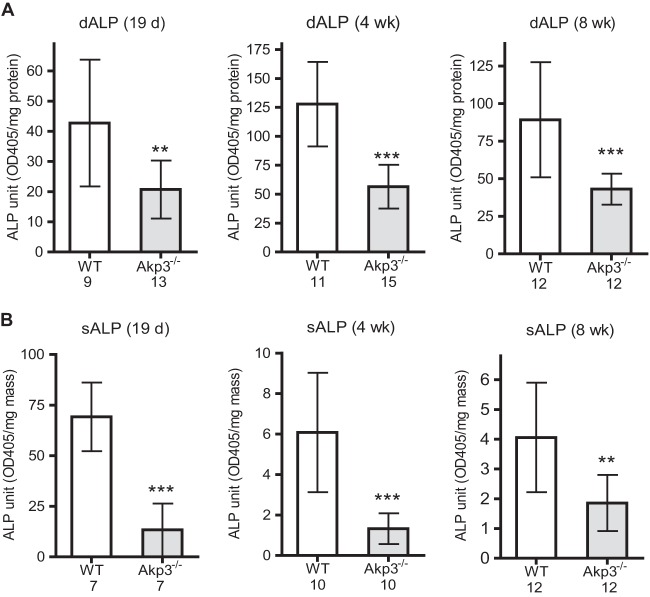
Akp3−/− mice have reduced ALPI in the intestine. Comparison of ALP activities between wild-type (WT) and Akp3−/− mice in duodenal epithelia (dALP) (A) and stools (sALP) (B) at different ages, as indicated at the top of each bar graph. Error bars represent the standard deviations. The number below the graph indicates the sample size. Asterisks mark significant differences (**, P < 0.01; ***, P < 0.001 [Student t test]).
FIG 3
FIG 3
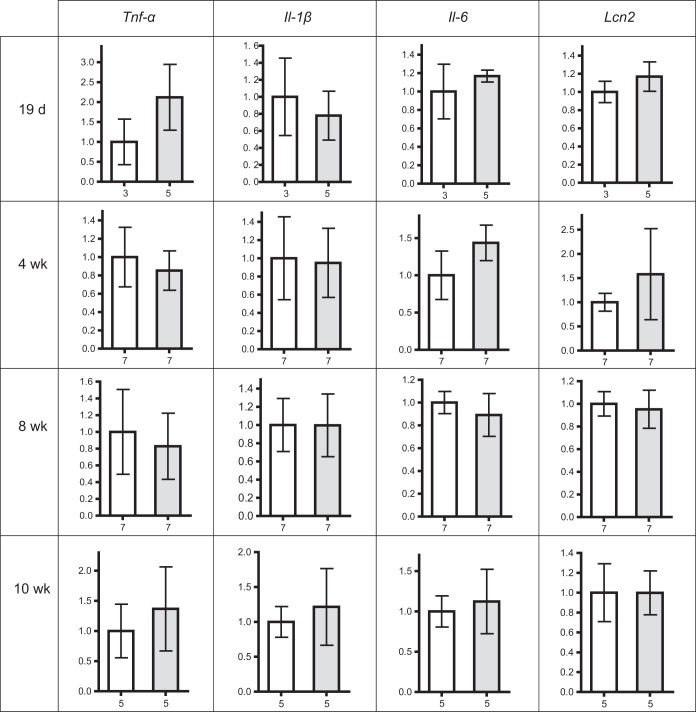
Akp3−/− mice show normal basal intestinal inflammatory responses. Comparison of ileal transcriptional levels of Tnf-α, Il-1β, Il-6, and Lcn2 between wild-type (white columns) and Akp3−/− (gray columns) mice at different ages. Error bars represent the standard deviations. The number below the graph indicates the sample size.
FIG 4
FIG 4
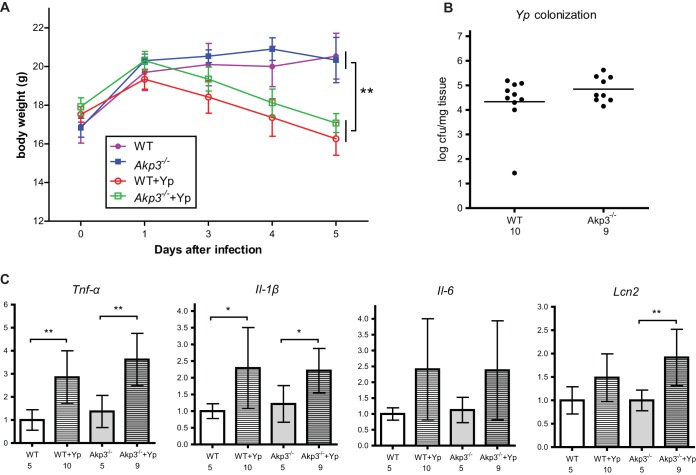
Akp3−/− and wild-type mice show similar susceptibilities to Y. pseudotuberculosis infection. (A) Body weight changes of wild-type (WT) and Akp3−/− mice, uninfected or infected with Y. pseudotuberculosis (Yp). Error bars indicate the standard errors of the mean (SEM). (B) Colonization of Y. pseudotuberculosis in Peyer's patches. Each dot represents a mouse. (C) qPCR quantification of transcription levels of Tnf-α, Il-1β, Il-6, and Lcn2 in the small intestines of uninfected or infected wild-type (WT) and Akp3−/− mice (10 weeks old). Error bars represent the standard deviations. The numbers below the graphs indicate the sample sizes. Asterisks mark the significant differences (*, P < 0.05; **, P < 0.01; determined by one-way analysis of variance [ANOVA], followed by the Bonferroni test).
FIG 5
FIG 5
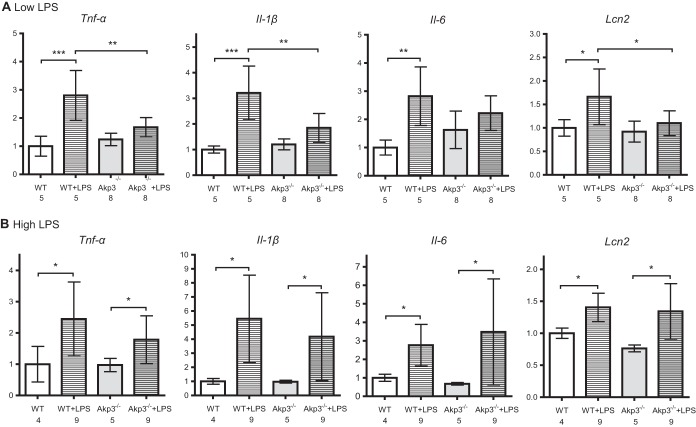
Adult Akp3−/− mice show intestinal immune tolerance to low-dose LPS. qPCR quantification of transcription levels of Tnf-α, Il-1β, Il-6, and Lcn2 in the small intestines of water- or LPS-treated 10-week-old wild-type (WT) and Akp3−/− mice (LPS at 100 mg/kg of body weight [A]; LPS at 200 mg/kg of body weight [B]). Error bars represent the standard deviations. The numbers below the graphs indicate the sample sizes. Asterisks mark significant differences (*, P < 0.05; **, P < 0.01; ***, P < 0.001 [one-way ANOVA, followed by the Bonferroni test]).
FIG 6
FIG 6
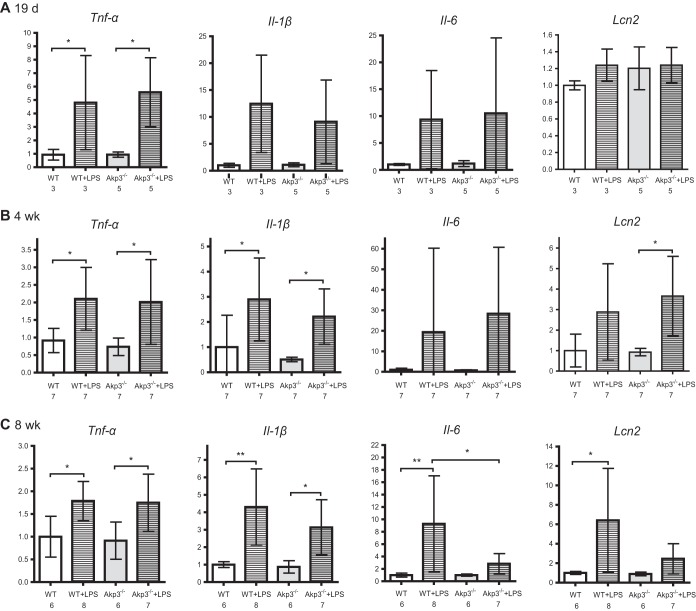
Akp3−/− mice acquire endotoxin tolerance during postweaning development. qPCR quantification of transcription levels of Tnf-α, Il-1β, Il-6, and Lcn2 in the small intestines of wild-type (WT) and Akp3−/− mice, treated with water or LPS (100 mg/kg of body weight) at 19 days (A), 4 weeks (B), or 8 weeks (C) of age. Error bars represent the standard deviations. The numbers below the graphs indicate the sample sizes. Asterisks mark the significant difference (*, P < 0.05; **, P < 0.01 [one-way ANOVA, followed by the Bonferroni test]).
FIG 7
FIG 7
LPS sensing is required for HFD-induced obesity in Akp3−/− mice. Body weight changes of wild-type (WT), Akp3−/−, CD14−/−, and Akp3−/−;CD14−/− mice fed an HFD were determined. Error bars represent the SEM. Asterisks indicate a significant difference (***, P < 0.001 [two-way ANOVA]).

References

    1. Tremaroli V, Backhed F. 2012. Functional interactions between the gut microbiota and host metabolism. Nature 489:242–249. doi:10.1038/nature11552. - DOI - PubMed
    1. Belkaid Y, Hand TW. 2014. Role of the microbiota in immunity and inflammation. Cell 157:121–141. doi:10.1016/j.cell.2014.03.011. - DOI - PMC - PubMed
    1. Goto Y, Kiyono H. 2012. Epithelial barrier: an interface for the cross-communication between gut flora and immune system. Immunol Rev 245:147–163. doi:10.1111/j.1600-065X.2011.01078.x. - DOI - PubMed
    1. Kamada N, Chen GY, Inohara N, Nunez G. 2013. Control of pathogens and pathobionts by the gut microbiota. Nat Immunol 14:685–690. doi:10.1038/ni.2608. - DOI - PMC - PubMed
    1. McComb RB, Bowers GN Jr, Posen S. 1979. Alkaline phosphatase. Plenum Press, Inc, New York, NY.

Publication types

LinkOut - more resources