


Schistosoma mansoni infection and undernutrition among school age children in Fincha'a sugar estate, rural part of West Ethiopia
- PMID: 25348748
- PMCID: PMC4216851
- DOI: 10.1186/1756-0500-7-763
Schistosoma mansoni infection and undernutrition among school age children in Fincha'a sugar estate, rural part of West Ethiopia
Abstract
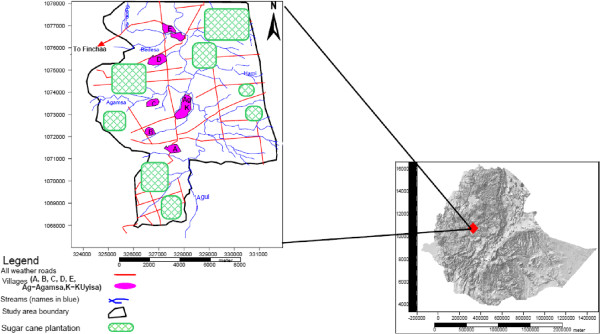
Background: Parasitic infection like schistosomiasis is known to exert a negative effect on nutritional status of school-aged children. However, studies associating parasitic infections with undernutrition are scarce. Thus, this study was primarily to document the association between Schistosoma mansoni infection and undernutrition among school-aged children in a rural setting of Fincha'a Sugar Estate, Ethiopia.
Methods: A cross-sectional study was conducted on a total of 453 school-aged children (5-18 years). Stool specimen was collected and examined using the standard Kato-katz technique. Children's height-for-Age Z-score (HAZ) and Body mass index-for-Age Z- score (BAZ) was determined. Z-Scores for each nutritional index were compared with the WHO child growth standards reference values. Children were considered stunted or wasted as HAZ or BAZ falls below -2 standard deviations, respectively.
Result: The overall prevalence of Schistosoma mansoni infection was 53.2%. Out of the total school children examined, 11.5% and 13.2% were stunted and wasted, respectively. Multivariate logistic regression analysis was done to determine the relationship between Schistosoma mansoni infection and nutritional status controlling for other factors. Accordingly, stunting was not significantly associated while wasting was negatively associated with Schistosoma mansoni infection. Paternal occupation was the best predictor of stunting and wasting such that, unemployed fathers have 4.28 (95% CI; 2.13, 8.63) (p < 0.001) and 3.83, 95% CI; 1.89, 7.79) (p < 0.001) chance of having stunted and wasted children, respectively.
Conclusion: Schistosoma mansoni infection is highly prevalent in the study area. The high prevalence of wasting, and moderate level of stunting among study subjects in this study area indicate that they are affected by both infection and undernutrition. Therefore, regular preventive chemotherapy against S. mansoni and other control measures are recommended. Moreover, possibilities of synchronized nutritional rehabilitation and creation of employment opportunities to the families should be looked for.
Figures
References
-
- Best C, Neufingerl N, van Geel L, van den Briel T, Osendarp S. The nutritional status of school-aged children: Why should we care? Food Nutr Bull. 2010;31(3):400–417. - PubMed
-
- Drake L. School-age children: Their Nutrition and Health. Partnership for Child Development. Department of Infectious Disease Epidemiology. London, UK: Imperial College; 2002.
-
- Jukes M. The long-term impact of preschool health and nutrition on education. Food Nutr Bull. 2005;26(Suppl 2):S193–S201. - PubMed
-
- Stoltzfus RJ, Albonico M, Tielsch JM, Chwaya HM, Savioli L. Linear growth retardation in Zanzibari school children. J Nutr. 1997;127:1099–1105. - PubMed
-
- Parraga IM, Assis AM, Prado MS, Barreto ML, Reis MG, King CH, Blanton RE. Gender differences in growth of school-aged children with schistosomiasis and geohelminth infection. Am J Trop Med Hyg. 1996;5:150–156. - PubMed
Publication types
MeSH terms
LinkOut - more resources
Full Text Sources
Other Literature Sources
Medical
