. 2015 Jan 1;197(1):219-30.
doi: 10.1128/JB.02192-14. Epub 2014 Oct 27.

Enantioselective regulation of lactate racemization by LarR in Lactobacillus plantarum

Affiliations

Enantioselective regulation of lactate racemization by LarR in Lactobacillus plantarum

Benoît Desguin et al. J Bacteriol. .

Abstract

Lactobacillus plantarum is a lactic acid bacterium that produces a racemic mixture of l- and d-lactate from sugar fermentation. The interconversion of lactate isomers is performed by a lactate racemase (Lar) that is transcriptionally controlled by the l-/d-lactate ratio and maximally induced in the presence of l-lactate. We previously reported that the Lar activity depends on the expression of two divergently oriented operons: (i) the larABCDE operon encodes the nickel-dependent lactate racemase (LarA), its maturases (LarBCE), and a lactic acid channel (LarD), and (ii) the larR(MN)QO operon encodes a transcriptional regulator (LarR) and a four-component ABC-type nickel transporter [Lar(MN), in which the M and N components are fused, LarQ, and LarO]. LarR is a novel regulator of the Crp-Fnr family (PrfA group). Here, the role of LarR was further characterized in vivo and in vitro. We show that LarR is a positive regulator that is absolutely required for the expression of Lar activity. Using gel retardation experiments, we demonstrate that LarR binds to a 16-bp palindromic sequence (Lar box motif) that is present in the larR-larA intergenic region. Mutations in the Lar box strongly affect LarR binding and completely abolish transcription from the larA promoter (PlarA). Two half-Lar boxes located between the Lar box and the -35 box of PlarA promote LarR multimerization on DNA, and point mutations within one or both half-Lar boxes inhibit PlarA induction by l-lactate. Gel retardation and footprinting experiments indicate that l-lactate has a positive effect on the binding and multimerization of LarR, while d-lactate antagonizes the positive effect of l-lactate. A possible mechanism of LarR regulation by lactate enantiomers is proposed.


Figures

FIG 1
FIG 1
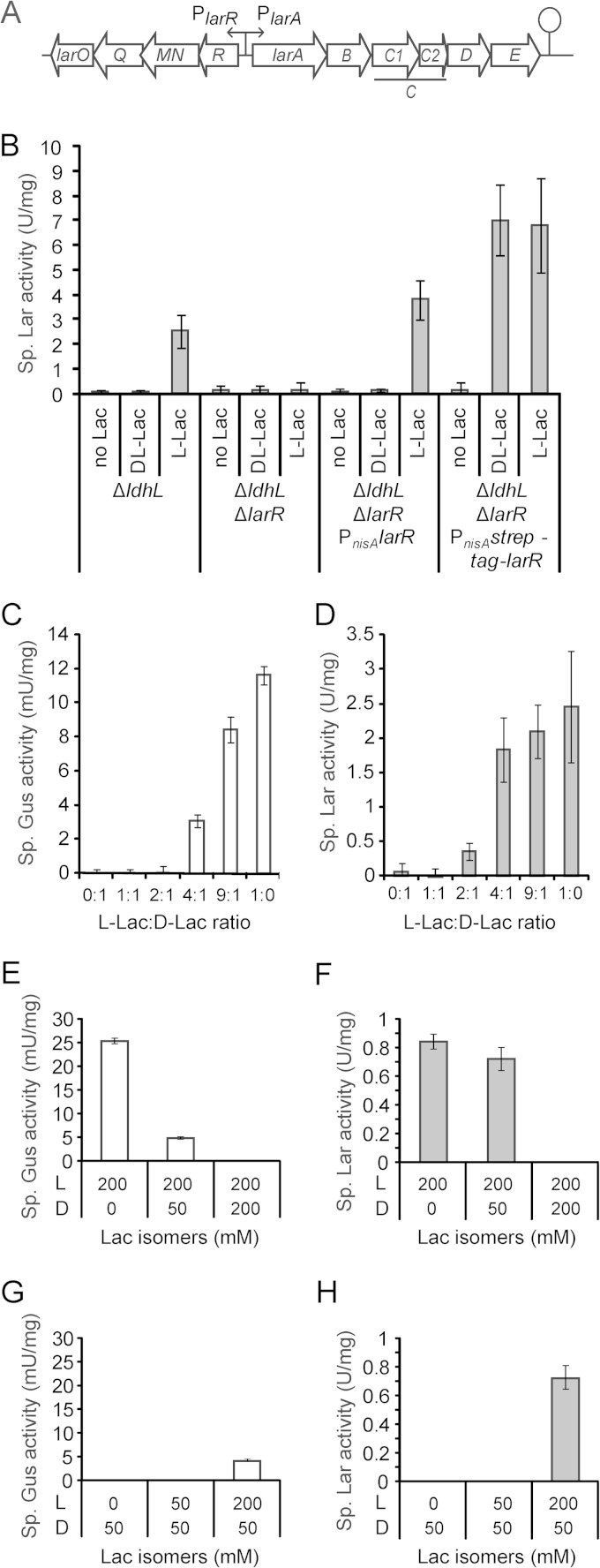
In vivo LarR regulation. (A) Schematic representation of the lar locus of Lactobacillus plantarum, which comprises the larA-E operon, responsible for the lactate racemization activity, and the larR-O operon, coding for LarR and for an ABC-type nickel transporter. (B) Specific lactate racemase (Lar) activity of the L. plantarum ΔldhL mutant (control), the double ΔlarR ΔldhL mutant, and the ΔlarR ΔldhL mutant complemented with larR (PnisA-larR) or StrepII-larR (PnisA-strep-tag-larR). Complementations were performed in the presence of the nisin inducer. The activity was measured after induction with 200 mM NaCl (no Lac), 200 mM Na-dl-Lac (dl-Lac), or 200 mM Na-l-Lac (l-Lac), as described in Materials and Methods. (C and D) Specific β-glucoronidase (Gus) activities (C) and specific lactate racemase (Lar) activities (D) of the L. plantarum ΔldhL mutant expressing the larA promoter-gusA fusion (PlarA-gusA) measured after induction with 200 mM Na-Lac at different l-/d-Lac ratios, as described in Materials and Methods. (E to H) Specific Gus activities (E and G) and specific Lar activities (F and H) of the L. plantarum ΔldhL mutant expressing PlarA-gusA after induction with 200 mM Na-l-Lac (E and F) or 50 mM Na-d-Lac (G and H) supplemented with 0, 50, or 200 mM Na-d-Lac (E and F) or Na-l-Lac (G and H). The values shown are the mean results of 3 repetitions from 1 significant experiment out of 2 experiments showing similar results. The error bars indicate the confidence intervals at 95% (Student's t test).
FIG 2
FIG 2
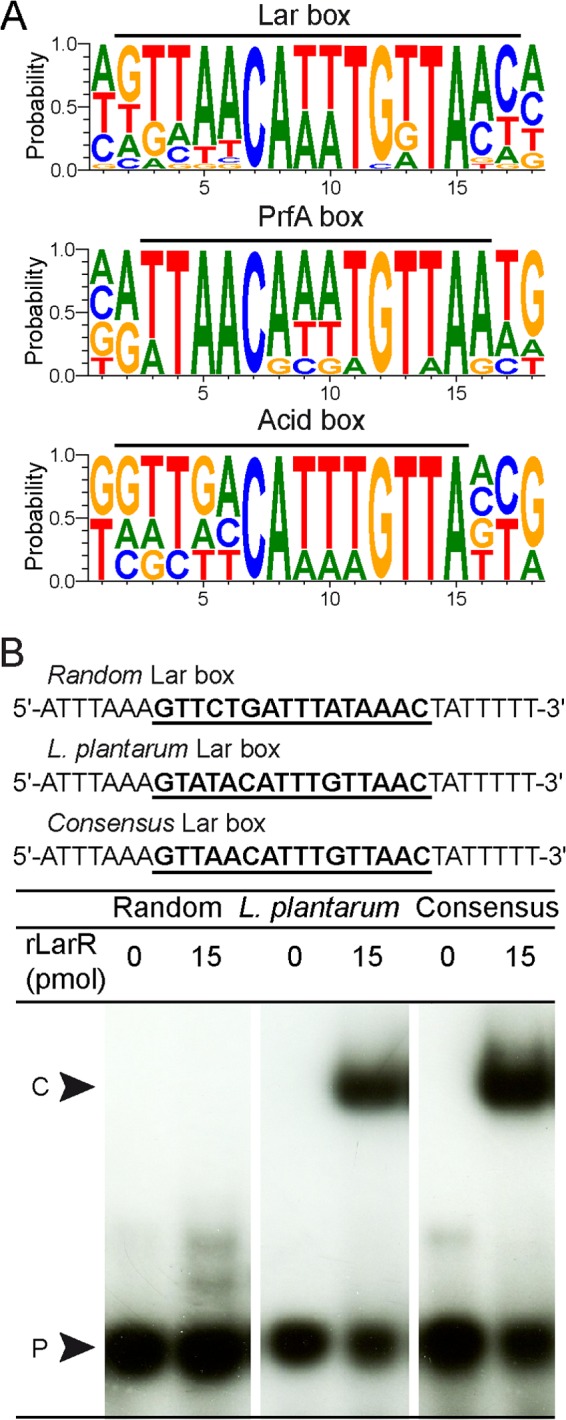
Lar box identification. (A) Logos of the Lar box, the PrfA box (29), and the ACiD (RcfB) box (9) drawn with WebLogo 3 (http://weblogo.berkeley.edu/). The black bars above the logos correspond to the Lar box consensus identified in this study and the previously reported PrfA box (29) and ACiD (RcfB) box (9). (B) EMSA of 30-bp 32P-radiolabeled probes containing the randomly shuffled Lar box (random), the Lar box from L. plantarum (L. plantarum), or a consensus Lar box (consensus) in the absence or presence of purified rLarR. The DNA sequences of the probes are shown, with the corresponding boxes in boldface and underlined. The rLarR-DNA complex (C) and unbound probe (P) are indicated.
FIG 3
FIG 3
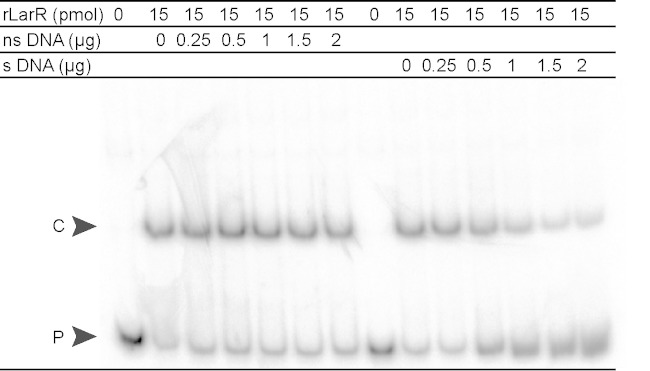
Specificity of rLarR interaction with the larR-larA intergenic region. Electrophoretic mobility shift assay (EMSA) of a 127-bp 32P-radiolabeled probe of the larR-larA intergenic region of L. plantarum in the presence of purified rLarR and increasing amounts of nonspecific DNA (ns DNA; larA-larB intergenic region, 137 bp) or specific DNA corresponding to the same unlabeled probe (s DNA). The LarR-DNA complex (C) and unbound probe (P) are indicated.
FIG 4
FIG 4
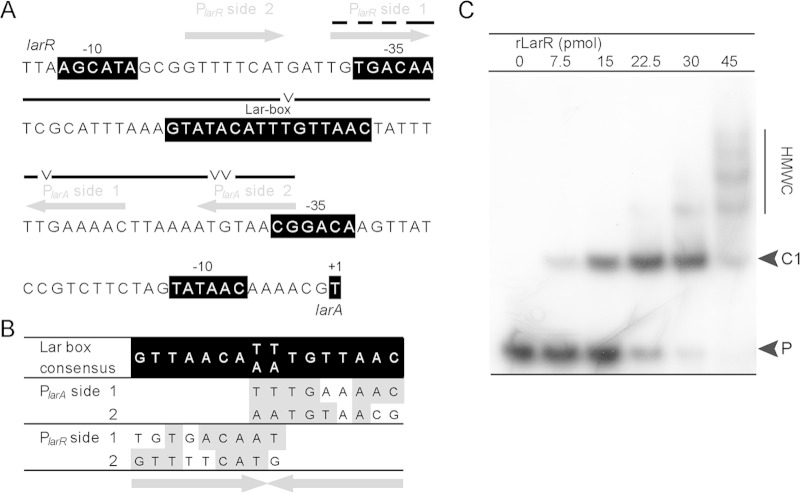
LarR multimerization. (A) DNA sequence of the central part of the L. plantarum larR-larA intergenic region. The putative −35 and −10 boxes of PlarR and PlarA, the Lar box, and the mapped transcriptional start (+1) of larA are highlighted in black. Protected regions in footprinting assays (lines) and sites displaying enhanced sensitivity to DNase I upon binding of LarR (V), such as are displayed in Fig. 6C, are indicated above the sequence. The half-Lar boxes surrounding the central Lar box are shown by arrows above the sequence. (B) Comparison of the half-Lar box sequences with the consensus Lar box sequence. (C) EMSA of a 256-bp 32P-radiolabeled probe of the larR-larA intergenic region of L. plantarum in the presence of increasing amounts of purified rLarR. The lower-molecular-weight rLarR-DNA complex (C1), unbound probe (P), and high-molecular-weight complexes (HMWC) are indicated.
FIG 5
FIG 5
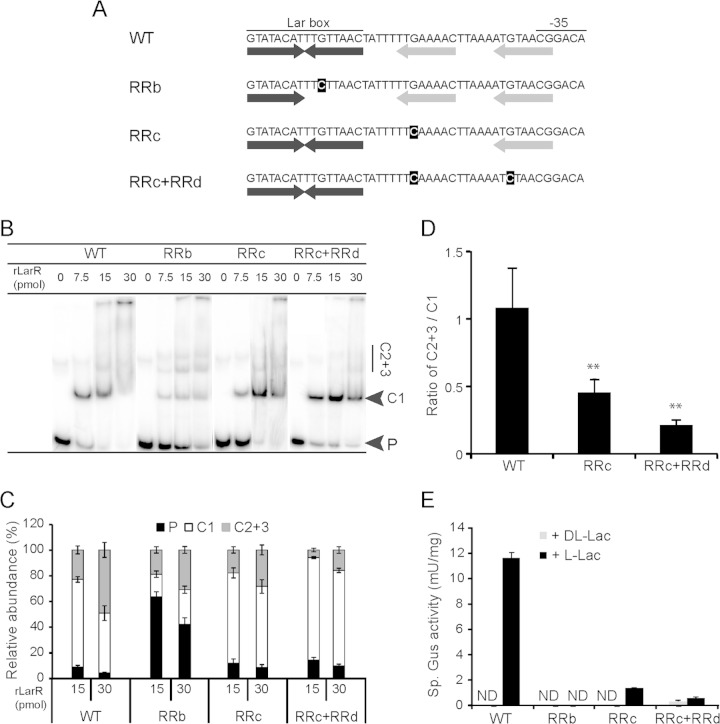
Mutagenesis of the larR-larA intergenic region. (A) Native (WT) and mutated DNA sequences (RRb, RRc, and RRc+RRd) of the region, including the Lar box and the −35 box of PlarA. The inverted repeat of the Lar box (black arrows) and the two half-Lar boxes on the PlarA side (gray arrows) are shown below the sequence. The mutations in the right repeats are highlighted in black. The arrow corresponding to a mutated right repeat was removed to indicate its alteration. (B) EMSA of 127-bp 32P-radiolabeled probes of the wild type (WT) and mutated larR-larA intergenic regions of L. plantarum in the presence of increasing amounts of purified rLarR. The lower-molecular-weight rLarR-DNA complex (C1), unbound probe (P), and high-molecular-weight complexes C2 and C3 (C2+3) are indicated. (C) Relative abundances of P, C1, and C2+3 in EMSA such as that shown in panel B. Data are from 4 replicates run in parallel on the same gel from one representative experiment. The error bars represent the standard deviations. (D) Ratios of C2+3 to C1 at 30 pmol of LarR in EMSA such as that shown in panel B. Data are from 4 replicates run in parallel on the same gel from one representative experiment. The error bars represent the standard deviations. Significance of the results was determined by Student's t test: **, P < 0.01. (E) Gus activities measured with the mutated larA promoters after induction by 200 mM dl-Lac or l-Lac. ND, not detected (<0.1 mU). The values shown are the mean results of 3 repetitions from 1 significant experiment out of 2 experiments showing similar results. The error bars give the confidence intervals at 95% (Student's t test).
FIG 6
FIG 6
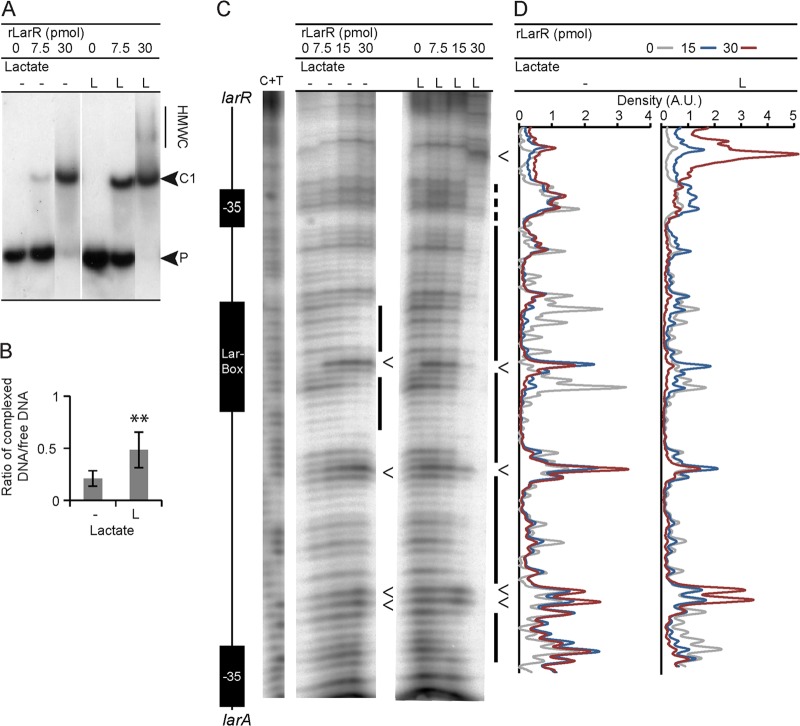
Effect of l-Lac on rLarR DNA binding. (A) EMSA of a 127-bp 32P-radiolabeled probe of the larR-larA intergenic region of L. plantarum in the presence of purified rLarR without or with 200 mM l-Lac (L). The lower-molecular-weight LarR-DNA complex (C1), unbound probe (P), and high-molecular-weight complexes (HMWC) are indicated. (B) Mean values of complexed DNA/free DNA ratios from EMSA such as that shown in panel A. Data are from 6 replicates from 1 significant experiment out of 3 experiments showing similar results. The error bars represent the standard deviations. Significance was determined by Student's t test: **, P < 0.01 compared to the results for the control. (C) DNase I footprint of a 127-bp 32P-radiolabeled probe of the larR-larA intergenic region of L. plantarum with increasing amounts of rLarR without or with 200 mM l-Lac (L). The C+T bands correspond to the Maxam and Gilbert sequencing reaction. A schematic representation of the larR-larA intergenic region is shown on the left. The lines on the right represent the protected regions, and the arrowheads indicate the enhancements. (D) Density measurements (A.U., arbitrary units) of the DNase I footprint shown in panel C. The areas under the curves of the data series have been standardized in order to be equal. Data are from 1 representative experiment out of 3 experiments showing similar results.
FIG 7
FIG 7
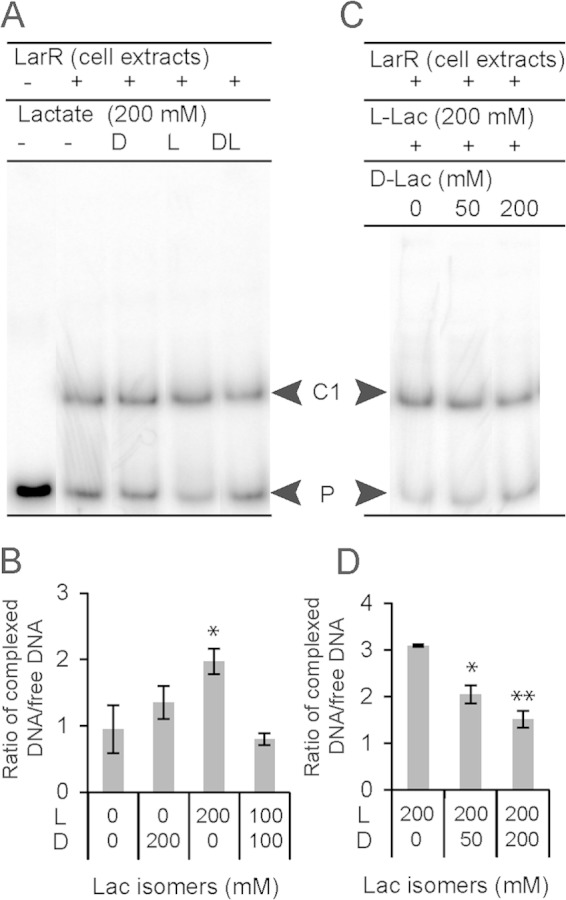
Effects of lactate isomers on untagged LarR DNA binding. (A) EMSA of a 127-bp 32P-radiolabeled probe of the larR-larA intergenic region of Lactobacillus plantarum in the presence of Lactococcus lactis cellular extracts (2 μg) containing untagged LarR without or with 200 mM d-Lac (D), l-Lac (L), or dl-Lac (DL, equimolar ratio). The LarR-DNA complex (C) and unbound probe (P) are indicated. (B) Mean values of complexed DNA/free DNA ratios from EMSA such as that shown in panel A. (C) EMSA of a 127-bp 32P-radiolabeled probe of the larR-larA intergenic region of L. plantarum in the presence of L. lactis cellular extracts (2 μg) containing untagged LarR with 200 mM Na-l-Lac supplemented with 0, 50, or 200 mM Na-d-Lac. (D) Mean values of complexed DNA/free DNA ratios from EMSA as shown in panel B. Data are from 3 replicates from 1 significant experiment out of 2 experiments showing similar results. The error bars represent the standard deviations. Significance was determined by Student's t test: *, P < 0.05; **, P < 0.01. Effects of lactate isomers are compared to the effect of the control (no lactate).
FIG 8
FIG 8
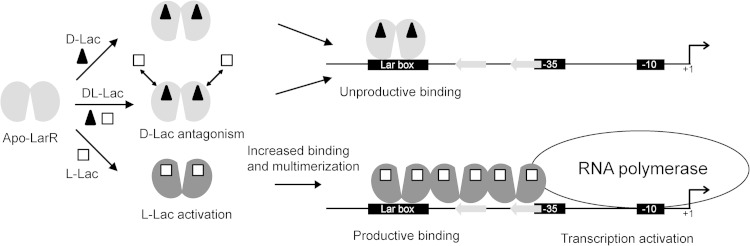
Hypothetical model of PlarA regulation by LarR. In the presence of l-Lac, activated LarR binds to the Lar box motif and multimerizes on the half-Lar boxes. This will promote direct interaction of one LarR dimer with the RNA polymerase, resulting in transcriptional activation of the PlarA (productive binding). In the presence of d-Lac, d-Lac could block LarR activation, for instance, by impairing l-Lac recognition as illustrated here, which will result in limited LarR binding and multimerization and absence of transcriptional activation (unproductive binding).

References

    1. Korner H, Sofia HJ, Zumft WG. 2003. Phylogeny of the bacterial superfamily of Crp-Fnr transcription regulators: exploiting the metabolic spectrum by controlling alternative gene programs. FEMS Microbiol Rev 27:559–592. doi:10.1016/S0168-6445(03)00066-4. - DOI - PubMed
    1. Busby S, Ebright RH. 1999. Transcription activation by catabolite activator protein (CAP). J Mol Biol 293:199–213. doi:10.1006/jmbi.1999.3161. - DOI - PubMed
    1. Desguin B, Goffin P, Viaene E, Kleerebezem M, Martin-Diaconescu V, Maroney MJ, Declercq JP, Soumillion P, Hols P. 2014. Lactate racemase is a nickel-dependent enzyme activated by a widespread maturation system. Nat Commun 5:3615. doi:10.1038/ncomms4615. - DOI - PMC - PubMed
    1. Bienert GP, Desguin B, Chaumont F, Hols P. 2013. Channel-mediated lactic acid transport: a novel function for aquaglyceroporins in bacteria. Biochem J 454:559–570. doi:10.1042/BJ20130388. - DOI - PubMed
    1. Vega Y, Dickneite C, Ripio MT, Bockmann R, Gonzalez-Zorn B, Novella S, Dominguez-Bernal G, Goebel W, Vazquez-Boland JA. 1998. Functional similarities between the Listeria monocytogenes virulence regulator PrfA and cyclic AMP receptor protein: the PrfA* (Gly145Ser) mutation increases binding affinity for target DNA. J Bacteriol 180:6655–6660. - PMC - PubMed

Publication types

MeSH terms