Review
. 2015 Jan;224(1):R15-30.
doi: 10.1530/JOE-14-0437. Epub 2014 Oct 27.

Autophagy in diabetic nephropathy

Affiliations
Review

Autophagy in diabetic nephropathy

Yan Ding et al. J Endocrinol. 2015 Jan.

Abstract

Diabetic nephropathy (DN) is the most common cause of end-stage kidney disease worldwide, and is associated with increased morbidity and mortality in patients with both type 1 and type 2 diabetes. Increasing prevalence of diabetes has made the need for effective treatment of DN critical and thereby identifying new therapeutic targets to improve clinical management. Autophagy is a highly conserved 'self-eating' pathway by which cells degrade and recycle macromolecules and organelles. Autophagy serves as an essential mechanism to maintain homeostasis of glomeruli and tubules, and plays important roles in human health and diseases. Impairment of autophagy is implicated in the pathogenesis of DN. Emerging body of evidence suggests that targeting the autophagic pathway to activate and restore autophagy activity may be renoprotective. In this review, we examine current advances in our understanding of the roles of autophagy in diabetic kidney injury, focusing on studies in renal cells in culture, human kidney tissues, and experimental animal models of diabetes. We discuss the major nutrient-sensing signal pathways and diabetes-induced altered intracellular metabolism and cellular events, including accumulation of advanced glycation end-products, increased oxidative stress, endoplasmic reticulum stress, hypoxia, and activation of the renin-angiotensin system, which modulate autophagic activity and contribute to the development of DN. We also highlight recent studies of autophagy and transforming growth factor-β in renal fibrosis, the final common response to injury that ultimately leads to end-stage kidney failure in both type 1 and type 2 diabetes. These findings suggest the possibility that autophagy can be a therapeutic target against DN.

Keywords: autophagy; diabetes mellitus; kidney; macroautophagy; nephropathy.


Figures

Fig. 1
Fig. 1
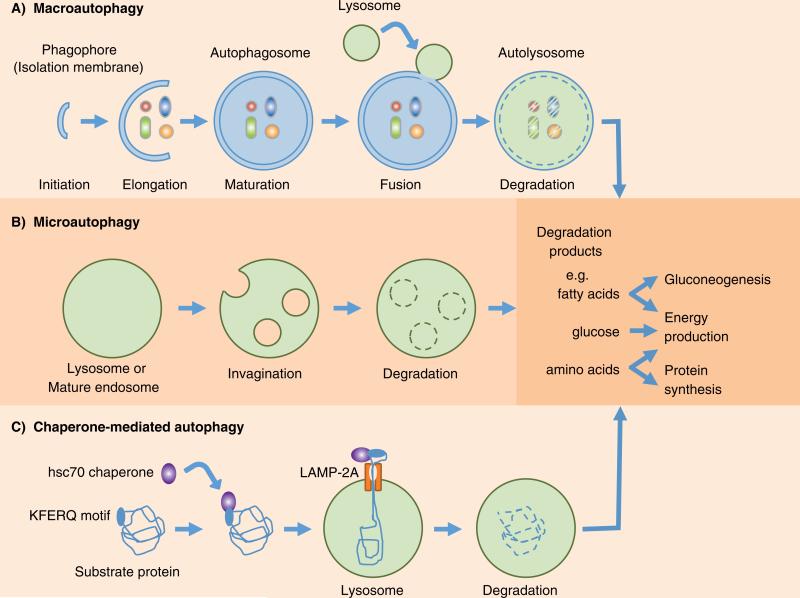
Schematic diagram of the three major types of autophagy. (A) Macroautophagy (generally referred as autophagy) initiates with the formation of the phagophore (isolation membrane) around cytosolic components and sequestration by double-membraned vesicles called autophagosomes. Fusion with lysosomes form autolysosomes and the sequestered components are degraded and recycled. (B) In microautophagy, the lysosomes directly engulf cytosolic contents for degradation through invaginations of the lysosomal membrane and internalization of single-membraned vesicles. (C) Chaperone-mediated autophagy selectively degrades proteins containing KFERQ motif that are recognized by the heat shock cognate protein of 70kDa (hsc70) chaperone, and transported into lysosomes via cooperation with lysosome-associated membrane protein-2A (LAMP-2A).
Fig. 2
Fig. 2
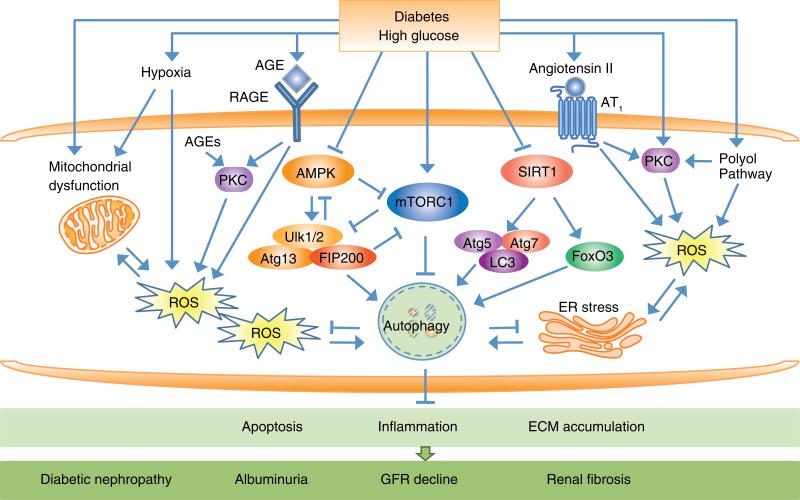
An overview of the regulation of autophagy by extracellular and intracellular stresses in the pathogenesis of diabetic nephropathy (DN). Three major nutrient-sensing signal pathways modulate autophagy activity under diabetic conditions through activation of mTORC1 and inhibition of AMPK and SIRT1 to negatively regulate autophagy activity. AMPK and mTORC1 oppositely regulate the Ulk1/2-Atg13-FIP200 complex. AMPK directly activates Ulk1/2 to induce autophagy. SIRT1 interacts with essential components of the autophagy machinery, such as Atg5, Atg7, and LC3, and the transcription factor FoxO3 to induce autophagy. Diabetes also induces alterations of intracellular metabolism such as accumulation of intracellular advanced glycation end-products (AGEs) and extracellular AGEs that act via their interaction with receptor for AGEs (RAGE). Other cellular events include increased reactive oxygen species (ROS), endoplasmic reticulum (ER) stress, enhanced protein kinase C (PKC) activity and increased flux through polyol pathways, hypoxia, and activation of the renin angiotensin system (RAS), which modulate autophagic activity and contribute to the development of DN. Impairment of autophagy activity lead to cellular injury responses including apoptosis, inflammation, and ECM accumulation, resulting in progression of DN with development of albuminuria, decline in GFR, and renal fibrosis. Abbreviations: mTORC1, mechanistic target of rapamycin complex 1; AMPK, adenosine monophosphate-activated protein kinase (AMPK); SIRT1, silent information regulator T1; Ulk1/2, Unc-51-like kinase 1/2; Atg, autophagy-related gene; LC3, microtubule-associated protein 1 light chain 3; FoxO3, forkhead box O3; ECM, extracellular matrix; GFR, glomerular filtration rate.
Fig. 3
Fig. 3
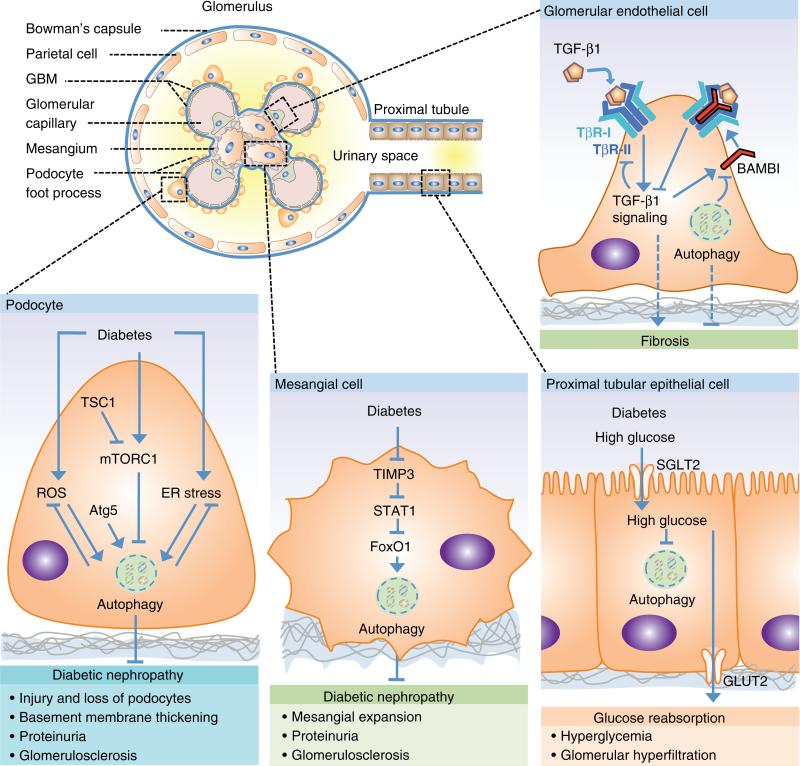
Schematic representation of the glomerulus and proximal tubule and summary of autophagy-mediated pathways in renal cells involved in diabetic nephropathy (DN). The highly specialized podocyte and its foot processes surround the glomerular basement membrane (GBM) and cover the glomerular capillary tuft. Mesangial cells occupy the centrilobular region called the mesangium. The Bowman’s capsule is lined by parietal epithelial cells. Approximately 180 L of renal plasma is filtered by the glomerulus daily. The resultant filtrate flows through the tubules with reabsorption and secretion of ions, carbonhydrates, amino acids, and eventual elimination of urine. Under normal condition, the ultrafiltrate is virtually free of plasma protein. Abbreviations: mTORC1, mechanistic target of rapamycin complex 1; TSC1, Tuberous sclerosis complex 1; ROS, reactive oxygen species; Atg, autophagy-related gene; ER, endoplasmic reticulum; TIMP3, tissue inhibitor of metalloproteinases-3; STAT1, signal transducers and activators of transcription 1; FoxO1, forkhead box protein O1; SGLT2, sodium glucose cotransporter 2; GLUT2, glucose transporter 2; TGF-β1, transforming growth factor-beta 1; TβR-I, TGF-β type I receptor, TβR-II, TGF-β type II receptor; BAMBI, Bone morphogenetic protein and Activin receptor Membrane Bound Inhibitor.

References

    1. Alers S, Löffler AS, Wesselborg S, Stork B. Role of AMPK-mTOR-Ulk1/2 in the regulation of autophagy: cross talk, shortcuts, and feedbacks. Molecular and Cellular Biology. 2012;32:2–11. - PMC - PubMed
    1. Arias E, Cuervo AM. Chaperone-mediated autophagy in protein quality control. Current Opinion in Cell Biology. 2010;23:184–189. - PMC - PubMed
    1. Barbosa Júnior Ade A, Zhou H, Hültenschmidt D, Totovic V, Jurilj N, Pfeifer U. Inhibition of cellular autophagy in proximal tubular cells of the kidney in streptozotocin-diabetic and uninephrectomized rats. Virchows Archiv. B, Cell Pathology including Molecular Pathology. 1992;61:359–366. - PubMed
    1. Belibi F, Zafar I, Ravichandran K, Segvic AB, Jani A, Ljubanovic DG, Edelstein CL. Hypoxia inducible factor-1α (HIF-1α) and autophagy in polycystic kidney disease (PKD). American Journal of Physiology Renal Physiology. 2011;300:F1235–1243. - PMC - PubMed
    1. Bellot G, Garcia-Medina R, Gounon P, Chiche J, Roux D, Pouysségur J, Mazure NM. Hypoxia-induced autophagy is mediated through hypoxia-inducible factor induction of BNIP3 and BNIP3L via their BH3 domains. Molecular Cell Biology. 2009;29:2570–2581. - PMC - PubMed

Publication types

MeSH terms

Substances