. 2015 Jan;32(1):193-210.
doi: 10.1093/molbev/msu296. Epub 2014 Oct 27.

Multiple polyploidy events in the early radiation of nodulating and nonnodulating legumes

Affiliations

Multiple polyploidy events in the early radiation of nodulating and nonnodulating legumes

Steven B Cannon et al. Mol Biol Evol. 2015 Jan.

Abstract

Unresolved questions about evolution of the large and diverse legume family include the timing of polyploidy (whole-genome duplication; WGDs) relative to the origin of the major lineages within the Fabaceae and to the origin of symbiotic nitrogen fixation. Previous work has established that a WGD affects most lineages in the Papilionoideae and occurred sometime after the divergence of the papilionoid and mimosoid clades, but the exact timing has been unknown. The history of WGD has also not been established for legume lineages outside the Papilionoideae. We investigated the presence and timing of WGDs in the legumes by querying thousands of phylogenetic trees constructed from transcriptome and genome data from 20 diverse legumes and 17 outgroup species. The timing of duplications in the gene trees indicates that the papilionoid WGD occurred in the common ancestor of all papilionoids. The earliest diverging lineages of the Papilionoideae include both nodulating taxa, such as the genistoids (e.g., lupin), dalbergioids (e.g., peanut), phaseoloids (e.g., beans), and galegoids (=Hologalegina, e.g., clovers), and clades with nonnodulating taxa including Xanthocercis and Cladrastis (evaluated in this study). We also found evidence for several independent WGDs near the base of other major legume lineages, including the Mimosoideae-Cassiinae-Caesalpinieae (MCC), Detarieae, and Cercideae clades. Nodulation is found in the MCC and papilionoid clades, both of which experienced ancestral WGDs. However, there are numerous nonnodulating lineages in both clades, making it unclear whether the phylogenetic distribution of nodulation is due to independent gains or a single origin followed by multiple losses.

Keywords: Mimosoideae; Papilionoideae; legume; nodulation; polyploidy; symbiotic nitrogen fixation.


Figures

F<sc>ig</sc>. 1.
Fig. 1.
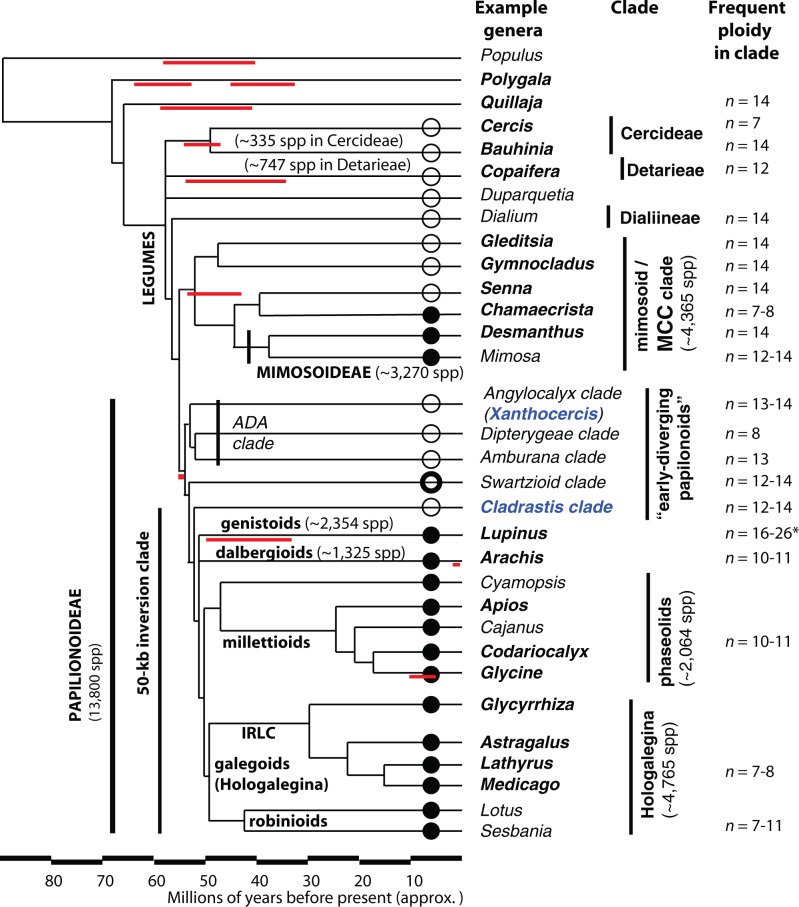
A summary phylogeny based on published trees for the Fabaceae (Wojciechowski et al. 2004; Cardoso et al. 2012; Manzanilla and Bruneau 2012), with approximate date estimates from Lavin et al. (2005). Estimates of species counts per clade are taken from Lewis et al. (2005). Nodulation status is shown with circles: Filled for “many species in this clade nodulate”; partly filled (Swartzieae) for “some species in this clade nodulate”; empty for “no species in this clade have been observed to nodulate.” Nodulation status is summarized from Sprent (2009). Chromosome counts on the right are predominant counts for each genus or clade. These are drawn from Doyle (2012) and supplementary file S5, Supplementary Material online. For the genistoids, the base chromosome count is likely x = 9, but chromosome counts within Lupinus (used in this project) are mostly in the range of n = 16–26 (Doyle 2012). Hypothesized placement of genome duplication events is indicated with horizontal red lines.
F<sc>ig</sc>. 2.
Fig. 2.
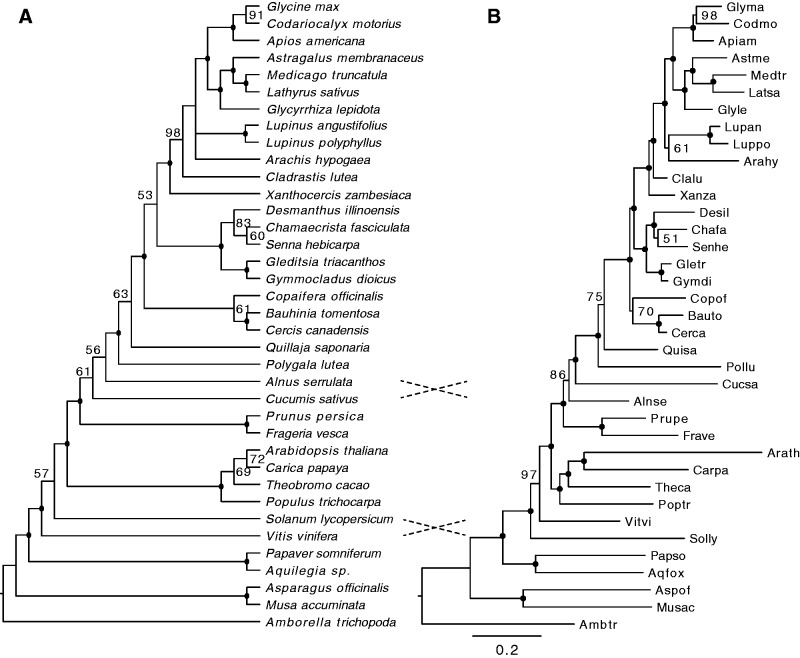
Species relationships estimated from 101 single copy nuclear genes using coalescence-based MP-EST (Liu et al. 2010) (A) and RAxML analysis (Stamatakis et al. 2008) of the concatenated alignments (B). Bootstrap support values are shown adjacent to each node, or as black dots for nodes with 100% support. Branch lengths in the RAxML tree are substitutions per site. Dotted lines highlight discordances between the two trees. Species abbreviations in (B) use the first three letters of the genus and first two letters of the species. These abbreviations are used in phylogenies in figures 3–5.
F<sc>ig</sc>. 3.
Fig. 3.
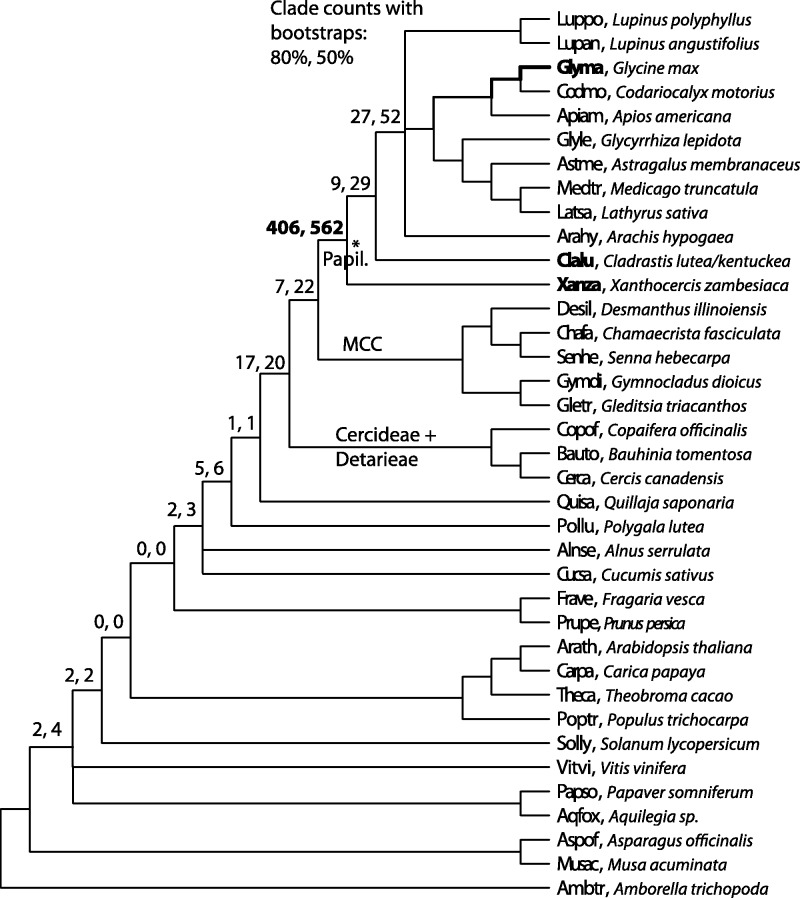
Illustration of tests for timing of the PWGD versus speciation times. Numbers at each node indicate the numbers of observed clades (at ≥80% and 50% BSVs, respectively) that are both consistent with the phylogeny in figure 2 and are rooted by the most recent common ancestor of Glycine paralogs (bold line) derived from the PWGD. The highest count (406 at ≥80% bootstrap) is at the papilionoid node itself, supporting a model in which the PWGD occurred just prior to the papilionoid diversification and thus gave rise to two clades with paralogous Glycine, Xanthocercis, and Cladrastis genes.
F<sc>ig</sc>. 4.
Fig. 4.
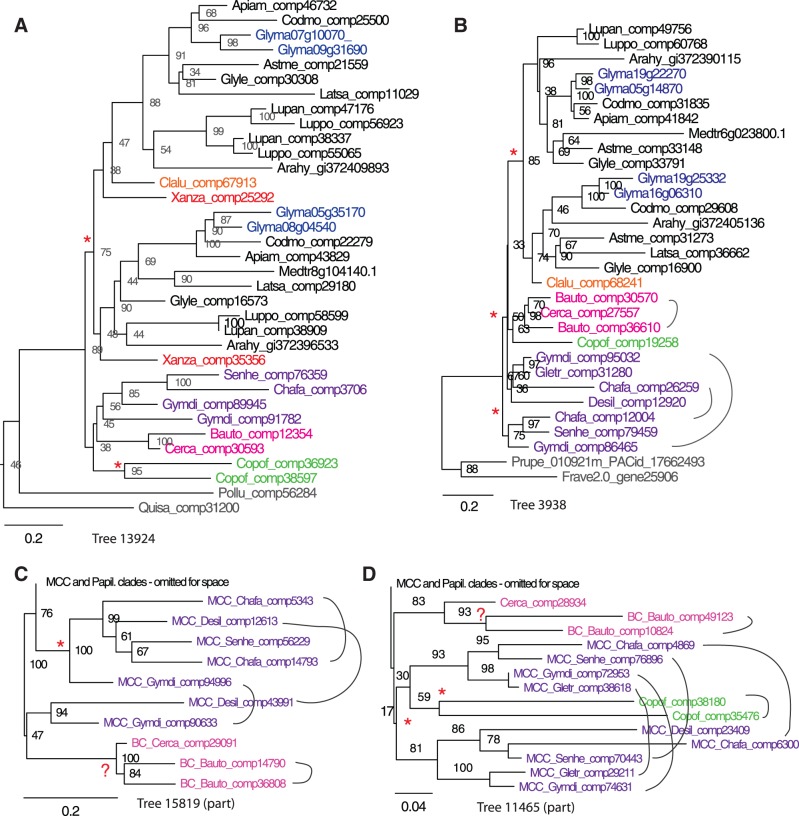
Sample gene trees, showing typical patterns seen among the 3,360 trees including Glycine homoeologs derived from the PWGD. Species names for each abbreviation are shown in figure 2 and table 1. Gene trees (A) and (B) are consistent with the PWGD predating divergence of Xanthocercis, Cladrastis, and other papilionoid lineages. Trees (B), (C), and (D) are consistent with an early WGD in the MCC clade and in the Cercideae. Outgroup taxa more distantly related than Polygala and Quillaja have been pruned for clarity. Trees are colored for ease of interpretation: Glycine max in blue; Xanthocercis and Cladrastis in red and orange, respectively; members of the MCC clade in purple, members of the Cercideae in pink, and the representative of the Detarieae (Copaifera) in green.
F<sc>ig</sc>. 5.
Fig. 5.
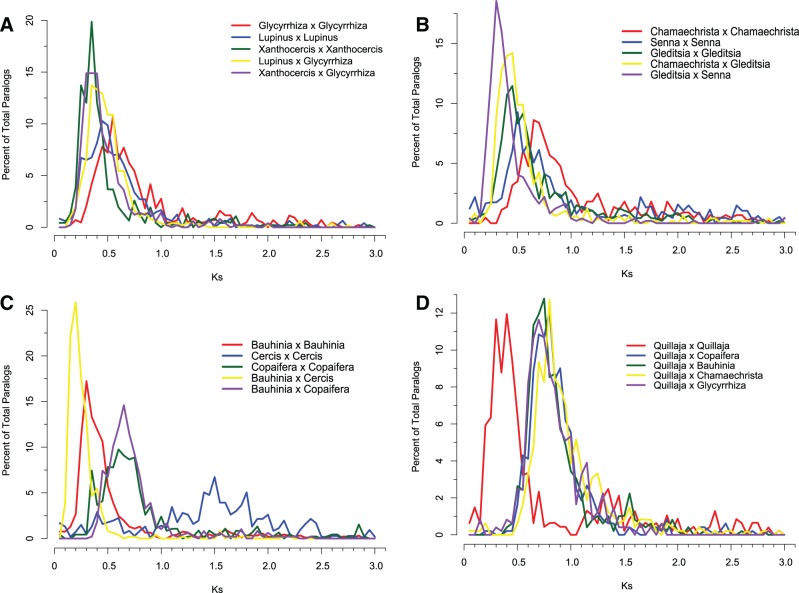
Plots of synonymous substitution frequencies by Ks class. Also see modal Ks values in figure 8. Selected comparisons: (A) Papilionoid examples: i) Glycyrrhiza paralog pairs (mode = 0.45), ii) Lupinus paralogs (mode = 0.50), iii) Xanthocercis paralogs (mode = 0.35), iv) Glycyrrhiza/Lupinus homolog pairs (mode = 0.35), and v) Glycyrrhiza/Xanthocercis homolog pairs (mode = 0.35). Comparisons suggest that PWGD (0.50–0.55 in Lupinus and 0.55 in Glycyrrhiza) predates Glycyrrhiza/Lupinus divergence (0.35). The Ks numbers for Cladrastis and Xanthocercis are ambiguous in terms of relative speciation versus PWGD timing. (B) MCC examples: i) Chamaecrista paralog pairs (mode = 0.65), ii) Senna paralog pairs (mode = 0.5), iii) Gleditsia paralog pairs (mode = 0.45), iv) Chamaecrista/Gleditsia ortholog pairs (mode = 0.45), and v) Senna/Gleditsia ortholog pairs (mode = 0.3). Comparisons among Senna and Gleditsia paralog and best BLAST hit homolog Ks plots suggest that the MCC WGD predates earliest diversification of MCC clade, but timing of WGD is ambiguous in comparison of the Chamaecrista and Gleditsia Ks plots. (C) Cercideae and Copaifera examples: Bauhinia paralog pairs (mode = 0.3), Cercis paralog pairs (mode = 0.4), Copaifera paralog pairs (mode = 0.6), Bauhinia/Cercis ortholog pairs (mode = 0.2), and Bauhinia/Copaifera ortholog pairs (mode = 0.65). These comparisons suggest separate Cercideae and Copof WGDs. (D) Comparisons with outgroup taxa, Quillaja: Quillaja paralog pairs (modes = 0.4, 1.4), Quillaja/Copaifera, Quillaja/Bauhinia, Quillaja/Chamaecrista, and Quillaja/Glycyrrhiza ortholog pairs (modes all 0.7–0.8).
F<sc>ig</sc>. 6.
Fig. 6.
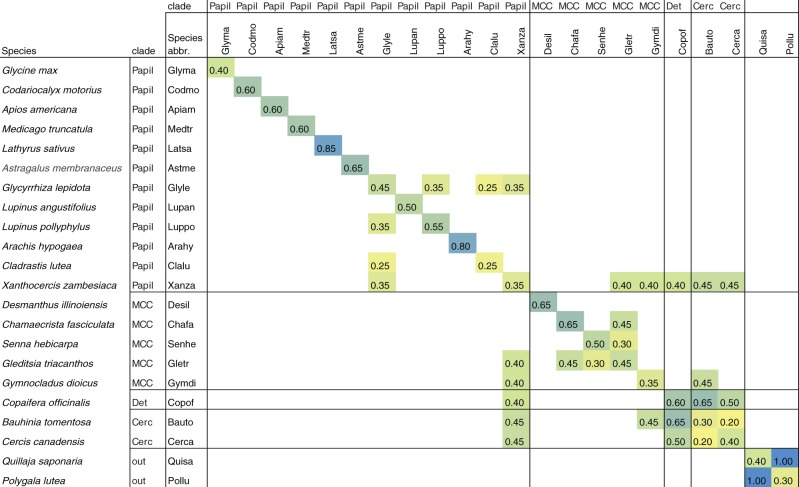
Ks modes for selected species comparisons. Values correspond to the primary peaks shown in figure 7. Higher Ks values are more blue; lower are more yellow. Example interpretation: WGDs occurred recently in each of Quillaja and Polygala (0.4 and 0.3), long after divergence of their respective lineages (1.0). The primary peak in the Xanthocercis Ks plot exhibits more recent divergence (0.35) than the peaks in plots for most species from the MCC, Detarieae, and Cercideae (0.4–0.45), suggesting old WGDs in those clades.

References

    1. Amborella Genome Project. The Amborella genome and the evolution of flowering plants. Science. 2013;342:1241089. - PubMed
    1. Ancestral Angiosperm Genome Project. 2013. [Internet]. Available: http://ancangio.uga.edu.
    1. Bell CD, Soltis DE, Soltis PS. The age and diversification of the angiosperms re-revisited. Am J Bot. 2010;97:1296–1303. - PubMed
    1. Bennett MD, Leitch IJ. 2012. Plant DNA C-values database (release 6.0, December 2012). [cited 2013 Dec]. Available from: http://www.kew.org/cvalues.
    1. Bertioli DJ, Moretzsohn MC, Madsen LH, Sandal N, Leal-Bertioli SC, Guimaraes PM, Hougaard BK, Fredslund J, Schauser L, Nielsen AM, et al. An analysis of synteny of Arachis with Lotus and Medicago sheds new light on the structure, stability and evolution of legume genomes. BMC Genomics. 2009;10:45. - PMC - PubMed

Publication types