


Distal transport of dissolved hydrothermal iron in the deep South Pacific Ocean
- PMID: 25349389
- PMCID: PMC4250120
- DOI: 10.1073/pnas.1418778111
Distal transport of dissolved hydrothermal iron in the deep South Pacific Ocean
Abstract
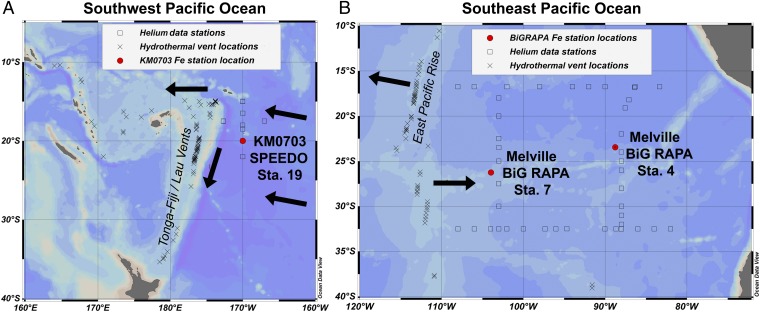
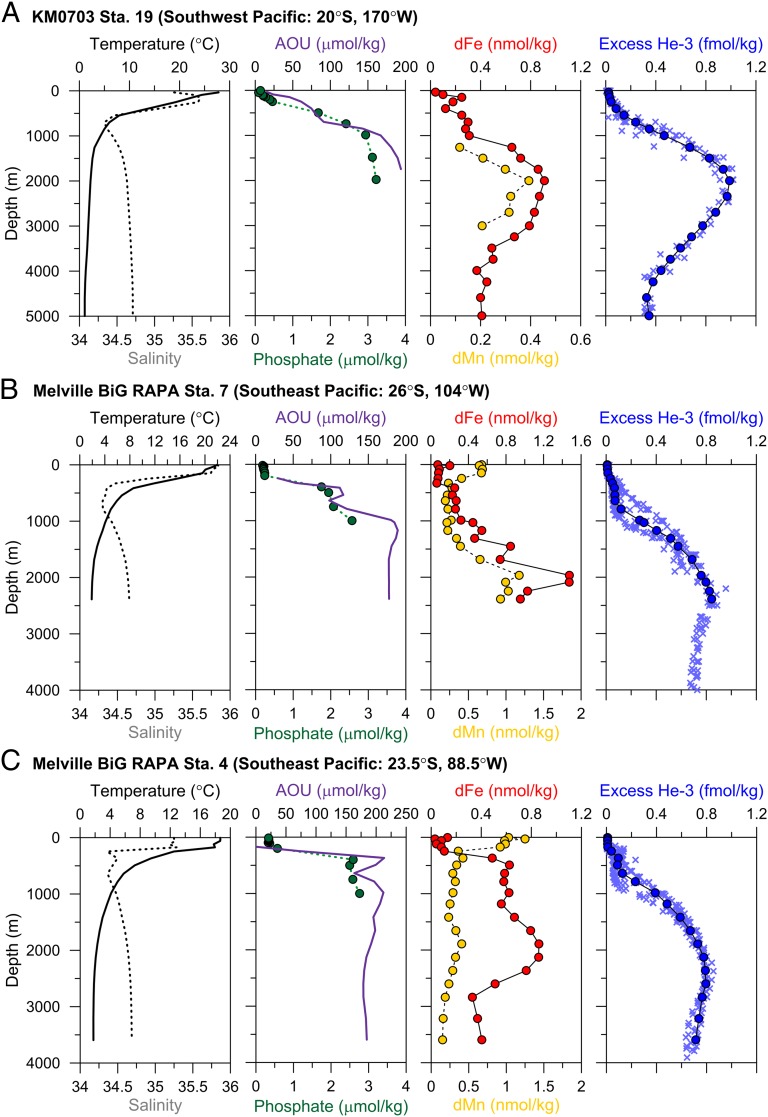
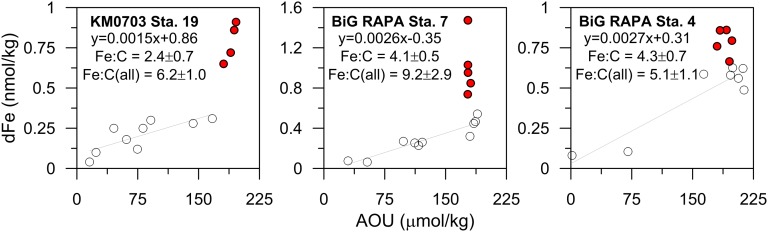
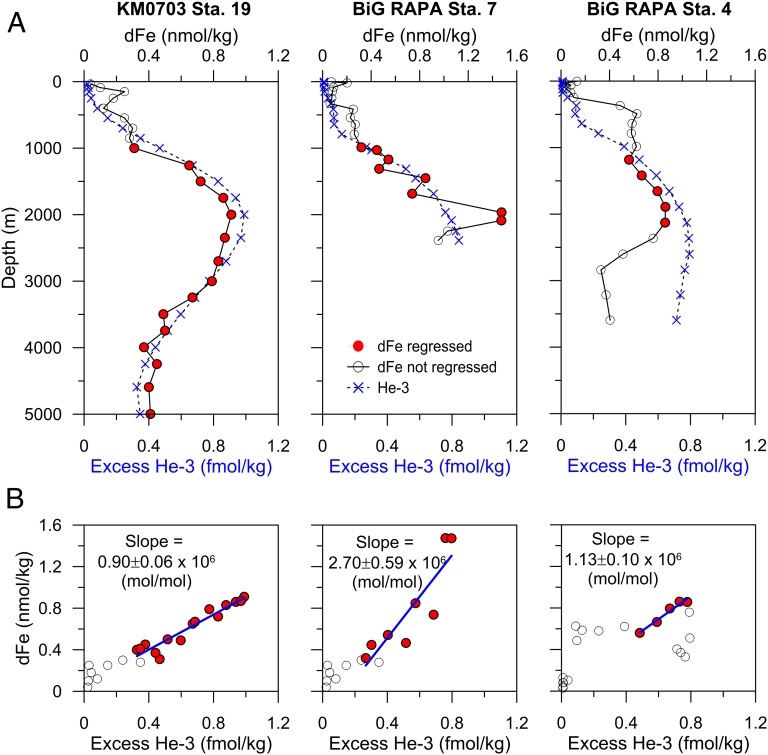
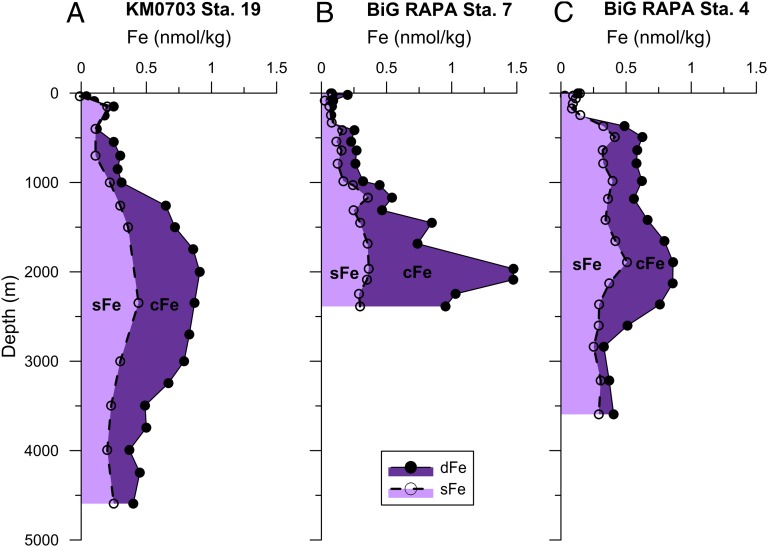
Until recently, hydrothermal vents were not considered to be an important source to the marine dissolved Fe (dFe) inventory because hydrothermal Fe was believed to precipitate quantitatively near the vent site. Based on recent abyssal dFe enrichments near hydrothermal vents, however, the leaky vent hypothesis [Toner BM, et al. (2012) Oceanography 25(1):209-212] argues that some hydrothermal Fe persists in the dissolved phase and contributes a significant flux of dFe to the global ocean. We show here the first, to our knowledge, dFe (<0.4 µm) measurements from the abyssal southeast and southwest Pacific Ocean, where dFe of 1.0-1.5 nmol/kg near 2,000 m depth (0.4-0.9 nmol/kg above typical deep-sea dFe concentrations) was determined to be hydrothermally derived based on its correlation with primordial (3)He and dissolved Mn (dFe:(3)He of 0.9-2.7 × 10(6)). Given the known sites of hydrothermal venting in these regions, this dFe must have been transported thousands of kilometers away from its vent site to reach our sampling stations. Additionally, changes in the size partitioning of the hydrothermal dFe between soluble (<0.02 µm) and colloidal (0.02-0.4 µm) phases with increasing distance from the vents indicate that dFe transformations continue to occur far from the vent source. This study confirms that although the southern East Pacific Rise only leaks 0.02-1% of total Fe vented into the abyssal Pacific, this dFe persists thousands of kilometers away from the vent source with sufficient magnitude that hydrothermal vents can have far-field effects on global dFe distributions and inventories (≥3% of global aerosol dFe input).
Keywords: East Pacific Rise; helium; hydrothermal vents; iron; trace metals.
Conflict of interest statement
The authors declare no conflict of interest.
Figures
Comment in
-
More to hydrothermal iron input than meets the eye.Proc Natl Acad Sci U S A. 2014 Nov 25;111(47):16641-2. doi: 10.1073/pnas.1419829111. Epub 2014 Nov 17. Proc Natl Acad Sci U S A. 2014. PMID: 25404312 Free PMC article. No abstract available.
References
-
- Moore JK, Doney SC, Glover DM, Fung IY. Iron cycling and nutrient-limitation patterns in surface waters of the World Ocean. Deep Sea Res Part II Top Stud Oceanogr. 2002;49(1-3):463–507.
-
- Boyd PW, et al. Mesoscale iron enrichment experiments 1993-2005: Synthesis and future directions. Science. 2007;315(5812):612–617. - PubMed
-
- Martin JH. Glacial-interglacial CO2 change: The iron hypothesis. Paleoceanography. 1990;5(1):1–13.
-
- Moore JK, Doney SC, Lindsay K. Upper ocean ecosystem dynamics and iron cycling in a global three-dimensional model. Global Biogeochem Cycles. 2004;18(4):GB4028.
-
- Von Damm KL, et al. Chemistry of submarine hydrothermal solutions at 21°N, East Pacific Rise. Geochim Cosmochim Acta. 1985;49(11):2197–2220.
Publication types
LinkOut - more resources
Full Text Sources
Other Literature Sources
