Clinical Trial
. 2014 Nov 11;111(45):16148-53.
doi: 10.1073/pnas.1409802111. Epub 2014 Oct 27.

Stretch-activated ion channel Piezo1 directs lineage choice in human neural stem cells

Affiliations
Clinical Trial

Stretch-activated ion channel Piezo1 directs lineage choice in human neural stem cells

Medha M Pathak et al. Proc Natl Acad Sci U S A. .

Abstract

Neural stem cells are multipotent cells with the ability to differentiate into neurons, astrocytes, and oligodendrocytes. Lineage specification is strongly sensitive to the mechanical properties of the cellular environment. However, molecular pathways transducing matrix mechanical cues to intracellular signaling pathways linked to lineage specification remain unclear. We found that the mechanically gated ion channel Piezo1 is expressed by brain-derived human neural stem/progenitor cells and is responsible for a mechanically induced ionic current. Piezo1 activity triggered by traction forces elicited influx of Ca(2+), a known modulator of differentiation, in a substrate-stiffness-dependent manner. Inhibition of channel activity by the pharmacological inhibitor GsMTx-4 or by siRNA-mediated Piezo1 knockdown suppressed neurogenesis and enhanced astrogenesis. Piezo1 knockdown also reduced the nuclear localization of the mechanoreactive transcriptional coactivator Yes-associated protein. We propose that the mechanically gated ion channel Piezo1 is an important determinant of mechanosensitive lineage choice in neural stem cells and may play similar roles in other multipotent stem cells.

Keywords: Yap/Taz; blebbistatin; calcium signaling; matrix mechanics; myosin II.


Conflict of interest statement

The authors declare no conflict of interest.

Figures
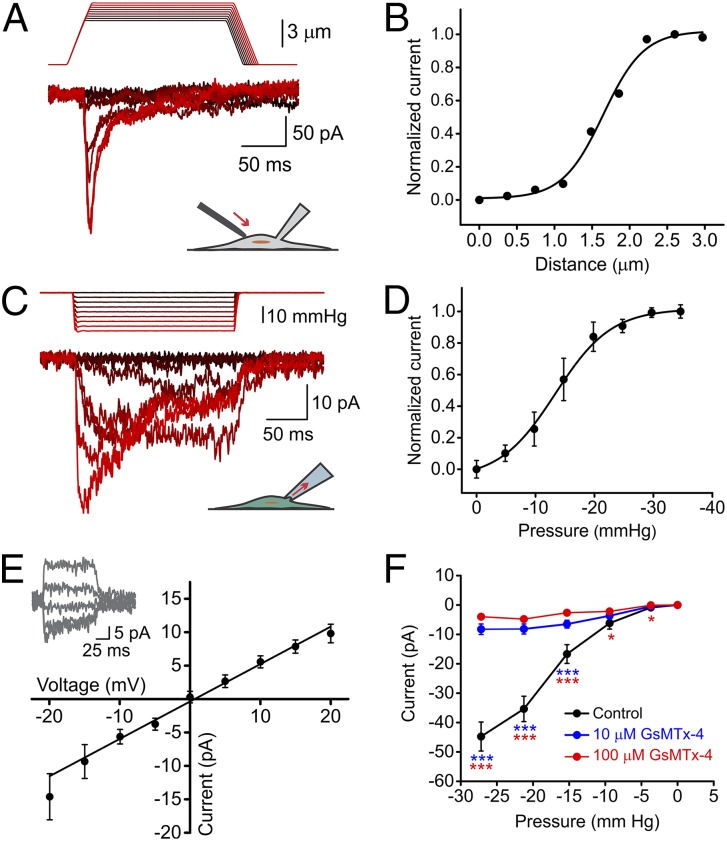
Fig. 1.
Fig. 1.
Mechanically induced currents in hNSPCs. (A) Representative traces of mechanically induced inward currents from SC23 hNSPC cells. Cells were subjected to a series of mechanical stimuli by indenting the plasma membrane with a stimulation probe. The probe was moved in 0.25-μm steps while recording in the whole-cell patch configuration with a holding potential of −80 mV. Data shown are representative of n = 6 cells. (B) Current amplitude in response to indentation by probe displacement from the traces shown in A. (C) Representative currents in an SC27 hNSPC cell induced by negative pipette pressure (0 to −30 mmHg in 3-mmHg steps) administered by a pressure clamp. Holding potential: −80 mV. (D) Normalized current–pressure relationship of SACs at a holding potential of −80 mV fitted with a Boltzmann equation with P50 = −13.4 mmHg and s = 4.75 mmHg. Results are shown as mean ± SEM (n = 8 cells). (E) Average current–voltage relationships of SACs in SC27 hNSPC cells. Results are shown as mean ± SEM (n = 7 cells). (Inset) Current traces in response to voltage steps from −40 mV to 40 mV in 20-mV steps, applied 250 ms before a negative pressure pulse of −30 mmHg. (F) Mean current amplitudes elicited by negative suction pulses in cell-attached patch-clamp mode in the absence (black, n = 29 cells) and presence of 10 μM (blue, n = 69 cells) and 100 μM (red, n = 42 cells) extracellular GsMTx-4. Error bars indicate SEM and are smaller than data points in some cases. *P < 0.05, **P < 0.01, ***P < 0.001 by two-sample t test. See also Fig. S1.
Fig. 2.
Fig. 2.
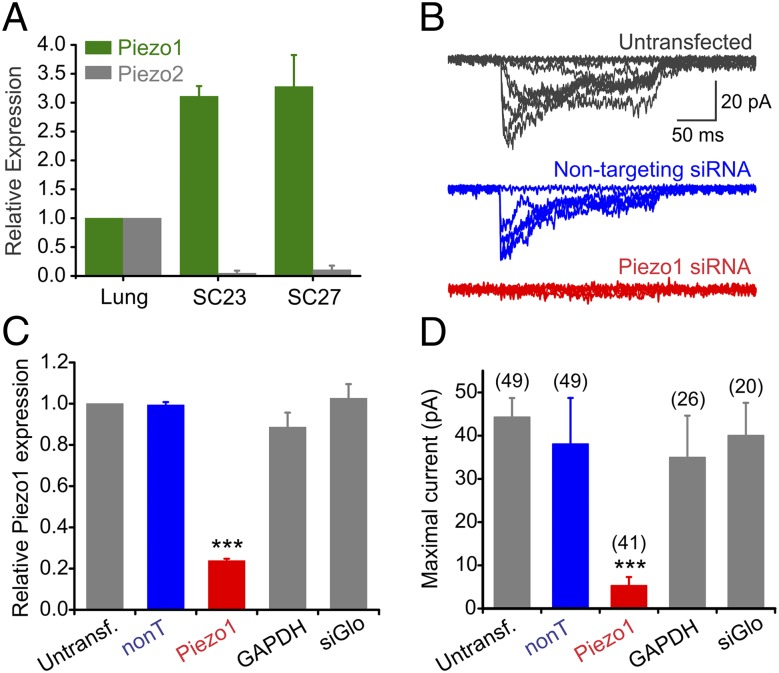
Piezo1 is essential for mechanically induced currents in hNSPCs. (A) mRNA expression of Piezo1 (green) and Piezo2 (gray) in SC23 and SC27 hNSPCs determined by qRT-PCR with 18S as the reference gene. Human lung was used as the tissue calibrator by the 2–∆∆CT method, because previously it was shown to express both channels (31). n = 6 independent experiments for Piezo1 and n = 4 independent experiments for Piezo2. Data are shown as mean ± SEM. (B) Representative mechanotransduction currents from an untransfected (Top, gray; same cell as in Fig. 1C), a cell transfected with a control nontargeting pool of siRNAs (Middle, blue), and a cell transfected with four siRNAs against Piezo1 (Bottom, red). The holding potential was −80 mV. (C) Quantification of Piezo1 transcripts by qRT-PCR from three independent transfection experiments. Parallel samples were used for patch-clamp measurements in D. ***P < 0.001 by ANOVA. (D) Mean maximal mechanotransduction currents recorded from untransfected cells, from cells transfected with a nontargeting pool of four siRNAs (nonT, 20 nM, blue), siGlo transfection marker alone (20 nM) or with a pool of four siRNAs against Piezo1 (20 nM, red) or GAPDH (25 nM). Numbers in parentheses refer to the numbers of cells patched for each condition. Data in C and D are from three independent transfection experiments. ***P < 0.001, Kruskal–Wallis test. See also Figs. S2 and S8.
Fig. 3.
Fig. 3.
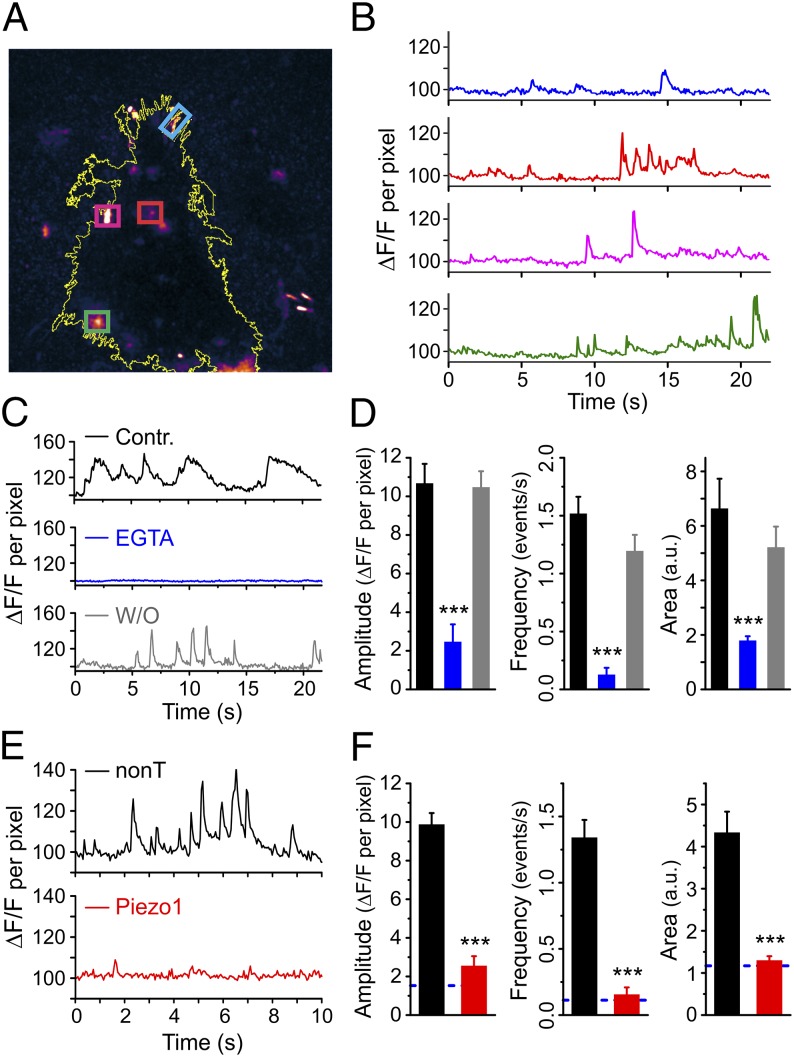
Piezo1 activity elicits spontaneous Ca2+ signals. (A) A maximum projection TIRFM image of an hNSPC cell loaded with Fluo-4 AM from a 600-frame video showing hotspots of Ca2+ activity. Four regions of interest are marked by colored boxes. The yellow line depicts the outline of the cell. See also Movie S1. (B) Plots of fluorescence intensity over time in the hotspots highlighted in A. The color of the trace matches the corresponding box color in A. Data are shown as signal per pixel with the fluorescence intensity at the start of the recording normalized to 100 (SI Methods). (C and D) Spontaneous Ca2+ transients are reversibly inhibited by addition of 6 mM EGTA to the bath solution. n = 22 for control (Contr.), 28 for EGTA, and 27 for washout (W/O). (E and F) hNSPCs transfected with Piezo1 siRNA show fewer and smaller spontaneous Ca2+ transients than cells transfected with nontargeting siRNA. The blue dashed line in F represents the levels expected in the absence of external calcium (based on D). n = 44 for nontargeting siRNA, and n = 53 for Piezo1 siRNA. Error bars represent SEM. ***P < 0.001 by two-sample t test. a.u., arbitrary units. See also Fig. S3.
Fig. 4.
Fig. 4.
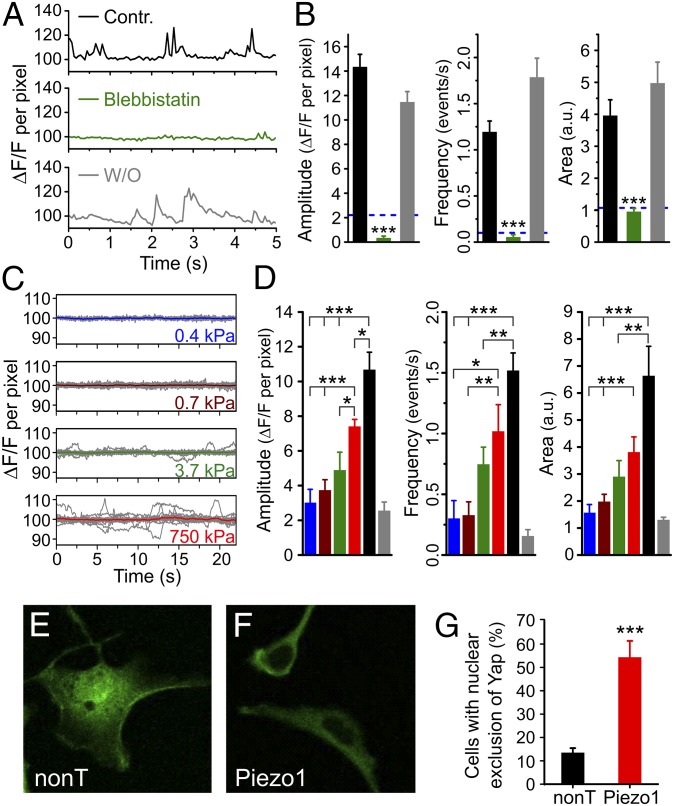
Piezo1 activity is linked to traction forces, substrate stiffness, and Yap localization. (A and B) Spontaneous Ca2+ transients are reversibly inhibited by the traction force inhibitor blebbistatin (50 μM), which acts by blocking the ATPase activity of myosin II. n = 57 for control (Contr.); n = 49 for blebbistatin; and n = 28 for washout (W/O). The dashed blue line in B represents levels expected in the absence of external calcium (based on Fig. 3D). (C and D) Spontaneous Ca2+ transients measured from hNSPCs grown on high-refractive-index silicone elastomers scale with substrate stiffness. n = 14 for 0.4 kPa; n = 26 for 0.7 kPa; n = 15 for 3.7 kPa; n = 14 for 750 kPa; and n = 22 for glass. The colors of the columns in D are matched to the traces in C: blue, 0.4 kPa; brown, 0.7 kPa; green, 3.7 kPa; red, 750 kPa; black, glass; gray, data from Piezo1 siRNA-transfected cells from Fig. 3F (reproduced for comparison). (EG) hNSPCs grown on glass coverslips show nuclear exclusion of Yap at a higher frequency when transfected with Piezo1 siRNA than when transfected with nontargeting siRNA. Error bars represent SEM. *P < 0.05, **P < 0.01, ***P < 0.001 by two-sample t test. a.u., arbitrary units.
Fig. 5.
Fig. 5.
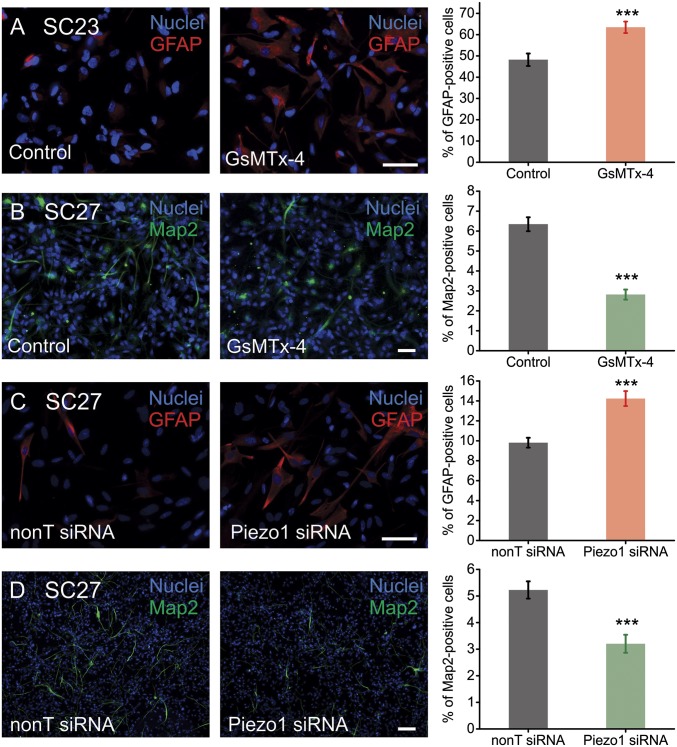
Piezo1 directs neuronal–glial lineage choice in human neural stem cells. (A) SC23 hNSPCs display an increase in astrogenesis (GFAP+ cells) in the presence of 5 μM free GsMTx-4 (SI Methods). n = 3 independent experiments. (B) SC27 hNSPCs display a reduction in the percentage of Map2+ cells when differentiated in the presence of 5 μM free GsMTx-4. n = 4 biological repeats from three independent experiments. (C) SC27 hNSPCs transfected with 20 nM Piezo1 siRNA differentiate into astrocytes more efficiently than SC27 hNSPCs transfected with 20 nM control nontargeting (nonT) siRNA. n = 3 biological repeats from two independent transfection experiments. (D) SC27 hNSPCs transfected with 20 nM Piezo1 siRNA show reduced neurogenesis as compared with cells transfected with 20 nM control nontargeting siRNA. n = 3 biological repeats from two independent transfection experiments. (Scale bars: 20 μm.) ***P < 0.001 with two-sample t test. See also Fig. S7.

References

    1. Sun Y, Chen C, Fu J. Forcing stem cells to behave: A biophysical perspective of the cellular microenvironment. Ann Review Biophys. 2012;41:519–542. - PMC - PubMed
    1. Watt FM, Huck WT. Role of the extracellular matrix in regulating stem cell fate. Nat Rev Mol Cell Biol. 2013;14(8):467–473. - PubMed
    1. Jones DL, Wagers AJ. No place like home: Anatomy and function of the stem cell niche. Nat Rev Mol Cell Biol. 2008;9(1):11–21. - PubMed
    1. Tyler WJ. The mechanobiology of brain function. Nat Rev Neurosci. 2012;13(12):867–878. - PubMed
    1. Yang C, Tibbitt MW, Basta L, Anseth KS. Mechanical memory and dosing influence stem cell fate. Nat Mater. 2014;13(6):645–652. - PMC - PubMed

Publication types