. 2014 Nov 11;111(45):16160-5.
doi: 10.1073/pnas.1419030111. Epub 2014 Oct 27.

Antisense COOLAIR mediates the coordinated switching of chromatin states at FLC during vernalization

Affiliations

Antisense COOLAIR mediates the coordinated switching of chromatin states at FLC during vernalization

Tibor Csorba et al. Proc Natl Acad Sci U S A. .

Abstract

Long noncoding RNAs (lncRNAs) have been proposed to play important roles in gene regulation. However, their importance in epigenetic silencing and how specificity is determined remain controversial. We have investigated the cold-induced epigenetic switching mechanism involved in the silencing of Arabidopsis thaliana Flowering Locus C (FLC), which occurs during vernalization. Antisense transcripts, collectively named COOLAIR, are induced by prolonged cold before the major accumulation of histone 3 lysine 27 trimethylation (H3K27me3), characteristic of Polycomb silencing. We have found that COOLAIR is physically associated with the FLC locus and accelerates transcriptional shutdown of FLC during cold exposure. Removal of COOLAIR disrupted the synchronized replacement of H3K36 methylation with H3K27me3 at the intragenic FLC nucleation site during the cold. Consistently, genetic analysis showed COOLAIR and Polycomb complexes work independently in the cold-dependent silencing of FLC. Our data reveal a role for lncRNA in the coordinated switching of chromatin states that occurs during epigenetic regulation.

Keywords: Arabidopsis; Polycomb; flowering; histone modifications; long noncoding RNA.


Conflict of interest statement

The authors declare no conflict of interest.

Figures
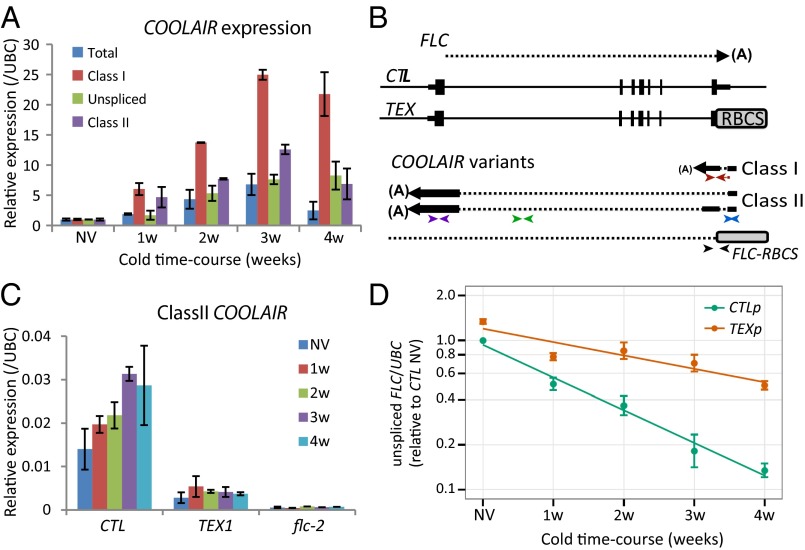
Fig. 1.
Fig. 1.
COOLAIR accelerates FLC transcriptional down-regulation during vernalization. (A) Quantitative RT-PCR (qRT-PCR) analysis showing COOLAIR forms are differentially induced during a time-course of cold exposure, nonvernalized material (NV), 1 wk cold exposure (1w), 2 wk cold (2w), 3 wk cold (3w), and 4 wk cold (4w). Values are normalized to NV (set as 1), means ± SEM of three biological replicates. (B) Schematic representation of the FLC genomic locus and sense and antisense RNA transcripts in the control (CTL) and Terminator EXchange lines (TEX). CTL lines were generated by transformation of FLC genomic construct (15 kb of the FLC locus, FLC-15) into flc-2 FRI background. TEX lines were generated as described (9, 10). For antisense transcripts in TEX lines, a combination of FLC and RBCS primers were used. (A), pA sites; RBCS, Rubisco gene terminator. The position of the primers used in qRT-PCR analysis to assess class I (red arrows), class II (purple arrows), unspliced antisense (green arrows), total COOLAIR (blue arrows), or antisense RNA transcript derived from TEX construct (black arrows) are shown; sequences are listed in SI Appendix, Table S2. (C) qRT-PCR analysis of class II COOLAIR relative to UBC in CTL and TEX. Values are means ± SEM of three biological replicates. (D) Down-regulation of FLC unspliced RNA is significantly abrogated (P < 0.005) in TEX compared with control during cold exposure. CTLp and TEXp correspond to a mix of 50 T3 transgenic lines (Materials and Methods). Values are means ± SEM of five biological replicates and are plotted on a log scale. NV levels are also significantly different (P < 0.001).
Fig. 2.
Fig. 2.
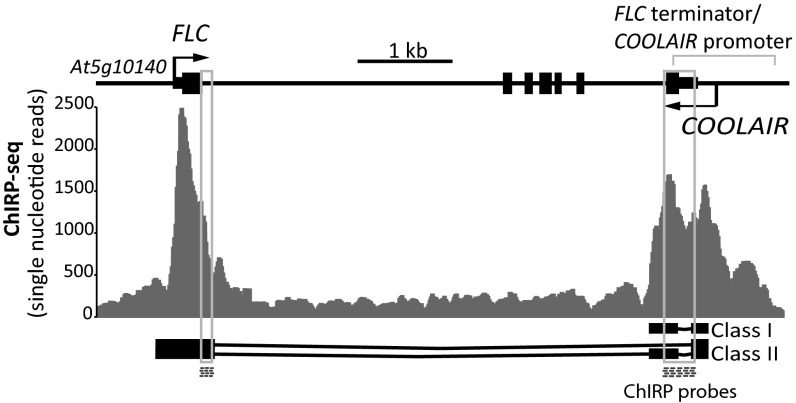
COOLAIR associates in cis with FLC chromatin. ChIRP deep sequencing analysis data shows COOLAIR associates with FLC chromatin in two distinct regions. Locations of biotinylated DNA probes used for COOLAIR ChIRP are shown (dashed boxes). A schematic of the FLC locus is shown with the structure of the class I and class II COOLAIR transcripts.
Fig. 3.
Fig. 3.
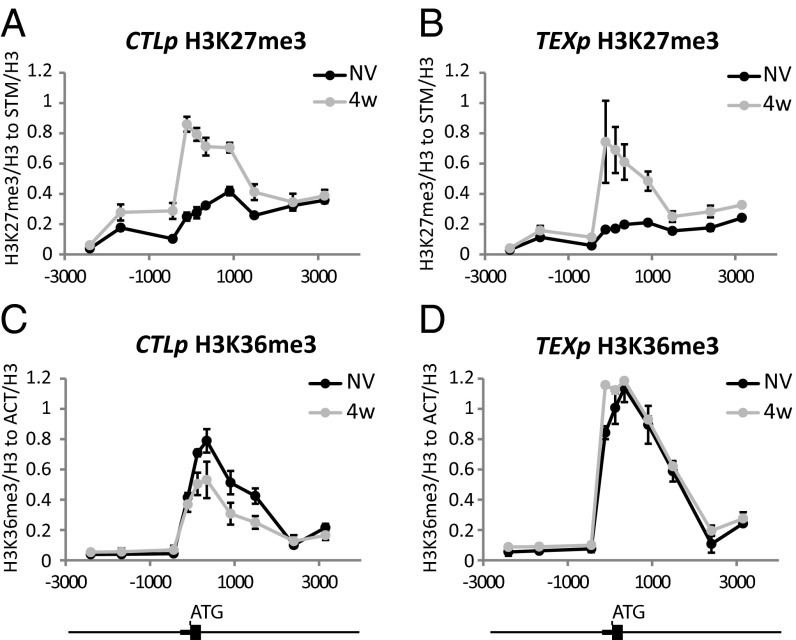
COOLAIR differentially affects the dynamics of H3K36me3 and H3K27me3 during cold-induced silencing at FLC. ChIP analysis of H3K27me3 in control lines (A) and TEX lines (B). ChIP analysis of H3K36me3 in control lines (C) and TEX lines (D). Nonvernalized (NV) and 4 wk vernalized (4w) samples were compared. Small and big boxes on the schematic below show the FLC 5′ UTR and exon1, respectively. Numbers define positions from translation start site (ATG). Values are means ± SEM of three biological replicates.
Fig. 4.
Fig. 4.
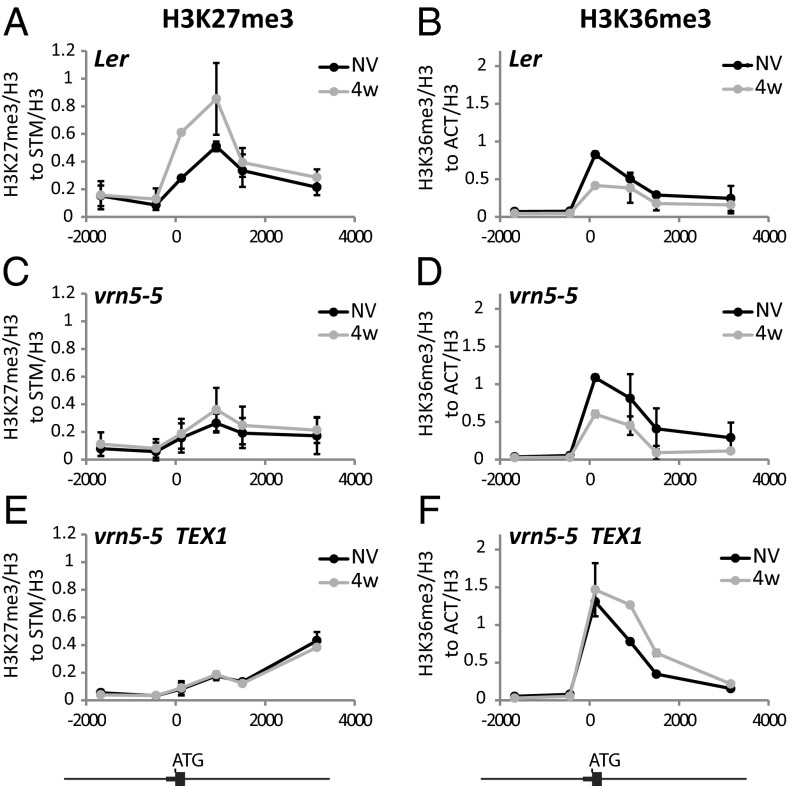
H3K36me3 and H3K27me3 change independently of each other. ChIP showing H3K27me3 dynamics in Landsberg erecta (Ler) (A), vrn5-5 (C), and vrn5-5/TEX1 plants (E), nonvernalized (NV), after 4 wk cold (4w). ChIP showing H3K36me3 dynamics in Ler (B), vrn5-5 (D), and vrn5-5/TEX1 plants (F) nonvernalized (NV), after 4 wk cold (4w). Numbers define positions from translation start site (ATG). Values are means ± SEM of three biological replicates.
Fig. 5.
Fig. 5.
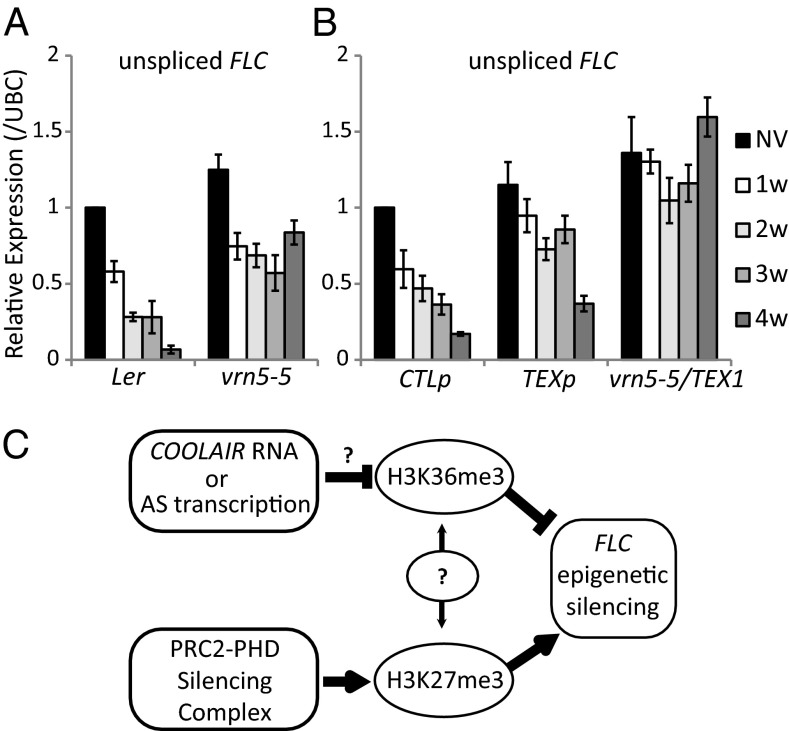
Loss of cold-induced transcriptional repression of FLC is additive when vrn5 is combined with a TEX transgene. qRT-PCR analysis of unspliced FLC RNA through a time-course of cold exposure in Ler and vrn5-5 plants (A) and CTL, TEX lines or vrn5-5/TEX (B). Values are means ± SEM of three biological replicates. (C) Proposed model: COOLAIR negatively affects H3K36me3-methylation status and functions independently of PHD-PRC2–mediated H3K27 trimethylation to promote FLC silencing during vernalization.

References

    1. Michaels SD, Amasino RM. FLOWERING LOCUS C encodes a novel MADS domain protein that acts as a repressor of flowering. Plant Cell. 1999;11(5):949–956. - PMC - PubMed
    1. Sheldon CC, Rouse DT, Finnegan EJ, Peacock WJ, Dennis ES. The molecular basis of vernalization: The central role of FLOWERING LOCUS C (FLC) Proc Natl Acad Sci USA. 2000;97(7):3753–3758. - PMC - PubMed
    1. Sheldon CC, et al. The FLF MADS box gene: A repressor of flowering in Arabidopsis regulated by vernalization and methylation. Plant Cell. 1999;11(3):445–458. - PMC - PubMed
    1. Gendall AR, Levy YY, Wilson A, Dean C. The VERNALIZATION 2 gene mediates the epigenetic regulation of vernalization in Arabidopsis. Cell. 2001;107(4):525–535. - PubMed
    1. De Lucia F, Crevillen P, Jones AM, Greb T, Dean C. A PHD-polycomb repressive complex 2 triggers the epigenetic silencing of FLC during vernalization. Proc Natl Acad Sci USA. 2008;105(44):16831–16836. - PMC - PubMed

Publication types

MeSH terms