


QTc interval prolongation with vascular endothelial growth factor receptor tyrosine kinase inhibitors
- PMID: 25349964
- PMCID: PMC4453446
- DOI: 10.1038/bjc.2014.564
QTc interval prolongation with vascular endothelial growth factor receptor tyrosine kinase inhibitors
Abstract
Background: Multi-targeted vascular endothelial growth factor receptor (VEGFR) tyrosine kinase inhibitors (TKIs) are known to cause cardiac toxicity, but the relative risk (RR) of QTc interval prolongation and serious arrhythmias associated with them are not reported.
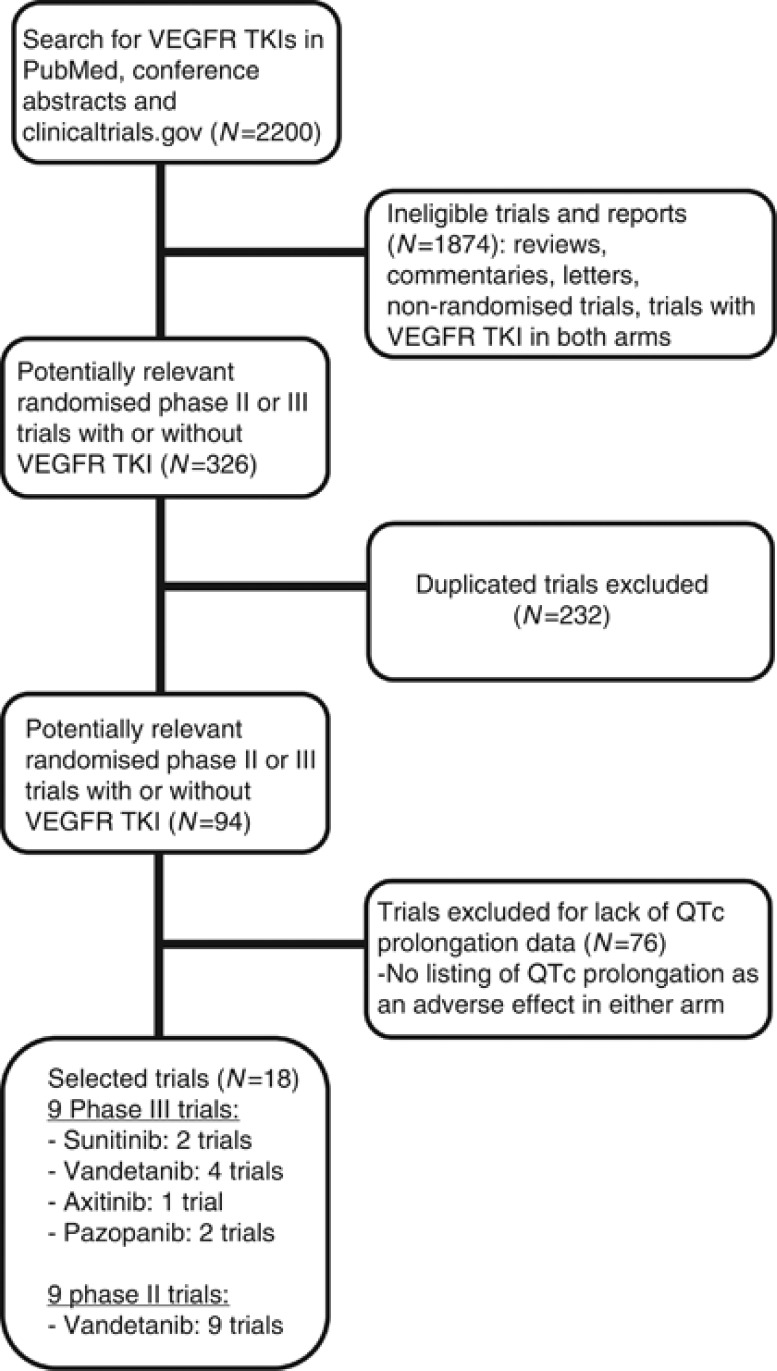
Methods: We conducted a trial-level meta-analysis of randomised phase II and III trials comparing arms with and without a US Food and Drug Administration-approved VEGFR TKI (sunitinib, sorafenib, pazopanib, axitinib, vandetanib, cabozantinib, ponatinib and regorafenib). A total of 6548 patients from 18 trials were selected. Statistical analyses were conducted to calculate the summary incidence, RR and 95% CIs.
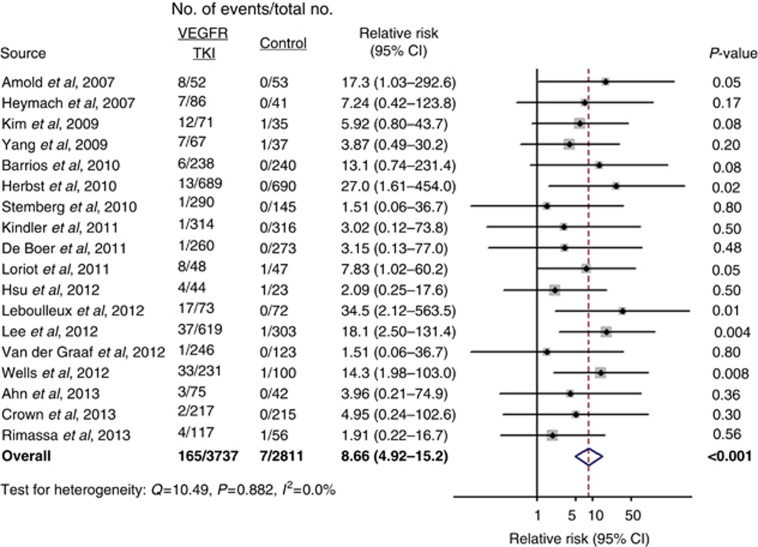
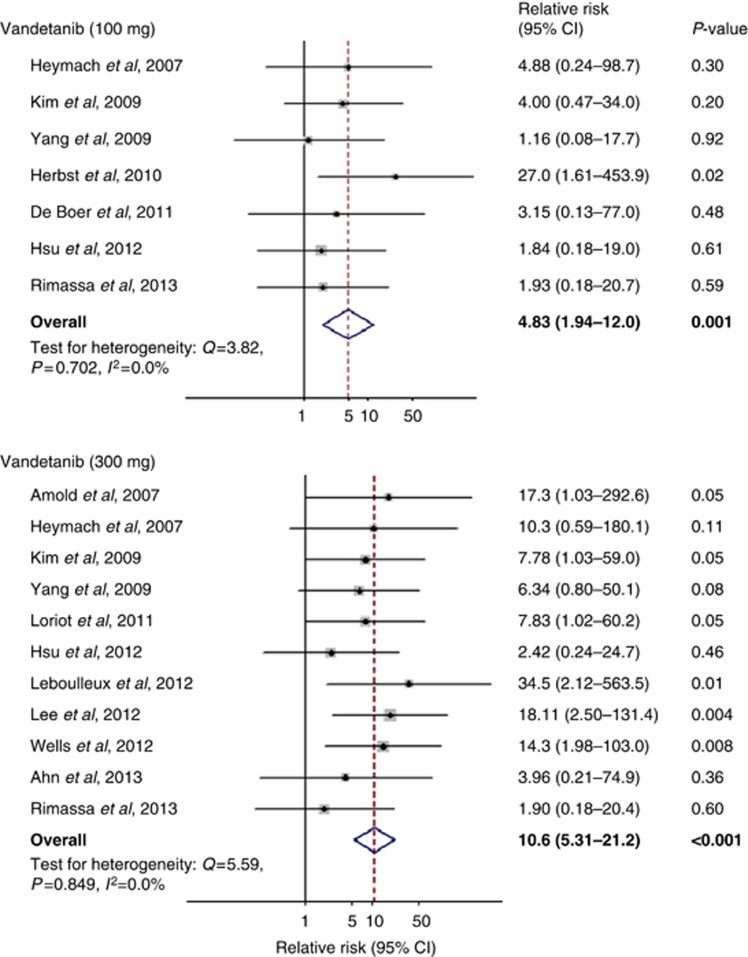
Results: The RR for all-grade and high-grade QTc prolongation for the TKI vs no TKI arms was 8.66 (95% CI 4.92-15.2, P<0.001) and 2.69 (95% CI 1.33-5.44, P=0.006), respectively, with most of the events being asymptomatic QTc prolongation. Respectively, 4.4% and 0.83% of patients exposed to VEGFR TKI had all-grade and high-grade QTc prolongation. On subgroup analysis, only sunitinib and vandetanib were associated with a statistically significant risk of QTc prolongation, with higher doses of vandetanib associated with a greater risk. The rate of serious arrhythmias including torsades de pointes did not seem to be higher with high-grade QTc prolongation. The risk of QTc prolongation was independent of the duration of therapy.
Conclusions: In the largest study to date, we show that VEGFR TKI can be associated with QTc prolongation. Although most cases were of low clinical significance, it is unclear whether the same applies to patients treated off clinical trials.
Figures
References
-
- Ahn JS, Lee KH, Sun JM, Park K, Kang ES, Cho EK, Lee DH, Kim SW, Lee GW, Kang JH, Lee JS, Lee JW, Ahn MJ. A randomized, phase II study of vandetanib maintenance for advanced or metastatic non-small-cell lung cancer following first-line platinum-doublet chemotherapy. Lung Cancer. 2013;82 (3:455–460. - PubMed
-
- Al-Khatib SM, LaPointe NM, Kramer JM, Califf RM. What clinicians should know about the QT interval. JAMA. 2003;289 (16:2120–2127. - PubMed
-
- Arnold AM, Seymour L, Smylie M, Ding K, Ung Y, Findlay B, Lee CW, Djurfeldt M, Whitehead M, Ellis P, Goss G, Chan A, Meharchand J, Alam Y, Gregg R, Butts C, Langmuir P, Shepherd F, National Cancer Institute of Canada Clinical Trials Group Study BR.20 Phase II study of vandetanib or placebo in small-cell lung cancer patients after complete or partial response to induction chemotherapy with or without radiation therapy: National Cancer Institute of Canada Clinical Trials Group Study BR.20. J Clin Oncol. 2007;25 (27:4278–4284. - PubMed
-
- Barrios CH, Liu MC, Lee SC, Vanlemmens L, Ferrero JM, Tabei T, Pivot X, Iwata H, Aogi K, Lugo-Quintana R, Harbeck N, Brickman MJ, Zhang K, Kern KA, Martin M. Phase III randomized trial of sunitinib versus capecitabine in patients with previously treated HER2-negative advanced breast cancer. Breast Cancer Res Treat. 2010;121 (1:121–131. - PMC - PubMed
-
- Bazett HC. An analysis of the time relations to electrocardiograms. Heart. 1920;7:353–370.
Publication types
MeSH terms
Substances
LinkOut - more resources
Full Text Sources
Other Literature Sources
Medical
