. 2014 Oct 27;15(11):19499-515.
doi: 10.3390/ijms151119499.

Over-expression of SlSHN1 gene improves drought tolerance by increasing cuticular wax accumulation in tomato

Affiliations

Over-expression of SlSHN1 gene improves drought tolerance by increasing cuticular wax accumulation in tomato

Ayed M Al-Abdallat et al. Int J Mol Sci. .

Abstract

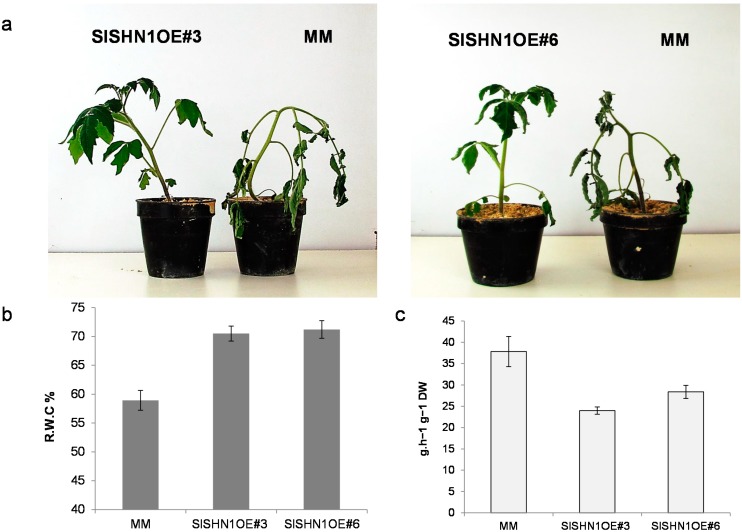
Increasing cuticular wax accumulation in plants has been associated with improving drought tolerance in plants. In this study, a cDNA clone encoding the SlSHN1 transcription factor, the closest ortholog to WIN/SHN1 gene in Arabidopsis, was isolated from tomato plant. Expression analysis of SlSHN1 indicated that it is induced in response to drought conditions. The over-expression of SlSHN1 in tomato under the control of the constitutive CaMV 35S promoter produced plants that showed mild growth retardation phenotype with shiny and dark green leaves. Scanning electron microscopy showed that the over-expression of SlSHN1 in tomato resulted in higher cuticular wax deposition on leaf epidermial tissue when compared to non-transformed plants. Expression analysis in transgenic lines over-expressing SlSHN1 indicated that several wax-related synthesis genes were induced. Transgenic tomato plants over-expressing SlSHN1 showed higher drought tolerance when compared with wild type plants; this was reflected in delayed wilting of transgenic lines, improved water status and reduced water loss rate when compared with wild type plants. In conclusion, the SlSHN1 gene can modulate wax accumulation and could be utilized to enhance drought tolerance in tomato plant.


Figures
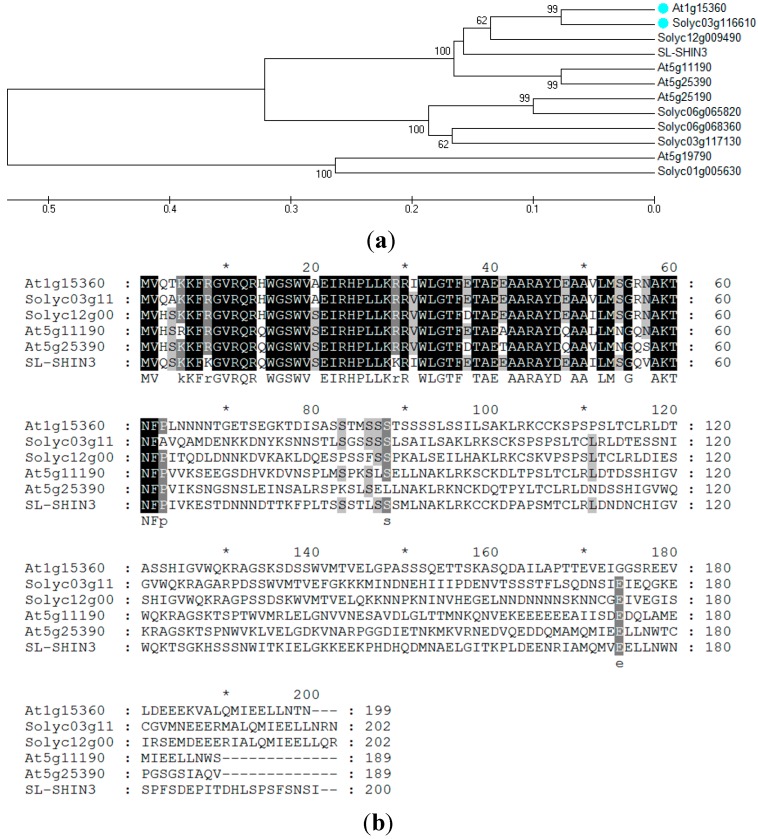
Figure 1
Figure 1
(a) Phylogenetic analysis of Arabidopsis proteins belonging to the ERF Gene Family Group Va and (b) their closest ortholog in tomato. Multiple sequence alignment analysis of three selected WIN/SHN Arabidopsis proteins (At1g15360 (WIN1/SHN1), At5g11190 (WIN2/SHN2) and At5g25390 (WIN3/SHN3)) with their closest ortholog in tomato (SlSHN1 (Solyc03g116610), SlSHN2 (Solyc12g009490) and SlSHN3) [28]. The AP2 domain is underlined. White letters shaded indicate amino acids that are either 100% identical (black) or identical in at least 80% (dark gray) or identical in at least 60% (light gray) of all proteins.
Figure 2
Figure 2
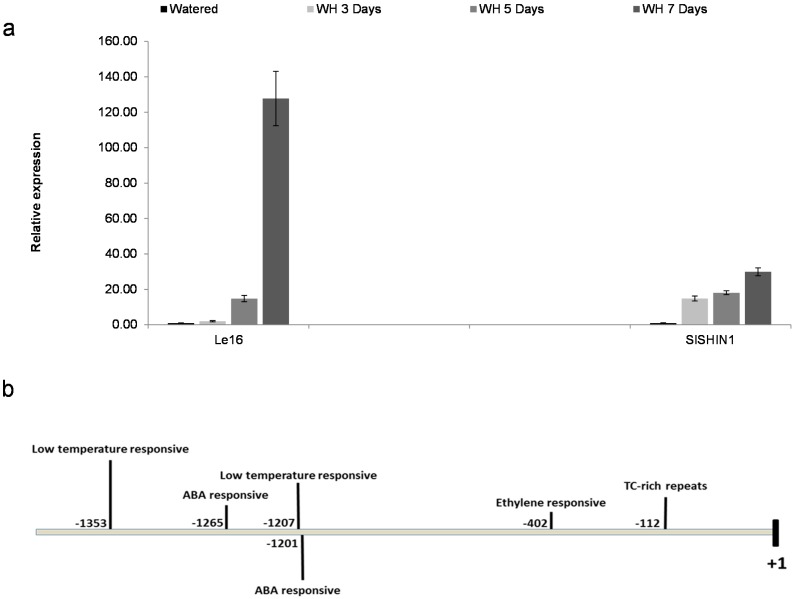
(a) Gene expression analysis of SlSHN1 in response to drought conditions. Tomato Moneymaker plants were subjected to water withholding (WH) conditions for 3, 5 and 7 days and compared to well-watered plants (control). The stress responsive Le16 (Solyc10g075090) gene was included as a control. The bars are standard deviations (SD) of three technical repeats; (b) Characteristics of the promoter region of SlSHN1 in tomato. Distribution of major known stress-related cis-elements in the first 1500 bp of the SlSHN1 promoter region as identified using PlantCARE cis-element databases.
Figure 3
Figure 3
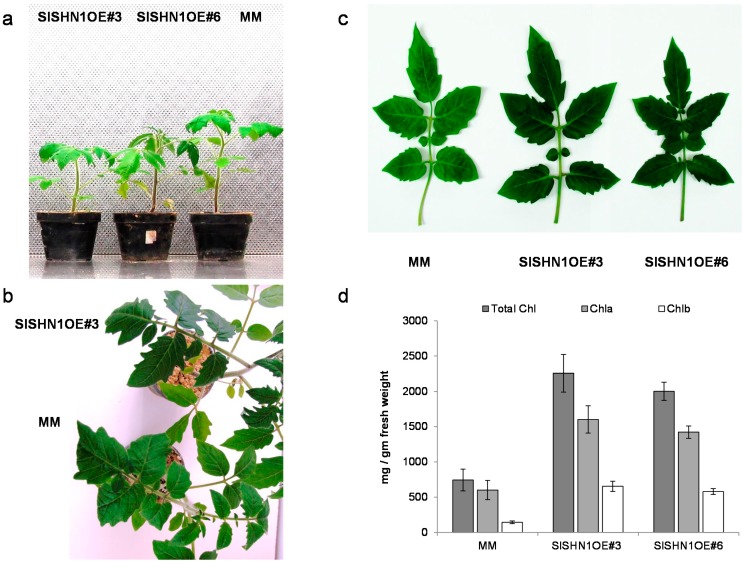
(a) Growth performance of two-week old tomato seedlings of two transgenic lines over-expressing SlSHN1 (SlSHN1OE#3 and SlSHN1OE#6) and wild type (MM) under normal conditions; (b) The shiny appearance of the transgenic line over-expressing SlSHN1 (SlSHN1OE#3) compared with wild type plant; (c) The dark green color phenotype of leaves in transgenic lines over-expressing SlSHN1 (SlSHN1OE#3 and SlSHN1OE#6) compared with wild type leaf (MM); (d) Total chlorophyll (total Chl), Chlorophyll a (Chla) and Chlorophyll b (Chlb) content in two transgenic lines over-expressing SlSHN1 (SlSHN1OE#3 and SlSHN1OE#6) and wild type leaves (MM).
Figure 4
Figure 4
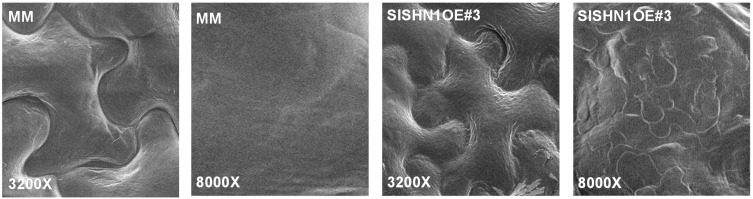
Scanning electron microscopy photos showing the leaf abaxial side in wild type (MM) and transgenic line over-expressing SlSHN1 (SLSHN1OE#3) at two magnification powers (3200× and 8000×).
Figure 5
Figure 5
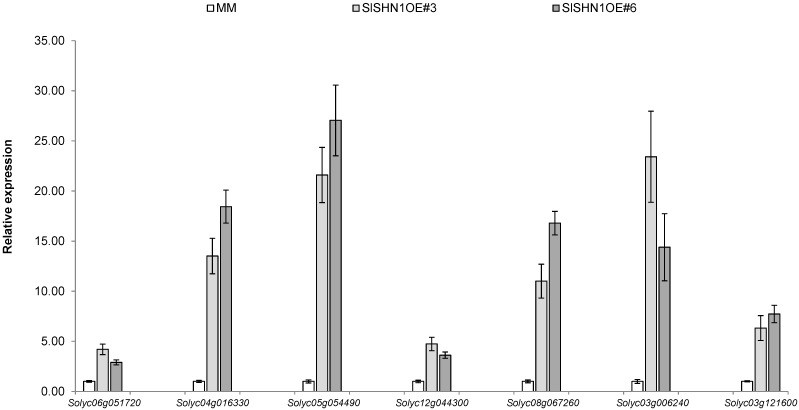
Gene expression analysis of seven cutin-related synthesis genes (Solyc06g051720 (GDSL-motif lipase), Solyc04g016330 (GDSL-motif lipase), Solyc05g054490 (Enoyl-CoA reductase), Solyc12g044300 (acyl-CoA synthase), Solyc08g067260 (Fiddlehead), Solyc03g006240 (HOTHEAD-like) and Solyc03g121600 (HOTHEAD-like)) in leaves of transgenic line over-expressing SlSHN1 (SlSHN1OE#3 and SlSHN1OE#6) and wild type plants (MM). The bars are standard deviations (SD) of three technical repeats.
Figure 6
Figure 6
(a) Growth performance of tomato plants of two transgenic lines over-expressing SlSHN1 (SlSHN1OE#3 and SlSHN1OE#6) and wild type (MM) after 21 days of water withholding; (b) R.W.C. in leaves of two transgenic lines over-expressing SlSHN1 (SlSHN1OE#3 and SlSHN1OE#6) and wild type (MM) after 21 days of water withholding. Values are the means ± S.E. of 5 plants; (c) Water loss as measured by decrease in fresh weight after 2 h in detached leaves from two transgenic lines over-expressing SlSHN1 (SlSHN1OE#3 and SlHN1OE#6) and wild type (MM). Values are the means ± S.E. of 5 plants.

References

    1. Neumann P.M. Coping mechanisms for crop plants in drought-prone environments. Ann. Bot. 2008;101:901–907. doi: 10.1093/aob/mcn018. - DOI - PMC - PubMed
    1. Cramer G.R., Urano K., Delrot S., Pezzotti M., Shinozaki K. Effects of abiotic stress on plants: A systems biology perspective. BMC Plant Biol. 2011;11:163. doi: 10.1186/1471-2229-11-163. - DOI - PMC - PubMed
    1. Osakabe Y., Osakabe K., Shinozaki K., Tran L.S. Response of plants to water stress. Front. Plant Sci. 2014;5:86. doi: 10.3389/fpls.2014.00086. - DOI - PMC - PubMed
    1. Nakashima K., Yamaguchi-Shinozaki K., Shinozaki K. The transcriptional regulatory network in the drought response and its crosstalk in abiotic stress responses including drought, cold, and heat. Front. Plant Sci. 2014;5:170. doi: 10.3389/fpls.2014.00170. - DOI - PMC - PubMed
    1. Kissoudis C., van de Wiel C., Visser R.G., van der Linden G. Enhancing crop resilience to combined abiotic and biotic stress through the dissection of physiological and molecular crosstalk. Front. Plant Sci. 2014;5:207. doi: 10.3389/fpls.2014.00207. - DOI - PMC - PubMed

Publication types