


Correlation between compartmental tenofovir concentrations and an ex vivo rectal biopsy model of tissue infectibility in the RMP-02/MTN-006 phase 1 study
- PMID: 25350130
- PMCID: PMC4211741
- DOI: 10.1371/journal.pone.0111507
Correlation between compartmental tenofovir concentrations and an ex vivo rectal biopsy model of tissue infectibility in the RMP-02/MTN-006 phase 1 study
Abstract
Objectives: This study was designed to assess the dose-response relationship between tissue, blood, vaginal and rectal compartment concentrations of tenofovir (TFV) and tenofovir diphosphate (TFVdp) and ex vivo rectal HIV suppression following oral tenofovir disoproxil fumarate (TDF) and rectal administration of TFV 1% vaginally-formulated gel.
Design: Phase 1, randomized, two-site (US), double-blind, placebo-controlled study of sexually-abstinent males and females.
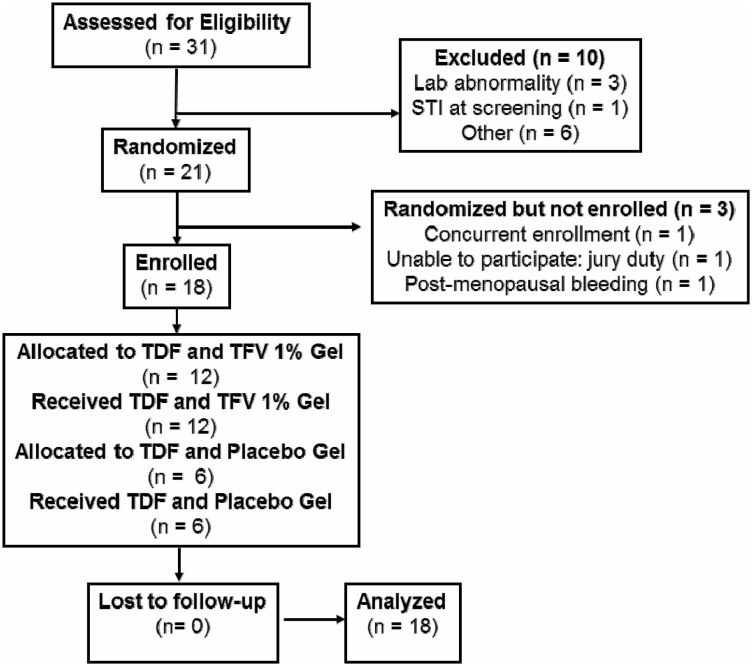
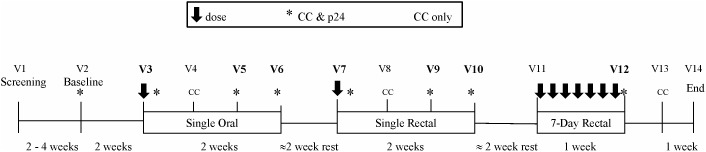
Methods: Eighteen participants received a single 300 mg exposure of oral TDF and were then randomized 2∶1 to receive a single then seven-daily rectal exposures of TFV 1% gel (40 mg TFV per 4 ml gel application) or hydroxyethyl-cellulose (HEC) placebo gel. Blood and rectal biopsies were collected for pharmacokinetic TDF and TFVdp analyses and ex vivo HIV-1 challenge.
Results: There was a significant fit for the TFVdp dose-response model for rectal tissue (p = 0.0004), CD4+MMC (p<0.0001), CD4-MMC (p<0.0001), and TotalMMC (p<0.0001) compartments with r2 ranging 0.36-0.64. Higher concentrations of TFVdp corresponded with lower p24, consistent with drug-mediated virus suppression. The single oral treatment failed to provide adequate compartment drug exposure to reach the EC50 of rectal tissue TFVdp predicted to be necessary to suppress HIV in rectal tissue. The EC50 for CD4+MMC was within the single topical treatment range, providing evidence that a 1% topical, vaginally-formulated TFV gel provided in-vivo doses predicted to provide for 50% efficacy in the ex vivo assay. The 7-daily topical TFV gel treatment provided TFVdp concentrations that reached EC90 biopsy efficacy for CD4-MMC, CD4+MMC and TotalMMC compartments.
Conclusion: The TFVdp MMC compartment (CD4+, CD4- and Total) provided the best surrogate for biopsy infectibility and the 7-daily topical TFV gel treatment provided the strongest PK profile for HIV suppression. ClinicalTrials.gov NCT00984971.
Conflict of interest statement
Figures
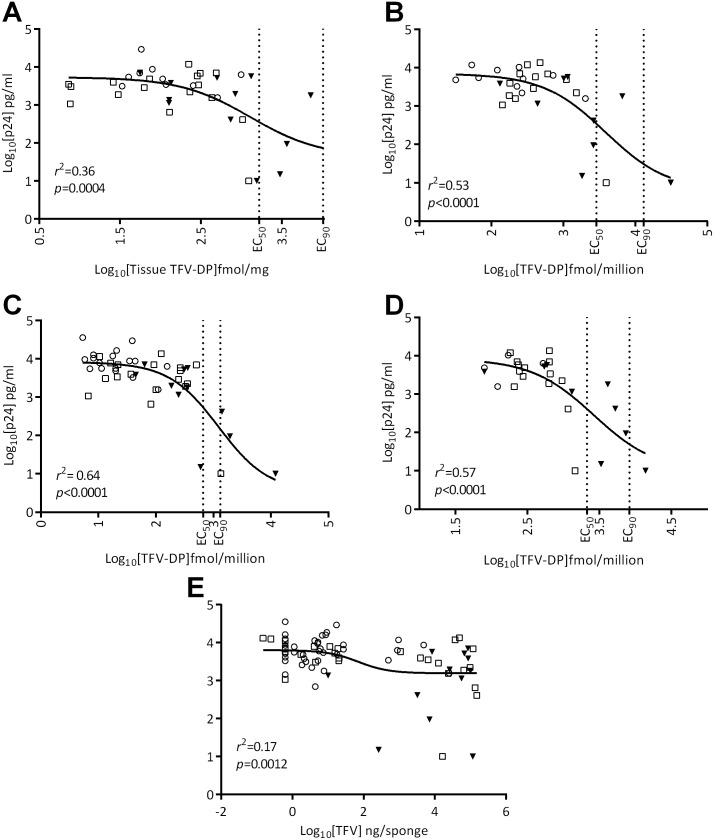
 ), single topical TFV gel (□) and 7-day topical TFV gel (▾) microbicide treatments for the dose-response relationship between CC drug concentrations and ex vivo p24 levels. Figure panels A-D show TFVdp in (A) rectal tissue, (B) TFVdp CD4+
MMC, (C) TFVdp CD4−
MMC, (D) TFVdp TotalMMC and (E) Tenofovir (TFV) rectal fluid concentration. Parameters from the log-log non-linear model with a Hill slope factor of –1.0, where r
2 and probability levels for the fit of the non-linear least-squares analysis of variance are embedded. Vertical lines indicate the EC50 and EC90 calculated by the logistic regression analysis as the compartmental drug concentrations predicted to provide 50 and 90% efficacy in the explant infectivity assay.
), single topical TFV gel (□) and 7-day topical TFV gel (▾) microbicide treatments for the dose-response relationship between CC drug concentrations and ex vivo p24 levels. Figure panels A-D show TFVdp in (A) rectal tissue, (B) TFVdp CD4+
MMC, (C) TFVdp CD4−
MMC, (D) TFVdp TotalMMC and (E) Tenofovir (TFV) rectal fluid concentration. Parameters from the log-log non-linear model with a Hill slope factor of –1.0, where r
2 and probability levels for the fit of the non-linear least-squares analysis of variance are embedded. Vertical lines indicate the EC50 and EC90 calculated by the logistic regression analysis as the compartmental drug concentrations predicted to provide 50 and 90% efficacy in the explant infectivity assay.References
-
- Abner SR, Guenthner PC, Guarner J, Hancock KA, Cummins JE Jr, et al. (2005) A human colorectal explant culture to evaluate topical microbicides for the prevention of HIV infection. J Infect Dis 192: 1545–1556. - PubMed
-
- Batman PA, Fleming SC, Sedgwick PM, MacDonald TT, Griffin GE (1994) HIV infection of human fetal intestinal explant cultures induces epithelial cell proliferation. AIDS 8: 161–167. - PubMed
Publication types
MeSH terms
Substances
Associated data
Grants and funding
LinkOut - more resources
Full Text Sources
Other Literature Sources
Medical
Research Materials
