. 2015 May;9(5):1195-207.
doi: 10.1038/ismej.2014.211. Epub 2014 Oct 28.

Physiology and evolution of nitrate acquisition in Prochlorococcus

Affiliations

Physiology and evolution of nitrate acquisition in Prochlorococcus

Paul M Berube et al. ISME J. 2015 May.

Abstract

Prochlorococcus is the numerically dominant phototroph in the oligotrophic subtropical ocean and carries out a significant fraction of marine primary productivity. Although field studies have provided evidence for nitrate uptake by Prochlorococcus, little is known about this trait because axenic cultures capable of growth on nitrate have not been available. Additionally, all previously sequenced genomes lacked the genes necessary for nitrate assimilation. Here we introduce three Prochlorococcus strains capable of growth on nitrate and analyze their physiology and genome architecture. We show that the growth of high-light (HL) adapted strains on nitrate is ∼17% slower than their growth on ammonium. By analyzing 41 Prochlorococcus genomes, we find that genes for nitrate assimilation have been gained multiple times during the evolution of this group, and can be found in at least three lineages. In low-light adapted strains, nitrate assimilation genes are located in the same genomic context as in marine Synechococcus. These genes are located elsewhere in HL adapted strains and may often exist as a stable genetic acquisition as suggested by the striking degree of similarity in the order, phylogeny and location of these genes in one HL adapted strain and a consensus assembly of environmental Prochlorococcus metagenome sequences. In another HL adapted strain, nitrate utilization genes may have been independently acquired as indicated by adjacent phage mobility elements; these genes are also duplicated with each copy detected in separate genomic islands. These results provide direct evidence for nitrate utilization by Prochlorococcus and illuminate the complex evolutionary history of this trait.


Figures
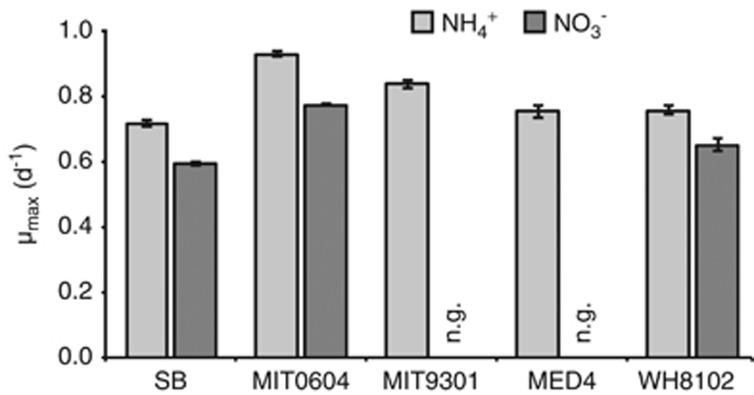
Figure 1
Figure 1
Maximum specific growth rates (μ max) of Prochlorococcus strains SB, MIT0604, MIT9301, MED4 and Synechococcus WH8102 in the presence of ammonium or nitrate. Values represent the mean and s.d. of three biological replicates. Growth rate differences for each strain grown on ammonium compared with nitrate as well as growth rate differences between strains on the same nitrogen source were significant (P<0.05) in a two-tailed homoscedastic t-test; n.g., no growth.
Figure 2
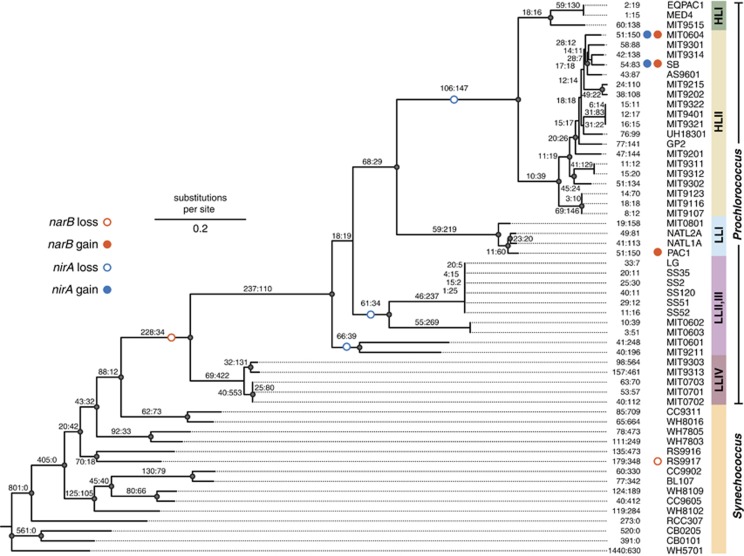
Figure 2
Maximum likelihood phylogeny of Prochlorococcus and Synechococcus based on the similarity of 100 randomly concatenated single-copy core genes. Nodes are marked by closed circles to indicate that the associated taxa clustered together in at least 75% of 100 replicate trees. Genes lost and gained in the evolution of Prochlorococcus and Synechococcus are indicated at each node by values representing losses followed by gains. Predicted losses (open circles) or gains (closed circles) of nirA (blue) or narB (orange) are labeled on their respective branches.
Figure 3
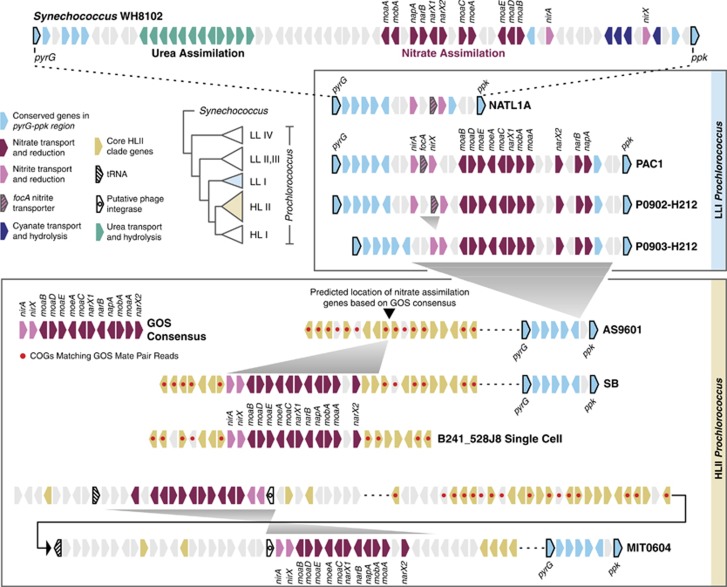
Figure 3
Architecture of the nitrite and nitrate assimilation genes in LL adapted (LLI clade) and HL adapted (HLII clade) Prochlorococcus relative to Synechococcus WH8102. Similar to Synechococcus, the nitrite and nitrate assimilation genes in the LLI clade of Prochlorococcus are found within the region between the pyrG (pyrimidine biosynthesis) and ppk (polyphosphate kinase) genes. Most LLI clade Prochlorococcus, with the exception of the P0903-H212 contig, possess a focA nitrite transporter in this region (possibly acquired from proteobacteria (Rocap et al., 2003)). Metagenome data (Martiny et al., 2009b), a partial genome from a single cell (B241-528J8) (Kashtan et al., 2014) and a culture genome (Prochlorococcus SB) indicate that the nitrate assimilation genes within HLII clade Prochlorococcus are commonly found in a syntenic region adjacent to genomic island ISL3 (see Figure 4). Prochlorococcus MIT0604 is an exception in that it possesses duplicate nitrate assimilation gene clusters located within genomic islands ISL3 and ISL4 (see Figure 4), with phage integrase genes immediately adjacent to each copy of the nirA (nitrite reductase) gene.
Figure 4
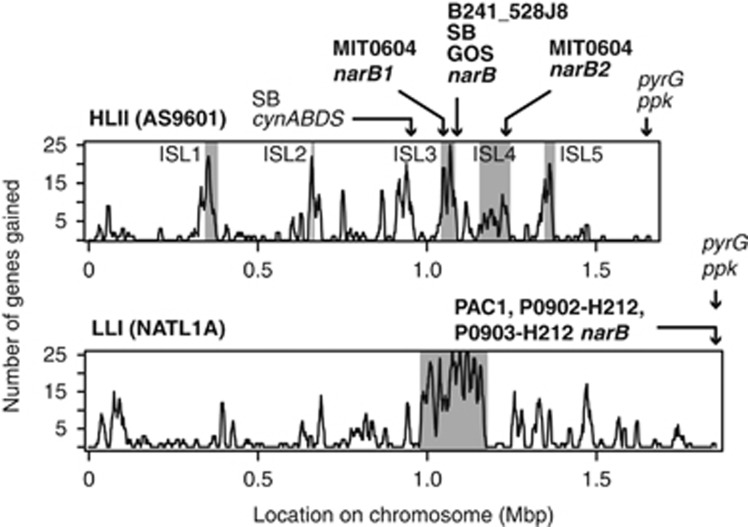
Figure 4
Locations of nitrate and cyanate assimilation genes in strains of Prochlorococcus capable of nitrate assimilation relative to the known genomic islands (shaded regions) observed in the HLII and LLI clades of Prochlorococcus; plots modified from Kettler et al. (2007). Prochlorococcus genomes are highly syntenic and genomic islands have been identified in HL adapted genomes (for example, AS9601) by conserved breaks in gene synteny among strains (Coleman et al., 2006; Kettler et al., 2007). Genomic islands have also been identified (for example, the large region within LLI clade genomes such as NATL1A) by predicted gene gain events along the chromosome (Kettler et al., 2007).
Figure 5
Figure 5
Neighbor-joining phylogeny of four proteins involved in the transport and reduction of nitrate and nitrite in marine cyanobacteria: (a) NirA; nitrite reductase, (b) NarB; nitrate reductase, (c) FocA; nitrite transporter and (d) NapA; nitrite/nitrate transporter. The percentage of 100 replicate trees in which the associated taxa clustered together is indicated at nodes by closed circles (>75%) or open circles (>50%). Scale bars represent substitutions per site.

References

    1. Abascal F, Zardoya R, Telford MJ. TranslatorX: multiple alignment of nucleotide sequences guided by amino acid translations. Nucleic Acids Res. 2010;38:W7–13. - PMC - PubMed
    1. Ahlgren NA, Rocap G. Culture isolation and culture-independent clone libraries reveal new marine Synechococcus ecotypes with distinctive light and N physiologies. Appl Environ Microbiol. 2006;72:7193–7204. - PMC - PubMed
    1. Aziz RK, Bartels D, Best AA, DeJongh M, Disz T, Edwards RA, et al. The RAST Server: rapid annotations using subsystems technology. BMC Genomics. 2008;9:75. - PMC - PubMed
    1. Biller SJ, Berube PM, Berta-Thompson JW, Kelly L, Roggensack SE, Awad L, et al. Genomes of diverse isolates of the marine cyanobacterium Prochlorococcus. Scientific Data. 2014;1:140034. - PMC - PubMed
    1. Bouman HA, Ulloa O, Scanlan DJ, Zwirglmaier K, Li WK, Platt T, et al. Oceanographic basis of the global surface distribution of Prochlorococcus ecotypes. Science. 2006;312:918–921. - PubMed

Publication types