Review
. 2015 Jan;37(1):70-9.
doi: 10.1002/bies.201400118. Epub 2014 Oct 28.

Histone proteolysis: a proposal for categorization into 'clipping' and 'degradation'

Affiliations
Free PMC article
Review

Histone proteolysis: a proposal for categorization into 'clipping' and 'degradation'

Maarten Dhaenens et al. Bioessays. 2015 Jan.
Free PMC article

Abstract

We propose for the first time to divide histone proteolysis into "histone degradation" and the epigenetically connoted "histone clipping". Our initial observation is that these two different classes are very hard to distinguish both experimentally and biologically, because they can both be mediated by the same enzymes. Since the first report decades ago, proteolysis has been found in a broad spectrum of eukaryotic organisms. However, the authors often not clearly distinguish or determine whether degradation or clipping was studied. Given the importance of histone modifications in epigenetic regulation we further elaborate on the different ways in which histone proteolysis could play a role in epigenetics. Finally, unanticipated histone proteolysis has probably left a mark on many studies of histones in the past. In conclusion, we emphasize the significance of reviving the study of histone proteolysis both from a biological and an experimental perspective. Also watch the Video Abstract.

Keywords: epigenetics; histone clipping; histone degradation; histone proteolysis.


Figures

Figure 1
Figure 1
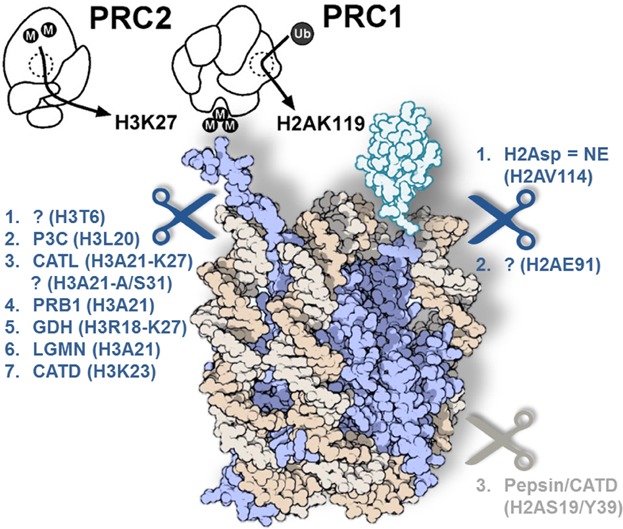
Model for a potential interplay between the Polycomb group (PcG) – Tritorax Group (Trx) axis and histone clipping. The PcG (depicted in black line drawing) comprises almost 20 different proteins, which are generally divided into three subgroups: The PRC1, PRC2, and PhoRC. In the hierarchical recruitment model, the PRC2 trimethylation of K27 on the N-terminus of histone H3 (H3K27) forms an anchor point for the PRC1 proteins to bind and ubiquitinate K119 (transparent blue) on the C-terminus of histone H2A (H2AK119), pausing RNA polymerase II and repressing transcription. This repressive PcG group of proteins antagonizes the activating Trx, which di- and trimethylate K4 of the H3 N-tail at bivalent genes (not shown here). When occurring in vivo, histone-clipping events would thus interfere with this PcG-Trx balanced epigenetic control and with other PTMs on these tails. Histones are shown in purple, DNA in yellow. Enzymes are ordered and abbreviated as discussed in detail under “Histone Clipping” (Left: H3-specific clipping; right: H2A specific clipping). Question marks represent unannotated enzymes. Figure adapted from http://www.pdb.org/ ,.

References

    1. Reid BR, Cole RD. Biosynthesis of a Lysine-rich histone in isolated calf thymus nuclei. Proc Natl Acad Sci USA. 1964;51:1044–50. - PMC - PubMed
    1. Carter DB, Efird PH, Chae CB. Chromatin-bound proteases and their inhibitors. Methods Cell Biol. 1978;19:175–90. - PubMed
    1. Duncan EM, Muratore-Schroeder TL, Cook RG, Garcia BA. Cathepsin L proteolytically processes histone H3 during mouse embryonic stem cell differentiation. Cell. 2008;135:284–94. - PMC - PubMed
    1. Santos-Rosa H, Kirmizis A, Nelson C, Bartke T. Histone H3 tail clipping regulates gene expression. Nat Struct Mol Biol. 2009;16:17–22. - PMC - PubMed
    1. Osley MA. Epigenetics: How to lose a tail. Nature. 2008;456:885–6. - PubMed