. 2015 Apr 15;21(8):1935-43.
doi: 10.1158/1078-0432.CCR-14-2124. Epub 2014 Oct 28.

MAP2K1 (MEK1) Mutations Define a Distinct Subset of Lung Adenocarcinoma Associated with Smoking

Affiliations

MAP2K1 (MEK1) Mutations Define a Distinct Subset of Lung Adenocarcinoma Associated with Smoking

Maria E Arcila et al. Clin Cancer Res. .

Abstract

Purpose: Genetic alterations affecting the MAPK/ERK pathway are common in lung adenocarcinoma (LAD). Early steps of the signaling pathway are most often affected with EGFR, KRAS, and BRAF mutations encompassing more than 70% of all alterations. Somatic mutations in MEK1, located downstream of BRAF, are rare and remain poorly defined as a distinct molecular subset.

Experimental design: Tumors harboring MEK1 mutations were identified through targeted screening of a large LAD cohort concurrently interrogated for recurrent mutations in MEK1, EGFR, KRAS, BRAF, ERBB2/HER2, NRAS, PIK3CA, and AKT. Additional cases were identified through a search of publically available cancer genomic datasets. Mutations were correlated with patient characteristics and treatment outcomes. Overall survival was compared with stage-matched patients with KRAS- and EGFR-mutant LADs.

Results: We identified 36 MEK1-mutated cases among 6,024 LAD (0.6%; 95% confidence interval, 0.42-0.85). The majority of patients were smokers (97%, n = 35/36). There was no association with age, sex, race, or stage. The most common mutations were K57N (64%, 23/36) followed by Q56P (19%, 7/36), all mutually exclusive with other driver mutations in the targeted panel. Transversions G:C>T:A were predominant (89%, 31/35), in keeping with smoking-associated DNA damage. Additional less common somatic mutations were identified in the kinase domain, all of which are predicted to converge into a single interaction area based on in silico 3D modeling.

Conclusions: MEK1 mutations define a distinct subset of lung cancers (∼1%) with potential sensitivity to MEK inhibitors. Mutations are predominantly transversions, in keeping with a strong association with smoking.


Figures

Figure 1
Figure 1
Top. Linear model of the MEK1 gene. Exons are represented by the numbered boxes. Red boxes indicate regions coding for the core kinase domain (residues 55–369) Bottom. Mapping of all mutations identified in this study and publically available data (cBio portal and Cosmic database). Each circle represents a single patient – Lung adenocarcinoma (green circle). Reported mutations in melanoma (light brown circle), colon carcinoma (brown circle), bladder (yellow), gastric carcinoma (blue), breast (light blue), head and neck (purple) are also mapped for comparison. D-Domain is the ERK docking site, Pro rich insert 262-307
Figure 2
Figure 2
Kaplan–Meier curves for overall survival in patients with MEK1 mutations (time plotted in months). A. Overall survival for MSKCC and VICC patients. B. Overall survival for patients with advanced disease. C. Survival comparison to other oncogene-driven lung cancers -The overall survival of the MEK1-mutant cohort was similar to the KRAS and BRAF-mutant lung and significantly inferior to those patients with EGFR mutations and with rearrangements involving ALK, RET and ROS1
Figure 3
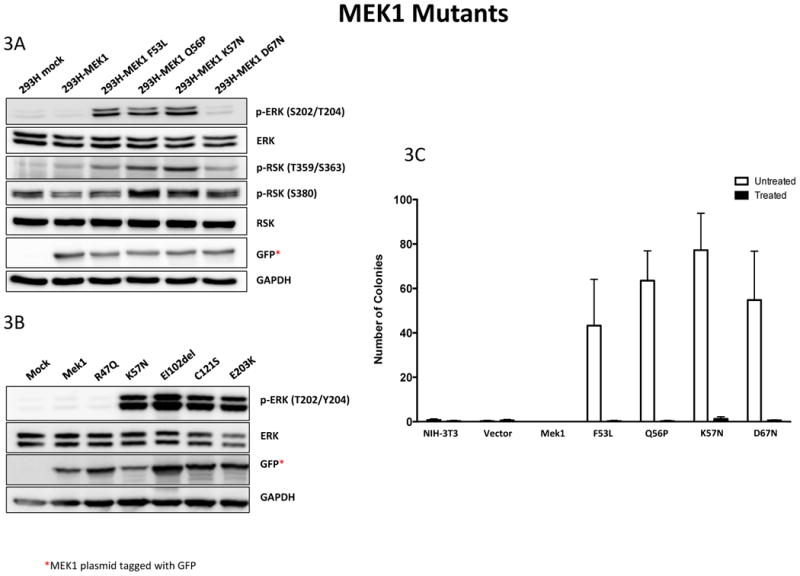
Figure 3
Functional characterization of MEK1 mutants. 293H cells were transfected with a wild-type or mutant GFP-tagged Mek1 plasmid. Cell lysates were collected after 24 hours and analyzed by Western blotting. 3A shows the F53L, Q56P and K57N mutants which display hyperactive downstream MAPK pathway signaling based upon phosphorylation of ERK and its downstream effector ribosomal S6 kinase (RSK). By contrast, the D67N mutant kinase activity is significantly lower than the other hyperactive mutants and not significantly different from the wild-type. 3B shows the EI102del, C121S and E203K mutants and display hyperactive downstream MAPK pathway signaling that was comparable to the K57N. 3C. NIH-3T3, NIH-3T3-vector, NIH-3T3-MEK1 and NIH-3T3-Mek1 mutant cells were cultured for 4 weeks in soft agar to assess anchorage-independent growth. Colonies greater than 150 microns in size formed in all four mutant cell lines but not in control and wild-type Mek1 cells. Treatment of mutant cell lines with 1 μM of Selumetinib (AZD6244) prevented colony formation in all the mutant cell lines.
Figure 4
Figure 4. Hotspots mutations in MEK1 destabilize the alpha-helix
A 3Dmodel of MEK1 showing the most common mutations identified in this study and selected mutations also identified in other solid tumors. Labeled residues identify the region of the mutation. Alpha helix – bright green (residues 43-67). Although in a linear model these mutations are separated into clusters in exons 2, 3 and 6, when mapped into a 3D model, mutations form a single hot spot.

References

    1. Ladanyi M, Pao W. Lung adenocarcinoma: guiding EGFR-targeted therapy and beyond. Modern pathology: an official journal of the United States and Canadian Academy of Pathology, Inc. 2008;21(Suppl 2):S16–22. - PubMed
    1. Riely GJ, Kris MG, Rosenbaum D, Marks J, Li A, Chitale DA, et al. Frequency and distinctive spectrum of KRAS mutations in never smokers with lung adenocarcinoma. Clinical cancer research: an official journal of the American Association for Cancer Research. 2008;14:5731–4. - PMC - PubMed
    1. Paik PK, Arcila ME, Fara M, Sima CS, Miller VA, Kris MG, et al. Clinical characteristics of patients with lung adenocarcinomas harboring BRAF mutations. Journal of clinical oncology: official journal of the American Society of Clinical Oncology. 2011;29:2046–51. - PMC - PubMed
    1. Marks JL, Gong Y, Chitale D, Golas B, McLellan MD, Kasai Y, et al. Novel MEK1 mutation identified by mutational analysis of epidermal growth factor receptor signaling pathway genes in lung adenocarcinoma. Cancer research. 2008;68:5524–8. - PMC - PubMed
    1. Derijard B, Raingeaud J, Barrett T, Wu IH, Han J, Ulevitch RJ, et al. Independent human MAP-kinase signal transduction pathways defined by MEK and MKK isoforms. Science. 1995;267:682–5. - PubMed

Publication types

MeSH terms

Substances