


Real-time detection of hepatic gluconeogenic and glycogenolytic states using hyperpolarized [2-13C]dihydroxyacetone
- PMID: 25352600
- PMCID: PMC4276855
- DOI: 10.1074/jbc.M114.613265
Real-time detection of hepatic gluconeogenic and glycogenolytic states using hyperpolarized [2-13C]dihydroxyacetone
Abstract
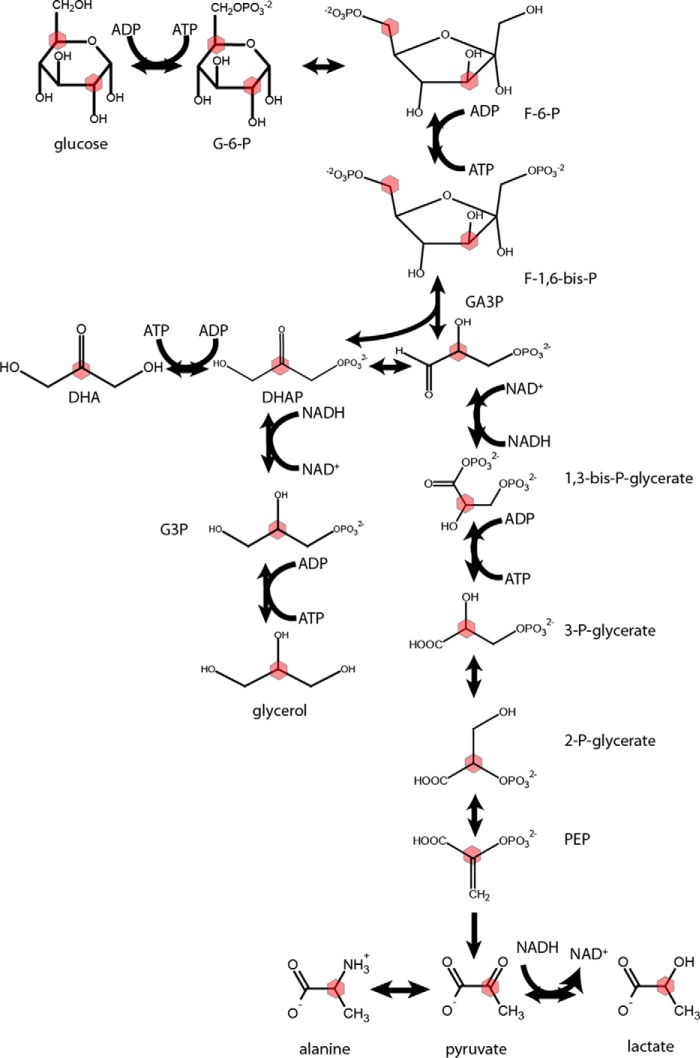
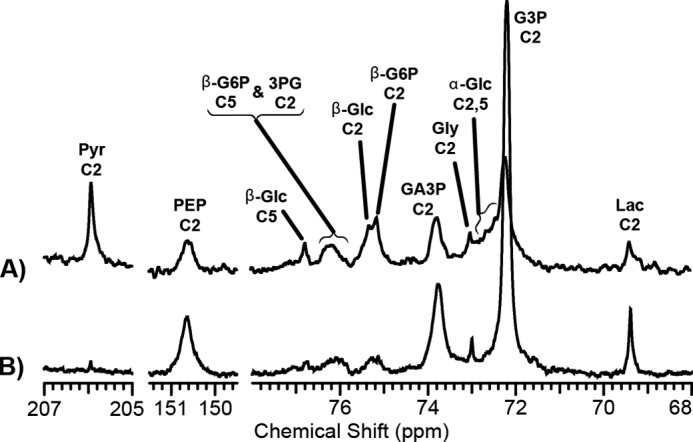
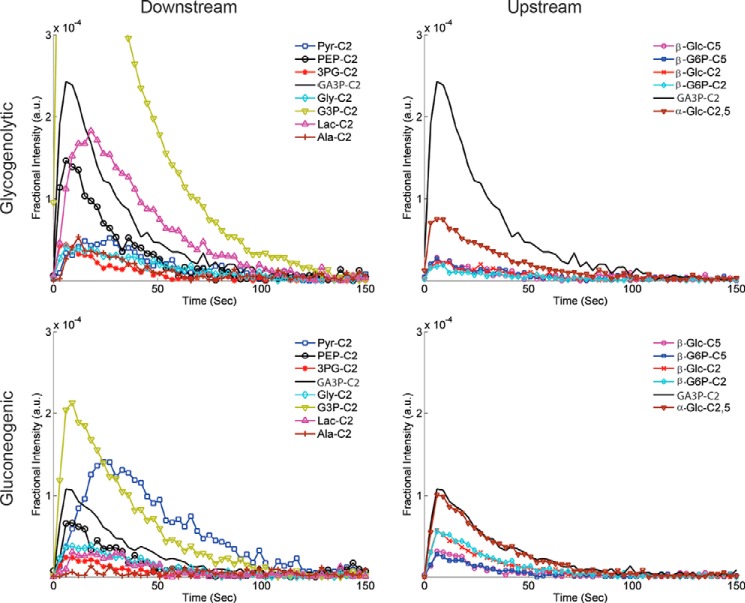
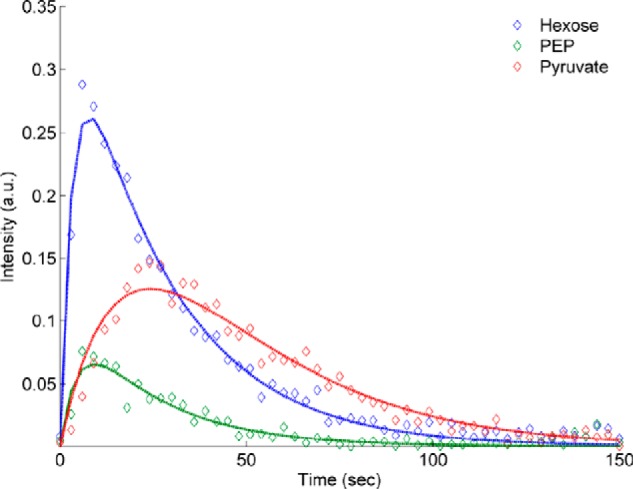
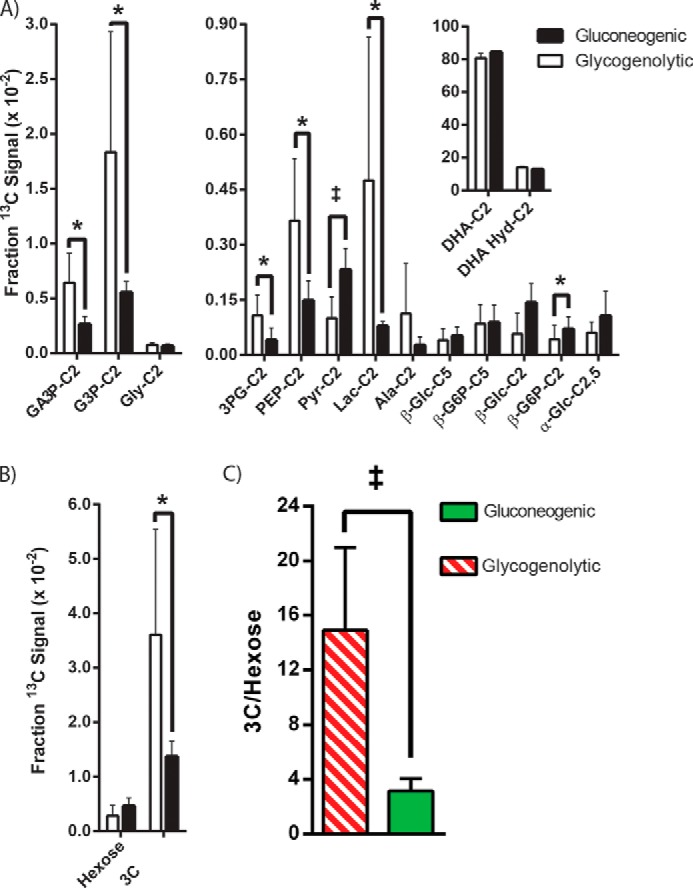
Glycogenolysis and gluconeogenesis are sensitive to nutritional state, and the net direction of flux is controlled by multiple enzymatic steps. This delicate balance in the liver is disrupted by a variety of pathological states including cancer and diabetes mellitus. Hyperpolarized carbon-13 magnetic resonance is a new metabolic imaging technique that can probe intermediary metabolism nondestructively. There are currently no methods to rapidly distinguish livers in a gluconeogenic from glycogenolytic state. Here we use the gluconeogenic precursor dihydroxyacetone (DHA) to deliver hyperpolarized carbon-13 to the perfused mouse liver. DHA enters gluconeogenesis at the level of the trioses. Perfusion conditions were designed to establish either a gluconeogenic or a glycogenolytic state. Unexpectedly, we found that [2-(13)C]DHA was metabolized within a few seconds to the common intermediates and end products of both glycolysis and gluconeogenesis under both conditions, including [2,5-(13)C]glucose, [2-(13)C]glycerol 3-phosphate, [2-(13)C]phosphoenolpyruvate (PEP), [2-(13)C]pyruvate, [2-(13)C]alanine, and [2-(13)C]lactate. [2-(13)C]Phosphoenolpyruvate, a key branch point in gluconeogenesis and glycolysis, was monitored in functioning tissue for the first time. Observation of [2-(13)C]PEP was not anticipated as the free energy difference between PEP and pyruvate is large. Pyruvate kinase is the only regulatory step of the common glycolytic-gluconeogenic pathway that appears to exert significant control over the kinetics of any metabolites of DHA. A ratio of glycolytic to gluconeogenic products distinguished the gluconeogenic from glycogenolytic state in these functioning livers.
Keywords: Diabetes; Dihydroxyacetone; Gluconeogenesis; Glucose Metabolism; Glycogenolytic; Glycolysis; Hyperpolarization; Nuclear Magnetic Resonance (NMR).
© 2014 by The American Society for Biochemistry and Molecular Biology, Inc.
Figures
References
-
- Jones J. G., Naidoo R., Sherry A. D., Jeffrey F. M., Cottam G. L., Malloy C. R. (1997) Measurement of gluconeogenesis and pyruvate recycling in the rat liver: a simple analysis of glucose and glutamate isotopomers during metabolism of [1,2,3-13C3]propionate. FEBS Lett. 412, 131–137 - PubMed
-
- Jones J. G., Solomon M. A., Cole S. M., Sherry A. D., Malloy C. R. (2001) An integrated 2H and 13C NMR study of gluconeogenesis and TCA cycle flux in humans. Am. J. Physiol. Endocrinol. Metab. 281, E848–E856 - PubMed
-
- Neese R. A., Schwarz J. M., Faix D., Turner S., Letscher A., Vu D., Hellerstein M. K. (1995) Gluconeogenesis and intrahepatic triose phosphate flux in response to fasting or substrate loads: application of the mass isotopomer distribution analysis technique with testing of assumptions and potential problems. J. Biol. Chem. 270, 14452–14466 - PubMed
-
- Petersen K. F., Price T., Cline G. W., Rothman D. L., Shulman G. I. (1996) Contribution of net hepatic glycogenolysis to glucose production during the early postprandial period. Am. J. Physiol. 270, E186–E191 - PubMed
Publication types
MeSH terms
Substances
Grants and funding
LinkOut - more resources
Full Text Sources
Other Literature Sources
Medical
Miscellaneous
