


The auditory brain-stem response to complex sounds: a potential biomarker for guiding treatment of psychosis
- PMID: 25352811
- PMCID: PMC4195270
- DOI: 10.3389/fpsyt.2014.00142
The auditory brain-stem response to complex sounds: a potential biomarker for guiding treatment of psychosis
Abstract
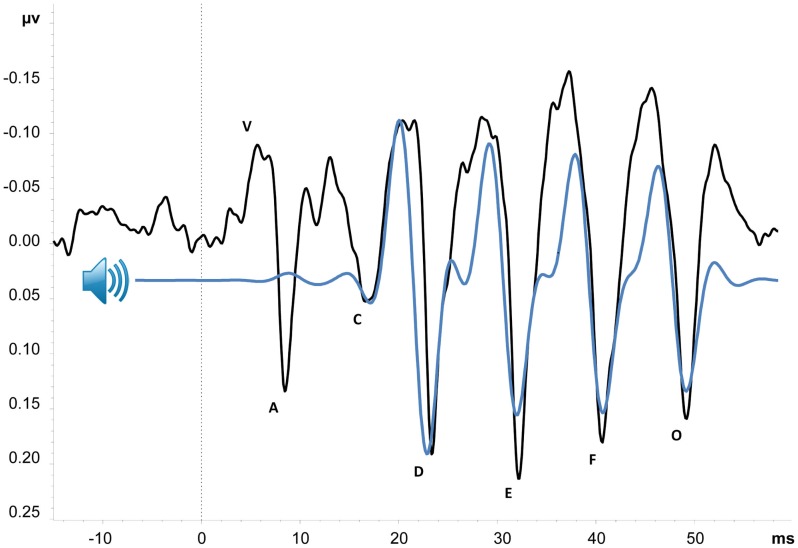
Cognitive deficits limit psychosocial functioning in schizophrenia. For many patients, cognitive remediation approaches have yielded encouraging results. Nevertheless, therapeutic response is variable, and outcome studies consistently identify individuals who respond minimally to these interventions. Biomarkers that can assist in identifying patients likely to benefit from particular forms of cognitive remediation are needed. Here, we describe an event-related potential (ERP) biomarker - the auditory brain-stem response (ABR) to complex sounds (cABR) - that appears to be particularly well-suited for predicting response to at least one form of cognitive remediation that targets auditory information processing. Uniquely, the cABR quantifies the fidelity of sound encoded at the level of the brainstem and midbrain. This ERP biomarker has revealed auditory processing abnormalities in various neurodevelopmental disorders, correlates with functioning across several cognitive domains, and appears to be responsive to targeted auditory training. We present preliminary cABR data from 18 schizophrenia patients and propose further investigation of this biomarker for predicting and tracking response to cognitive interventions.
Keywords: EEG; auditory brain-stem response; biomarkers; cognitive remediation; complex auditory brain-stem response; psychosis; schizophrenia.
Figures
References
-
- Green MF. What are the functional consequences of neurocognitive deficits in schizophrenia? Am J Psychiatry (1996) 153:321–30 - PubMed
-
- Takahashi H, Rissling AJ, Pascual-Marqui R, Kirihara K, Pela M, Sprock J, et al. Neural substrates of normal and impaired preattentive sensory discrimination in large cohorts of nonpsychiatric subjects and schizophrenia patients as indexed by MMN and P3a change detection responses. Neuroimage (2012) 66C:594–603 10.1016/j.neuroimage.2012.09.074 - DOI - PMC - PubMed
-
- Kawakubo Y, Kasai K, Kudo N, Rogers MA, Nakagome K, Itoh K, et al. Phonetic mismatch negativity predicts verbal memory deficits in schizophrenia. Neuroreport (2006) 17:1043–6 10.1097/01.wnr.0000221828.10846.ba - DOI - PubMed
Grants and funding
LinkOut - more resources
Full Text Sources
Other Literature Sources
