


Prenatal phthalate exposures and anogenital distance in Swedish boys
- PMID: 25353625
- PMCID: PMC4286276
- DOI: 10.1289/ehp.1408163
Prenatal phthalate exposures and anogenital distance in Swedish boys
Abstract
Background: Phthalates are used as plasticizers in soft polyvinyl chloride (PVC) and in a large number of consumer products. Because of reported health risks, diisononyl phthalate (DiNP) has been introduced as a replacement for di(2-ethylhexyl) phthalate (DEHP) in soft PVC. This raises concerns because animal data suggest that DiNP may have antiandrogenic properties similar to those of DEHP. The anogenital distance (AGD)--the distance from the anus to the genitals--has been used to assess reproductive toxicity.
Objective: The objective of this study was to examine the associations between prenatal phthalate exposure and AGD in Swedish infants.
Methods: AGD was measured in 196 boys at 21 months of age, and first-trimester urine was analyzed for 10 phthalate metabolites of DEP (diethyl phthalate), DBP (dibutyl phthalate), DEHP, BBzP (benzylbutyl phthalate), as well as DiNP and creatinine. Data on covariates were collected by questionnaires.
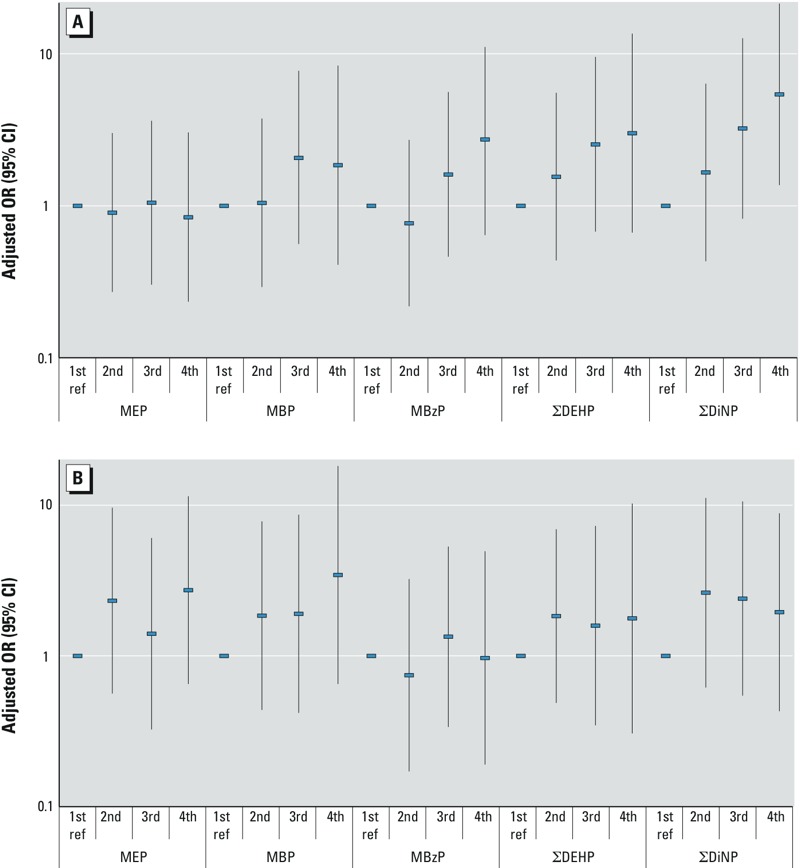
Results: The most significant associations were found between the shorter of two AGD measures (anoscrotal distance; AGDas) and DiNP metabolites and strongest for oh-MMeOP [mono-(4-methyl-7-hydroxyloctyl) phthalate] and oxo-MMeOP [mono-(2-ethyl-5-oxohexyl) phthalate]. However, the AGDas reduction was small (4%) in relation to more than an interquartile range increase in DiNP exposure.
Conclusions: These findings call into question the safety of substituting DiNP for DEHP in soft PVC, particularly because a shorter male AGD has been shown to relate to male genital birth defects in children and impaired reproductive function in adult males and the fact that human levels of DiNP are increasing globally.
Conflict of interest statement
The authors declare they have no actual or potential competing financial interests.
Figures
References
-
- Abb M, Heinrich T, Sorkau E, Lorenz W. Phthalates in house dust. Environ Int. 2009;35:965–970. - PubMed
-
- American Chemistry Council. Overview of Our Work and Review of Current Challenges. American Chemistry Council High Phthalates Panel. Presentation at SPI Flexible Vinyl Products 23rd Annual Conference July 2012. 2012. Available: http://www.plasticsindustry.org/files/events/Eileen_Conneely Tuesday.pdf [accessed 26 September 2014]
-
- Bergh C, Torgrip R, Emenius G, Östman C. Organophosphate and phthalate esters in air and settled dust—a multi-location indoor study. Indoor Air. 2011;21(1):67–76. - PubMed
-
- Bergman Å, Heindel JJ, Jobling S, Kidd KA, Zoeller RT, Jobling SK, eds. State of the Science of Endocrine Disrupting Chemicals—2012. Geneva:United Nations Environment Programme and World Health Organization. 2013. Available: http://apps.who.int/iris/handle/10665/78101 [accessed 26 September 2014]
Publication types
MeSH terms
Substances
Grants and funding
LinkOut - more resources
Full Text Sources
Other Literature Sources
Miscellaneous