


Non-surgical interventions for adolescents with idiopathic scoliosis: an overview of systematic reviews
- PMID: 25353954
- PMCID: PMC4213139
- DOI: 10.1371/journal.pone.0110254
Non-surgical interventions for adolescents with idiopathic scoliosis: an overview of systematic reviews
Abstract
Background: Non-surgical interventions for adolescents with idiopathic scoliosis remain highly controversial. Despite the publication of numerous reviews no explicit methodological evaluation of papers labeled as, or having a layout of, a systematic review, addressing this subject matter, is available.
Objectives: Analysis and comparison of the content, methodology, and evidence-base from systematic reviews regarding non-surgical interventions for adolescents with idiopathic scoliosis.
Design: Systematic overview of systematic reviews.
Methods: Articles meeting the minimal criteria for a systematic review, regarding any non-surgical intervention for adolescent idiopathic scoliosis, with any outcomes measured, were included. Multiple general and systematic review specific databases, guideline registries, reference lists and websites of institutions were searched. The AMSTAR tool was used to critically appraise the methodology, and the Oxford Centre for Evidence Based Medicine and the Joanna Briggs Institute's hierarchies were applied to analyze the levels of evidence from included reviews.
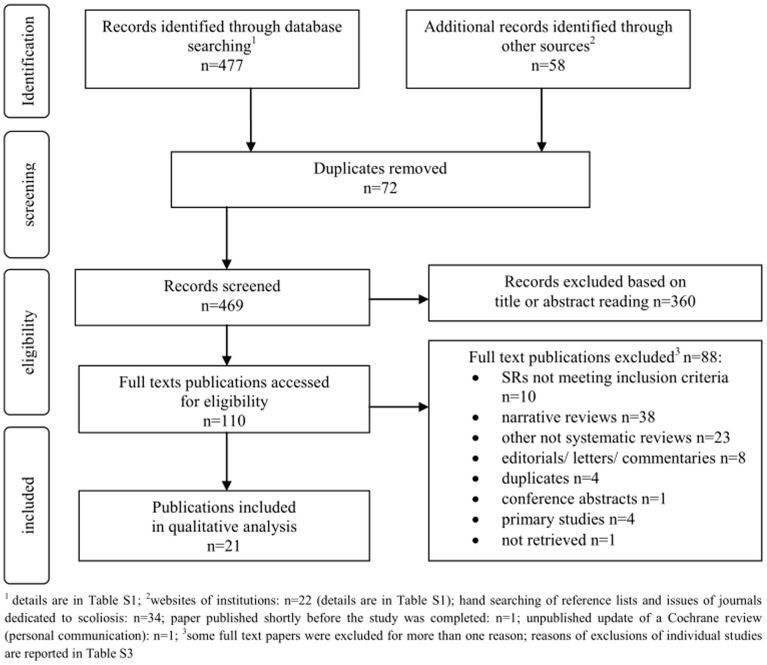
Results: From 469 citations, twenty one papers were included for analysis. Five reviews assessed the effectiveness of scoliosis-specific exercise treatments, four assessed manual therapies, five evaluated bracing, four assessed different combinations of interventions, and one evaluated usual physical activity. Two reviews addressed the adverse effects of bracing. Two papers were high quality Cochrane reviews, Three were of moderate, and the remaining sixteen were of low or very low methodological quality. The level of evidence of these reviews ranged from 1 or 1+ to 4, and in some reviews, due to their low methodological quality and/or poor reporting, this could not be established.
Conclusions: Higher quality reviews indicate that generally there is insufficient evidence to make a judgment on whether non-surgical interventions in adolescent idiopathic scoliosis are effective. Papers labeled as systematic reviews need to be considered in terms of their methodological rigor; otherwise they may be mistakenly regarded as high quality sources of evidence.
Protocol registry number: CRD42013003538, PROSPERO.
Conflict of interest statement
Figures
References
-
- Bettany-Saltikov J, Parent E, Romano M, Villagrasa M, Negrini S (2014) Physiotherapeutic scoliosis-specific exercises for adolescents with idiopathic scoliosis. Eur J Phys Rehabil Med 50: 111–121. - PubMed
-
- Hawes MC (2003) The use of exercises in the treatment of scoliosis: an evidence-based critical review of the literature. Pediatr Rehabil 6: 171–182. - PubMed
-
- Negrini S, Aulisa AG, Aulisa L, Circo AB, de Mauroy JC, et al. (2012) 2011 SOSORT guidelines: Orthopaedic and rehabilitation treatment of idiopathic scoliosis during growth. Scoliosis 7: 3 Available: http://www.scoliosisjournal.com/content/7/1/3 Accessed 2014 Feb 10.. - PMC - PubMed
-
- Zaina F, De Mauroy JC, Grivas T, Hresko MT, Kotwicki T, et al. (2014) Bracing for scoliosis in 2014: state of the art. Eur J Phys Rehabil Med 50: 93–110. - PubMed
-
- Horne JP, Flannery R, Usman S (2014) Adolescent idiopathic scoliosis: diagnostics and management. Am Fam Physician 89: 193–198. - PubMed
Publication types
MeSH terms
LinkOut - more resources
Full Text Sources
Other Literature Sources
Medical
