. 2014 Oct 29;9(10):e110479.
doi: 10.1371/journal.pone.0110479. eCollection 2014.

Poly-dA:dT tracts form an in vivo nucleosomal turnstile

Affiliations

Poly-dA:dT tracts form an in vivo nucleosomal turnstile

Carl G de Boer et al. PLoS One. .

Abstract

Nucleosomes regulate many DNA-dependent processes by controlling the accessibility of DNA, and DNA sequences such as the poly-dA:dT element are known to affect nucleosome binding. We demonstrate that poly-dA:dT tracts form an asymmetric barrier to nucleosome movement in vivo, mediated by ATP-dependent chromatin remodelers. We theorize that nucleosome transit over poly-A elements is more energetically favourable in one direction, leading to an asymmetric arrangement of nucleosomes around these sequences. We demonstrate that different arrangements of poly-A and poly-T tracts result in very different outcomes for nucleosome occupancy in yeast, mouse, and human, and show that yeast takes advantage of this phenomenon in its promoter architecture.


Conflict of interest statement

Competing Interests: The authors have declared that no competing interests exist.

Figures

Figure 1
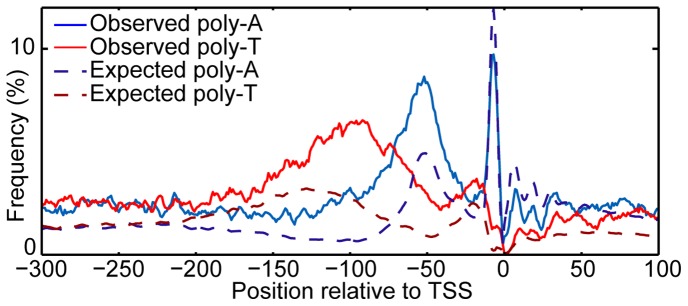
Figure 1. Yeast promoters have a biased distribution of poly-As and poly-Ts.
The observed and expected frequency of poly-A and poly-T (AAAAA/TTTTT) elements across yeast promoters is shown, with expected calculated given the base content of the region. A greater number of poly-Ts and poly-As occur than expected in the −115:−75 and −75:−35 regions, respectively (p<10−6 by simulation; see methods).
Figure 2
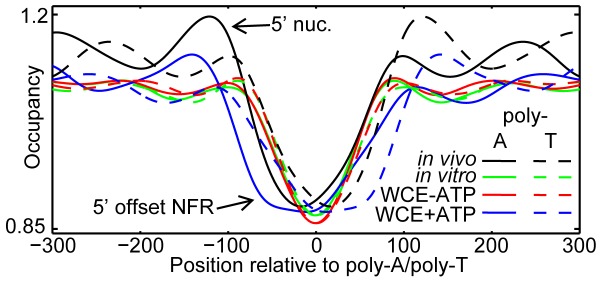
Figure 2. Nucleosomes are arranged asymmetrically around poly-dA:dT tracts.
Average nucleosome occupancy surrounding poly-A and poly-T sequences (AAAAA/TTTTT) for salt gradient dialysis (in vitro), WCE without ATP (WCE-ATP), WCE with ATP added (WCE+ATP), as well as in vivo occupancy . The difference in occupancy between poly-As and poly-Ts is significant only for in vivo and WCE+ATP (by rank sum; see Figure S1 in File S1).
Figure 3
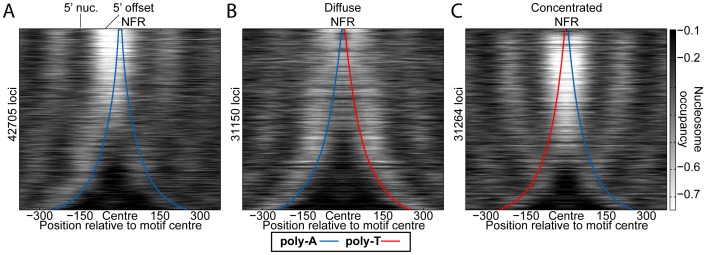
Figure 3. The different poly-A/poly-T arrangements result in vastly different nucleosome occupancy outcomes.
In vivo nucleosome occupancy (heatmap) surrounding all instances of (A) poly-A/poly-A, (B) poly-A/poly-T, and (C) poly-T/poly-A combinations in the yeast genome separated by no more than 500 bp. Red and blue curves represent the outer motif edges of poly-Ts and poly-As, respectively. Note that the poly-T/poly-T combination is a mirror image of the poly-A/poly-A data.
Figure 4
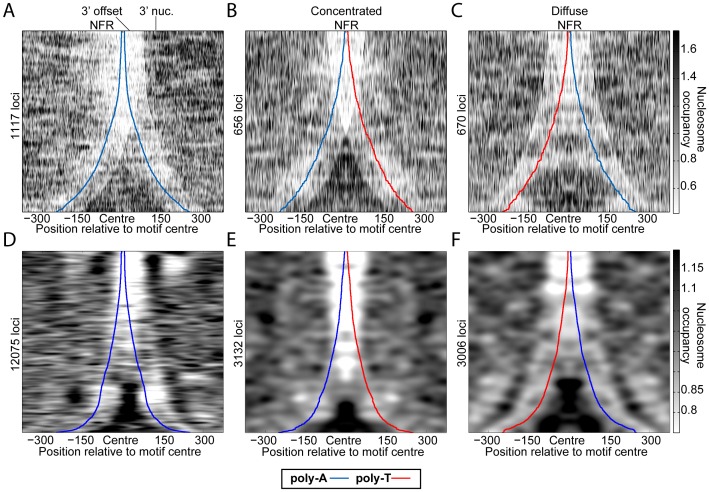
Figure 4. Mammalian nucleosome occupancy is also biased surrounding poly-As and poly-Ts, but the trend is opposite to yeast.
In vivo nucleosome occupancy for (A–C) regions with available high-resolution nucleosome data from mouse Th1 cells and (D–F) non-repetitive regions on chromosome 22, for human granulocytes (heatmaps) surrounding all instances of (A, D) poly-A/poly-A, (B, E) poly-A/poly-T, and (C, F) poly-T/poly-A combinations. Gaussian smoothed between rows (SD = 10 and 50, for mouse and human, respectively). The distinct transitions from light to dark in the mouse data (A-C) result from using unsmoothed data, which corresponds roughly to nucleosome dyad occupancy (in this case the poly-A/poly-T bias was more obvious without smoothing). This distinct transition is presumably caused by the destabilization of nucleosomes as poly-dA:dT tracts are incorporated, and nucleosomes appear to be most unstable when the dyad is 69 bp from the proximal poly-dA:dT tract edge in human, mouse, and yeast (Figure S4 in File S1).

References

    1. Zhang Z, Wippo CJ, Wal M, Ward E, Korber P, et al. (2011) A packing mechanism for nucleosome organization reconstituted across a eukaryotic genome. Science 332: 977–980. - PMC - PubMed
    1. Tillo D, Hughes TR (2009) G+C content dominates intrinsic nucleosome occupancy. BMC Bioinformatics 10: 442. - PMC - PubMed
    1. Kaplan N, Moore IK, Fondufe-Mittendorf Y, Gossett AJ, Tillo D, et al. (2009) The DNA-encoded nucleosome organization of a eukaryotic genome. Nature 458: 362–366. - PMC - PubMed
    1. Wu R, Li H (2010) Positioned and G/C-capped poly(dA:dT) tracts associate with the centers of nucleosome-free regions in yeast promoters. Genome Res 20: 473–484. - PMC - PubMed
    1. Hampson S, Kibler D, Baldi P (2002) Distribution patterns of over-represented k-mers in non-coding yeast DNA. Bioinformatics 18: 513–528. - PubMed

Publication types

LinkOut - more resources