


Kidney stones are common after bariatric surgery
- PMID: 25354237
- PMCID: PMC4382441
- DOI: 10.1038/ki.2014.352
Kidney stones are common after bariatric surgery
Abstract
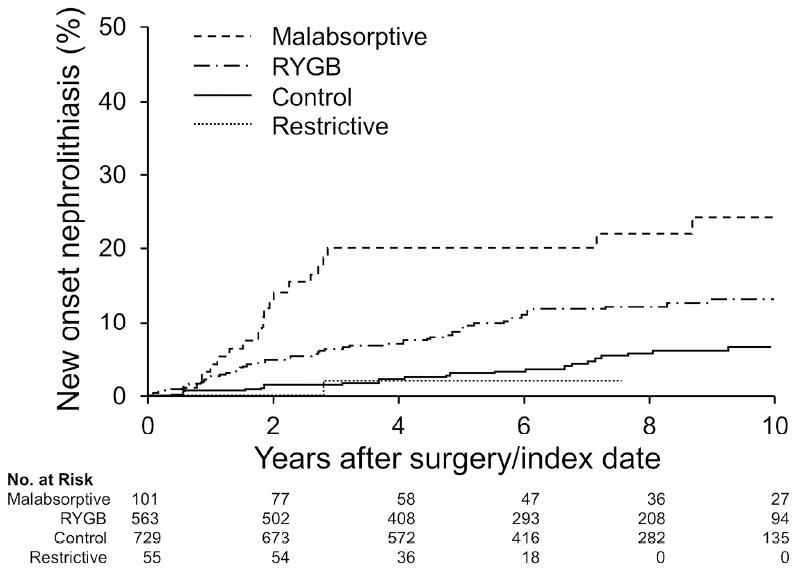
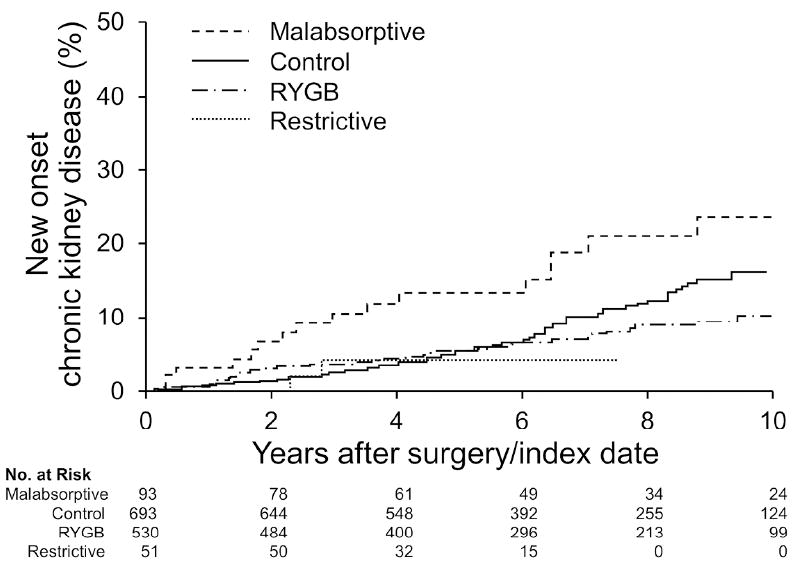
Obesity, a risk factor for kidney stones and chronic kidney disease (CKD), is effectively treated with bariatric surgery. However, it is unclear whether surgery alters stone or CKD risk. To determine this we studied 762 Olmsted County, Minnesota residents who underwent bariatric surgery and matched them with equally obese control individuals who did not undergo surgery. The majority of bariatric patients underwent standard Roux-en-Y gastric bypass (RYGB; 78%), with the remainder having more malabsorptive procedures (very long limb RYGB or biliopancreatic diversion/duodenal switch; 14%) or restrictive procedures (laparoscopic banding or sleeve gastrectomy; 7%). The mean age was 45 years with 80% being female. The mean preoperative body mass index (BMI) was 46.7 kg/m(2) for both cohorts. Rates of kidney stones were similar between surgery patients and controls at baseline, but new stone formation significantly increased in surgery patients (11.0%) compared with controls (4.3%) during 6.0 years of follow-up. After malabsorptive and standard surgery, the comorbidity-adjusted hazard ratio of incident stones was significantly increased to 4.15 and 2.13, respectively, but was not significantly changed for restrictive surgery. The risk of CKD significantly increased after the malabsorptive procedures (adjusted hazard ratio of 1.96). Thus, while RYGB and malabsorptive procedures are more effective for weight loss, both are associated with increased risk of stones, while malabsorptive procedures also increase CKD risk.
Conflict of interest statement
The authors have no financial interests to disclose.
Figures
References
-
- Carlsson LM, Peltonen M, Ahlin S, et al. Bariatric surgery and prevention of type 2 diabetes in Swedish obese subjects. The New England journal of medicine. 2012;367:695–704. - PubMed
-
- Sjostrom L, Peltonen M, Jacobson P, et al. Bariatric surgery and long-term cardiovascular events. JAMA : the journal of the American Medical Association. 2012;307:56–65. - PubMed
-
- Nguyen NT, Nguyen B, Gebhart A, et al. Changes in the makeup of bariatric surgery: a national increase in use of laparoscopic sleeve gastrectomy. Journal of the American College of Surgeons. 2013;216:252–257. - PubMed
-
- Nguyen NT, Masoomi H, Magno CP, et al. Trends in use of bariatric surgery, 2003-2008. Journal of the American College of Surgeons. 2011;213:261–266. - PubMed
-
- Sinha MK, Collazo-Clavell ML, Rule A, et al. Hyperoxaluric nephrolithiasis is a complication of Roux-en-Y gastric bypass surgery. Kidney Int. 2007;72:100–107. - PubMed
Publication types
MeSH terms
Grants and funding
LinkOut - more resources
Full Text Sources
Other Literature Sources
Medical
Research Materials
