


Surgical approaches for cervical spine facet dislocations in adults
- PMID: 25354696
- PMCID: PMC6464931
- DOI: 10.1002/14651858.CD008129.pub2
Surgical approaches for cervical spine facet dislocations in adults
Abstract
Background: The choice of surgical approach for the management of subaxial cervical spine facet dislocations is a controversial subject amongst spine surgeons. Reasons for this include differences in the technical familiarity and experience of surgeons with the different surgical approaches, and variable interpretation of image studies regarding the existence of a traumatic intervertebral disc herniation and of the neurological status of the patient. Moreover, since the approaches are dissimilar, important variations are likely in neurological, radiographical and clinical outcomes.
Objectives: To compare the effects (benefits and harms) of the different surgical approaches used for treating adults with acute cervical spine facet dislocation.
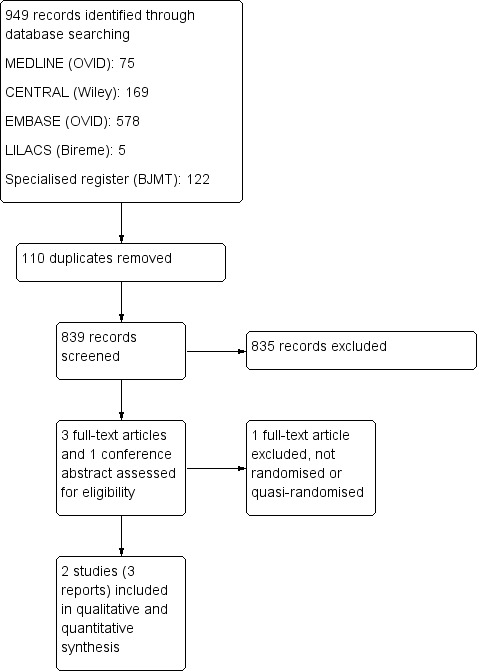
Search methods: We searched the Cochrane Bone, Joint and Muscle Trauma Group Specialised Register (9 May 2014), The Cochrane Central Register of Controlled Trials (The Cochrane Library, 2014 Issue 4), MEDLINE (1946 to April Week 5 2014), MEDLINE In-Process & Other Non-Indexed Citations (8 May 2013), EMBASE (1980 to 2014 Week 18), Latin American and Caribbean Health Sciences (9 May 2014), trial registries, conference proceedings and reference lists of articles to May 2014.
Selection criteria: We included randomised and quasi-randomised controlled trials that compared surgical approaches for the management of adults with acute cervical spine facet dislocations with and without spinal cord injury.
Data collection and analysis: Two review authors independently selected studies, assessed risk of bias and extracted data.
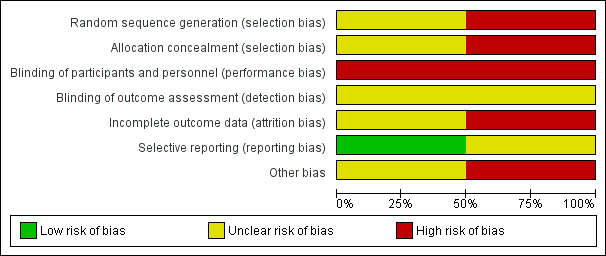
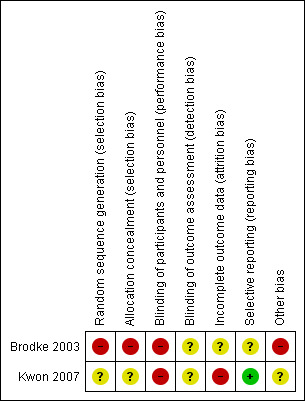
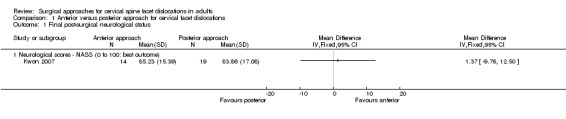
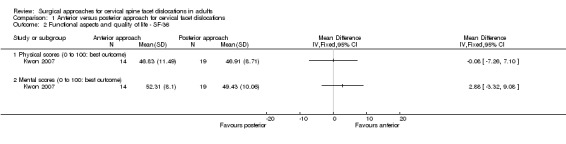
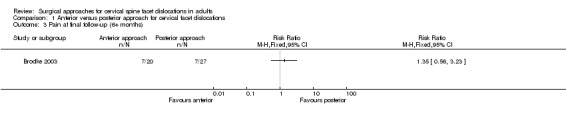
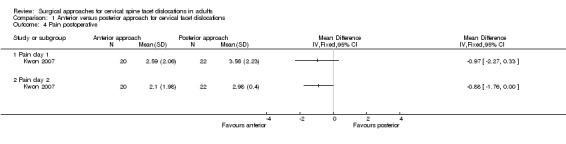
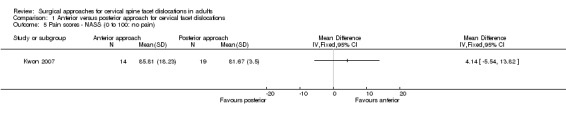
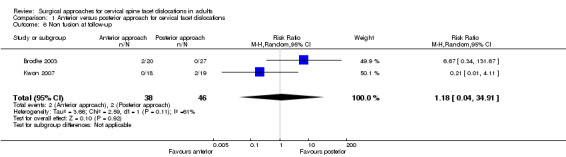
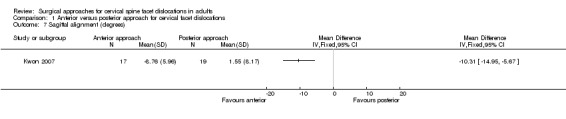
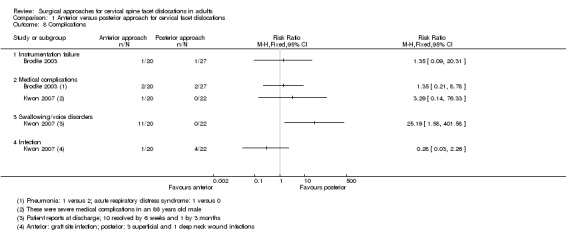
Main results: We included one randomised and one quasi-randomised controlled trial involving a total of 94 participants and reporting results for a maximum of 84 participants. One trial included patients with spinal cord injuries and the other included patients without spinal cord injuries. Both trials compared anterior versus posterior surgical approaches. Both trials were at high risk of bias, including selection bias (one trial), performance bias (both trials) and attrition bias (one trial). Data were pooled for one outcome only: non-union. Reflecting also the imprecision of the results, the evidence was deemed to be of very low quality for all outcomes; which means that our level of uncertainty about the estimates is high.Neither trial found differences between the two approaches in neurological recovery or status, as shown in one study by small clinically insignificant differences in NASS (Northern American Spine Society) neurological scores (0 to 100: optimal score) at one year of follow-up: anterior mean score: 85.23 versus posterior mean score: 83.86; mean difference (MD) 1.37 favouring anterior approach, 95% confidence interval (CI) -9.76 to 12.50; 33 participants; 1 study). The same trial found no relevant between-approach differences at one year in patient-reported quality of life measured using the 36-item Short Form Survey physical (MD -0.08, 95% CI -7.26 to 7.10) and mental component scores (MD 2.88, 95% CI -3.32 to 9.08). Neither trial found evidence of significant differences in long-term pain, or non-union (2/38 versus 2/46; risk ratio (RR) 1.18, 95% CI 0.04 to 34.91). One trial found better sagittal and more 'normal' alignment after the anterior approach (MD -10.31 degrees favouring anterior approach, 95% CI -14.95 degrees to -5.67 degrees), while the other trial reported no significant differences in cervical alignment. There was insufficient evidence to indicate between-group differences in medical adverse events, rates of instrumentation failure and infection. One trial found that the several participants had voice and swallowing disorders after anterior approach surgery (11/20) versus none (0/22) in the posterior approach group: RR 25.19, 95% CI 1.58 to 401.58); all had recovered by three months.
Authors' conclusions: Very low quality evidence from two trials indicated little difference in long-term neurological status, pain or patient-reported quality of life between anterior and posterior surgical approaches to the management of individuals with subaxial cervical spine facet dislocations. Sagittal alignment may be better achieved with the anterior approach. There was insufficient evidence available to indicate between-group differences in medical adverse events, rates of instrumentation failure and infection. The disorders of the voice and swallowing that occurred exclusively in the anterior approach group all resolved by three months. We are very uncertain about this evidence and thus we cannot say whether one approach is better than the other. There was no evidence available for other approaches. Further higher quality multicentre randomised trials are warranted.
Conflict of interest statement
None known.
Figures
Update of
References
References to studies included in this review
Brodke 2003 {published data only}
-
- Brodke DS, Anderson PA, Newell DW, Grady MS, Chapman JR. Comparison of anterior and posterior approaches in cervical spinal cord injuries. Journal of Spinal Disorders & Techniques 2003;16(3):229‐35. [PUBMED: 12792335] - PubMed
-
- Brodke DS, Chapman JR, Anderson PA, Newell DW, Grady MS, Harthan B. Anterior vs. posterior stabilization of cervical spine fractures in spinal cord injured patients. Proceedings of the Orthopaedic Trauma Association Annual Meeting; 1996 Sept 27‐29; Boston. www.hwbf.org/ota/am/ota96/otapa/OTA96506.htm. 1996 (accessed 8 May 2006).
Kwon 2007 {published data only}
-
- Kwon BK, Fisher CG, Boyd MC, Cobb J, Jebson H, Noonan V, et al. A prospective randomized controlled trial of anterior compared with posterior stabilization for unilateral facet injuries of the cervical spine. Journal of Neurosurgery Spine 2007;7(1):1‐12. [PUBMED: 17633481] - PubMed
References to studies excluded from this review
Kandziora 2005 {published data only}
-
- Kandziora F, Pflugmacher R, Scholz M, Schnake K, Putzier M, Khodadadyan‐Klostermann C, et al. Treatment of traumatic cervical spine instability with interbody fusion cages: a prospective controlled study with a 2‐year follow‐up. Injury 2005;36 Suppl 2:B27‐35. [PUBMED: 15993115] - PubMed
Additional references
Abumi 2000
-
- Abumi K, Shono Y, Kotani Y, Kaneda K. Indirect posterior reduction and fusion of the traumatic herniated disc by using a cervical pedicle screw system. Journal of Neurosurgery 2000;92(1 Suppl):30‐7. [PUBMED: 10616055] - PubMed
Allen 1982
-
- Allen BL Jr, Ferguson RL, Lehmann TR, O'Brien RP. A mechanistic classification of closed, indirect fractures and dislocations of the lower cervical spine. Spine 1982;7(1):1‐27. [PUBMED: 7071658] - PubMed
Allred 2001
-
- Allred CD, Sledge JB. Irreducible dislocations of the cervical spine with a prolapsed disc: preliminary results from a treatment technique. Spine 2001;26(17):1927‐30. [PUBMED: 11588707] - PubMed
ASIA 1992
-
- American Spinal Injury Association. International Standards for Neurological and Functional Classification of Spinal Cord Injury (Revised 1992). Chicago, IL: American Spinal Injury Association, 1992.
Bellabarba 2006
-
- Bellabarba C, Anderson PA. Injuries of the lower cervical spine. In: Herkowitz HN, Garfin SR, Eismont FJ, Bell GR, Balderston RA editor(s). Rothman‐Simeone The Spine. 5th Edition. Philadelphia: Elsevier Press, 2006:1100‐31.
Burke 2001
-
- Burke DA, Linden RD, Zhang YP, Maiste AC, Shields CB. Incidence rates and populations at risk for spinal cord injury:a regional study. Spinal Cord 2001;39(5):274‐8. [PUBMED: 11438844] - PubMed
Burney 1993
-
- Burney RE, Maio RF, Maynard F, Karunas R. Incidence, characteristics, and outcome of spinal cord injury at trauma centers in North America. Archives of Surgery 1993;128(5):596‐9. [PUBMED: 8489395] - PubMed
Castro 1999
-
- Castro AA, Clark OA, Atallah AN. Optimal search strategy for clinical trials in the Latin American and Caribbean Health Science Literature database (LILACS database). Sao Paulo Medical Journal 1999;117(3):138‐9. - PubMed
De Lure 2003
-
- Lure F, Scimeca GB, Palmisani M, Donati U, Gasbarrini A, Bandiera S, et al. Fractures and dislocations of the lower cervical spine: surgical treatment. A review of 83 cases. Chirurgia Degli Organi di Movimento 2003;88(4):397‐410. [PUBMED: 15259556] - PubMed
Deeks 2011
-
- Deeks JJ, Higgins JPT, Altman DG (editors). Chapter 9: Analysing data and undertaking meta‐analyses. In: Higgins JPT, Green S (editors). Cochrane Handbook for Systematic Reviews of Interventions. Version 5.1.0 [updated March 2011]. The Cochrane Collaboration, 2011. Available from www.cochrane‐handbook.org.
DeVivo 1997
-
- DeVivo MJ. Causes and costs of spinal cord injury in the United States. Spinal Cord 1997;35(12):809‐13. [PUBMED: 9429259] - PubMed
Doran 1993
-
- Doran SE, Papadopoulos SM, Ducker TB, Lillehei KO. Magnetic resonance imaging documentation of coexistent traumatic locked facets of the cervical spine and disc herniation. Journal of Neurosurgery 1993;79(3):341‐5. [PUBMED: 8360729] - PubMed
Dvorak 2007
-
- Dvorak MF, Fisher CG, Fehlings MG, Rampersaud YR, Oner FC, Aarabi B, et al. The surgical approach to subaxial cervical spine injuries: an evidence‐based algorithm based on the SLIC classification system. Spine 2007;32(23):2620‐9. [PUBMED: 17978665] - PubMed
Eismont 1991
-
- Eismont FJ, Arena MJ, Green BA. Extrusion of an intervertebral disc associated with traumatic subluxation or dislocation of the cervical facets. Case report. Journal of Bone & Joint Surgery ‐ American Volume 1991;73(10):1555‐60. [PUBMED: 1748703] - PubMed
Fisher 2006
-
- Fisher CG, Noonan VK, Dvorak MF. Changing face of spine trauma care in North America. Spine 2006;31(11 Suppl):S2‐8. [PUBMED: 16685231] - PubMed
Frankel 1969
-
- Frankel HL, Hancock DO, Hyslop G, Melzak J, Michaelis LS, Ungar GH, et al. The value of postural reduction in the initial management of closed injuries in the spine with paraplegia and tetraplegia. Paraplegia 1969;7(3):179–92. - PubMed
Harrington 1991
-
- Harrington JF, Likavec MJ, Smith AS. Disc herniation in cervical fracture subluxation. Neurosurgery 1991;29(3):374‐9. [PUBMED: 1922704] - PubMed
Harrop 2001
-
- Harrop JS, Sharan AD, Vaccaro AR, Przybylski GJ. The cause of neurologic deterioration after acute cervical spinal cord injury. Spine 2001;26(4):340‐6. [PUBMED: 11224879] - PubMed
Hart 2002
-
- Hart RA, Vaccaro AR, Nachwalter RS. Cervical facet dislocation: When is magnetic resonance imaging indicated?. Spine 2002;27(1):116‐7. [PUBMED: 11805648] - PubMed
Higgins 2003
Higgins 2008
-
- Higgins JPT, Green S (editors). Cochrane Handbook for Systematic Reviews of Interventions Version 5.0.0 [updated February 2008]. The Cochrane Collaboration, 2008. Available from www.cochrane‐handbook.org.
Higgins 2011
-
- Higgins JPT, Green S (editors). Cochrane Handbook for Systematic Reviews of Interventions Version 5.1.0 [updated March 2011]. The Cochrane Collaboration, 2011. Available from www.cochrane‐handbook.org.
Kahn 1998
-
- Kahn A, Leggon R, Lindsey RW. Cervical facet dislocation: management following delayed diagnosis. Orthopedics 1998;21(10):1089‐91. [PUBMED: 9801232] - PubMed
Kraus 1975
-
- Kraus JF, Franti CE, Riggins RS, Richards D, Borhani NO. Incidence of traumatic spinal cord lesions. Journal of Chronic Diseases 1975;28(9):471‐92. [PUBMED: 1176577] - PubMed
Lasfargues 1995
-
- Lasfargues JE, Custis D, Morrone F, Carswell J, Nguyen T. A model for estimating spinal cord injury prevalence in the United States. Paraplegia 1995;33(2):62‐8. [PUBMED: 7753569] - PubMed
Lee 1994
-
- Lee AS, MacLean JC, Newton DA. Rapid traction for reduction of cervical spine dislocations. Journal of Bone & Joint Surgery ‐ British Volume 1994;76(3):352‐6. [PUBMED: 8175833] - PubMed
Lefebvre 2011
-
- Lefebvre C, Manheimer E, Glanville J. Chapter 6: Searching for studies. In: Higgins JPT, Green S (editors). Cochrane Handbook for Systematic Reviews of Interventions Version 5.1.0 [updated March 2011]. The Cochrane Collaboration, 2011. Available from www.cochrane‐handbook.org.
Maiman 1986
-
- Maiman DJ, Barolat G, Larson SJ. Management of bilateral locked facets of the cervical spine. Neurosurgery 1986;18(5):542‐7. [PUBMED: 3714001] - PubMed
Nassr 2008
-
- Nassr A, Lee JY, Dvorak MF, Harrop JS, Dailey AT, Shaffrey CI, et al. Variations in surgical treatment of cervical facet dislocations. Spine 2008;33(7):E188‐93. [PUBMED: 18379387] - PubMed
Nobunaga 1999
-
- Nobunaga AI, Go BK, Karunas RB. Recent demographic and injury trends in people served by the Model Spinal Cord Injury Care Systems. Archives of Physical Medicine and Rehabilitation 1999;80(11):1372‐82. [PUBMED: 10569430] - PubMed
Ordonez 2000
-
- Ordonez BJ, Benzel EC, Naderi S, Weller SJ. Cervical facet dislocation: techniques for ventral reduction and stabilization. Journal of Neurosurgery 2000;92(1 Suppl):18‐23. [PUBMED: 10616053] - PubMed
Reindl 2006
-
- Reindl R, Ouellet J, Harvey EJ, Berry G, Arlet V. Anterior reduction for cervical spine dislocation. Spine 2006;31(6):648‐52. [PUBMED: 16540868] - PubMed
Robertson 1992
-
- Robertson PA, Ryan MD. Neurological deterioration after reduction of cervical subluxation. Mechanical compression by disc tissue. Journal of Bone & Joint Surgery ‐ British Volume 1992;74(2):224‐7. [PUBMED: 1544957] - PubMed
Star 1990
-
- Star AM, Jones AA, Cotler JM, Balderston RA, Sinha R. Immediate closed reduction of cervical spine dislocations using traction. Spine 1990;15(10):1068‐72. [PUBMED: 2263974] - PubMed
Surkin 2000
-
- Surkin J, Gilbert BJ, Harkey HL 3rd, Sniezek J, Currier M. Spinal cord injury in Mississippi. Findings and evaluation, 1992‐1994. Spine 2000;25(6):716‐21. [PUBMED: 10752104] - PubMed
Tator 1995
-
- Tator CH, Duncan EG, Edmonds VE, Lapczak LI, Andrews DF. Neurological recovery, mortality and length of stay after acute spinal cord injury associated with changes in management. Paraplegia 1995;33(5):254‐62. [PUBMED: 7630650] - PubMed
Publication types
MeSH terms
LinkOut - more resources
Full Text Sources
Other Literature Sources
Medical
Miscellaneous
