. 2014 Dec 22;281(1797):20142089.
doi: 10.1098/rspb.2014.2089.

Different effects of paternal trans-generational immune priming on survival and immunity in step and genetic offspring

Affiliations

Different effects of paternal trans-generational immune priming on survival and immunity in step and genetic offspring

Hendrik Eggert et al. Proc Biol Sci. .

Abstract

Paternal trans-generational immune priming, whereby fathers provide immune protection to offspring, has been demonstrated in the red flour beetle Tribolium castaneum exposed to the insect pathogen Bacillus thuringiensis. It is currently unclear how such protection is transferred, as in contrast to mothers, fathers do not directly provide offspring with a large amount of substances. In addition to sperm, male flour beetles transfer seminal fluids in a spermatophore to females during copulation. Depending on whether paternal trans-generational immune priming is mediated by sperm or seminal fluids, it is expected to either affect only the genetic offspring of a male, or also their step offspring that are sired by another male. We therefore conducted a double-mating experiment and found that only the genetic offspring of an immune primed male show enhanced survival upon bacterial challenge, while phenoloxidase activity, an important insect immune trait, and the expression of the immune receptor PGRP were increased in all offspring. This indicates that information leading to enhanced survival upon pathogen exposure is transferred via sperm, and thus potentially constitutes an epigenetic effect, whereas substances transferred with the seminal fluid could have an additional influence on offspring immune traits and immunological alertness.

Keywords: Bacillus thuringiensis; Tribolium castaneum; insect immunity; paternal immune priming; transgenerational immune priming.


Figures
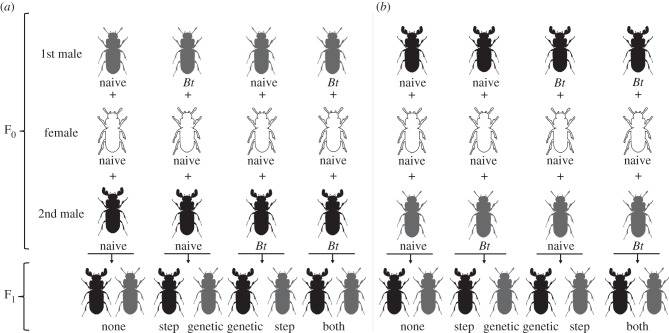
Figure 1.
Figure 1.
Double-mating design. To elucidate the way of transfer of paternal immune priming, we compare survival and immunity of step and genetic offspring of primed males. Each double-mating set consisted of a Cro1 female (white), an Rd male (black) and a Cro1 male (grey). To determine paternity, we used antenna morphology. The Rd males show a dominant mutation in the shape of reindeer antlers. Four priming treatments were established: (i) both males naive, (ii) Cro1 male primed, (iii) Rd male primed, (iv) both males primed. Treatment (i) served as the control, treatments (ii) and (iii) to exclude strain effects, and treatment (iv) to test for additive effects of paternal immune priming. To control for the effect of mating order, once Cro1 males mated first and Rd males mated secondly (a), and vice versa (b).
Figure 2.
Figure 2.
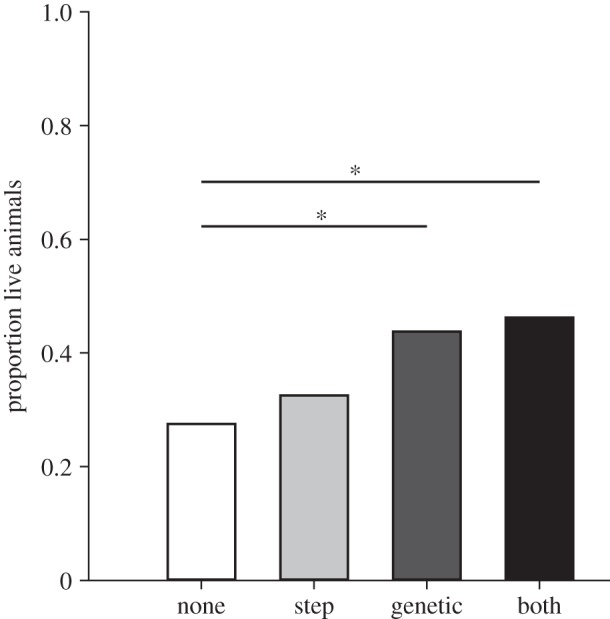
Result of a bacterial challenge in T. castaneum offspring after paternal immune priming. One offspring per father was either randomly assigned to bacterial challenge, to sham treatment with PBS, or left naive as control. Each treatment group consisted of 40 individuals (n = 40). Asterisks show significantly different survival rates between the priming treatments.
Figure 3.
Figure 3.
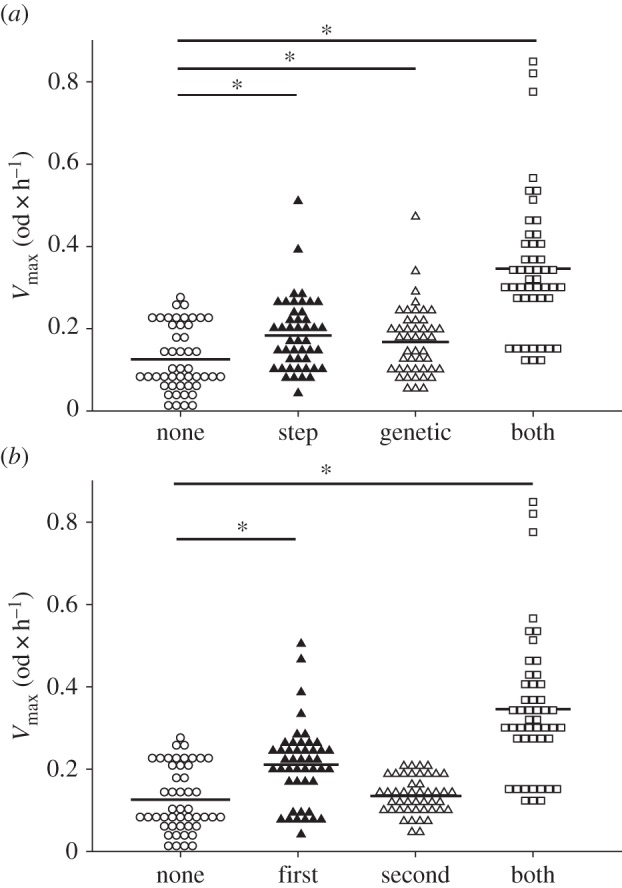
Constitutive PO measurement of haemolymph samples taken from naive offspring. (a) Offspring is categorized by the relationship to the primed male. None (n = 48); step (n = 46); genetic (n = 46); both (n = 48). (b) Offspring is categorized by mating order. None (n = 48); first (n = 46); second (n = 46); both (n = 48). Asterisks show significantly different PO between the priming treatments.
Figure 4.
Figure 4.
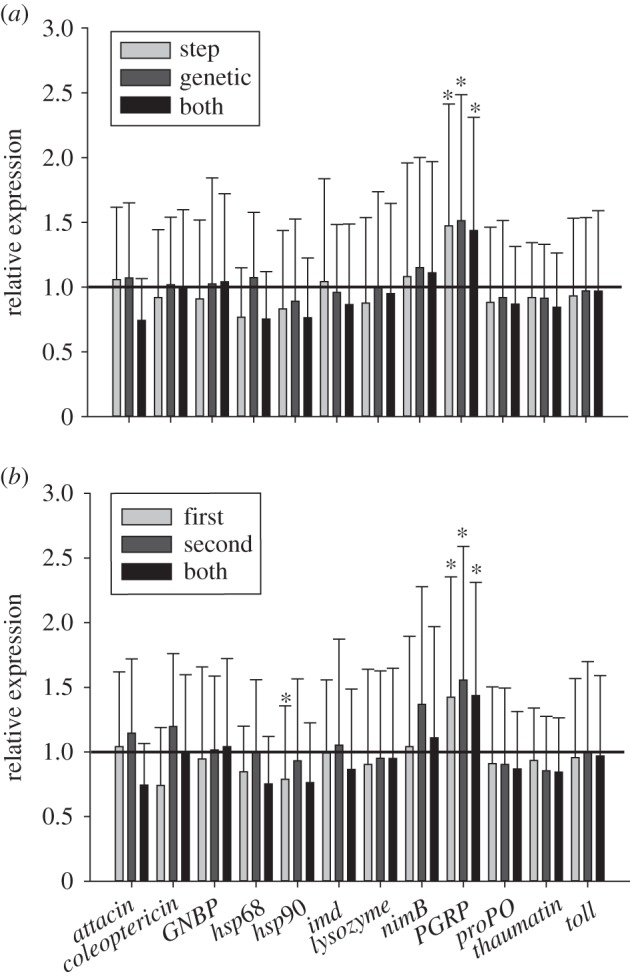
Constitutive relative gene expression measurements from naive offspring. (a) Offspring is categorized by the relation to the primed male. (b) Offspring is categorized by the mating order. Each treatment group consisted of 12 pools (n = 12).

References

    1. Mousseau TA, Fox CW. 1998. The adaptive significance of maternal effects . Trends Ecol. Evol. 13, 403–407. ( 10.1016/S0169-5347(98)01472-4) - DOI - PubMed
    1. Agrawal AA, Laforsch C, Tollrian R. 1999. Transgenerational induction of defences in animals and plants . Nature 401, 60–63. ( 10.1038/43425) - DOI
    1. Harvell CD. 1990. The ecology and evolution of inducible defenses . Q. Rev. Biol. 65, 323–340. ( 10.1086/416841) - DOI - PubMed
    1. Grindstaff JL, Brodie ED, III, Ketterson ED. 2003. Immune function across generations: integrating mechanism and evolutionary process in maternal antibody transmission . Proc. R. Soc. Lond. B 270, 2309–2319. ( 10.1098/rspb.2003.2485) - DOI - PMC - PubMed
    1. Rolff J. 2007. Why did the acquired immune system of vertebrates evolve? Dev. Comp. Immunol. 31, 476–482. ( 10.1016/j.dci.2006.08.009) - DOI - PubMed

Publication types